A Job Nobody Wants

Classifieds1

“We are making progress in education in Tennessee according to every data point, but we also have challenges,” acknowledged Tennessee Commissioner of Education Candice McQueen. Dr. McQueen has been at the forefront of public education the last four years, since she replaced the unpopular and non-communicative Kevin Huffman.

Huffman, the proverbial outsider from Washington DC, was his own worst enemy. A known Democrat, he was never embraced by the newly elected Republican majority that governed the Tennessee General Assembly. His popularity and likability never extended outside the recruits he brought into the state with him, the Governor’s Office or the State Collaborative on Reforming Education (SCORE). Huffman perfected the art of rubbing people the wrong way. After Governor Bill Haslam won a second term, he must have decided it was time for one of the most divisive figures in Tennessee politics to exit the stage. Enter McQueen.

In order to reverse public education’s disdain, Haslam needed the antithesis of Mr. Huffman, and Candice McQueen clearly provided that to the Commissioner of Education position. McQueen was a senior vice president and dean of the college of education at Lipscomb University. McQueen had an intricate task ahead of her. She inherited many personnel who were ill-fitted to the state. Many lacked requisite experience in leadership, in the state, or in the field in which they were being relied on to provide expertise. She had to restore relationships with Legislators, Superintendents, School Boards, Educators and parents. She understood the nuances of working with the scores of special interest groups that populate the K-12 landscape. She became one of the best communicators in state government. She had to do this while providing management to arguably the most important agency in state government. It was truly an example of flying the plane while they attempt to build it.

However, the Achilles heal of her term in office has been standardized test administration. This failure is well-documented. Whether or not that is a fair accusation is debatable. She inherited some of the baggage. Nonetheless, Commissioner McQueen concedes the problems with standardized testing, including online implementation and delivery challenges. She apologized, on behalf of the Tennessee Department of Education, for the challenges and frustrations of the test administration. In addition, the state has taken specific steps to address the concerns as the state moves into the 2018-19 testing cycle. Governor Haslam and Commissioner McQueen recently engaged in a statewide listening tour to get educator input. It is yet to be determined if that effort will have any bearing on the next Governor.

Here is what is certain, the next Governor of Tennessee will either be Republican Bill Lee or Democrat Karl Dean. Both men, for better or worse, will inherit the responsibility of building on Haslam’s record in public education. The choice of Commissioner of Education will assume the overwhelming burden of ensuring that every child in Tennessee graduates from high school prepared for college or the workforce. The success or failure, of the next Commissioner of Education will largely determine the success or failure of the next Governor. It will be a difficult job to fill and it may be a job that nobody wants.

The next Governor will want to select someone who understands public education, understands the state of Tennessee, and is capable of running the most visible agency in the state. For all the local school superintendents who wake up thinking they are up to the task, they should be reminded that the lights of Nashville burn bright and they will be living in a fishbowl. The next Governor cannot afford to go outside the state to recruit a Commissioner of Education as Haslam did, after the Huffman fiasco.

The next Commissioner of Education must have a vision that aligns with the new Governor. They must understand the commitment they will be asked to make. Their evaluation will occur every single day by policymakers and stakeholders across the state, and often in the media. Their success only occurs when every person at a bureaucracy is working in the same direction, understanding and buying into the mission. The obstacles may seem insurmountable, and may keep you from reaching your objectives and not even be under your control. Items like contracts with vendors may be impediments to success, or a bureaucracy which stymies your objectives.

For a Commissioner, the risk is having a Governor who does not support your vision, which will hinder support for your management. Your resources will certainly be limited. Failure will almost certainly be associated with you personally. Financially, many school superintendents are already paid more than the Commissioner of Education, and their headaches are much smaller. Those people who have the skills to perform the task are more limited than the short list of people who think they are up to the challenge.

A disruption in January for 70,000 educators and 1,000,000 students, created by a new agenda for the state, might generate many unexpected issues and unnecessary anxiety during a transition. It is something that a candidate running for office cannot readily discuss, but something that a candidate elected to office must rapidly address. It must be someone who understands our unique language in public education, our stakeholders and policymakers in K-12, and the challenges facing our state.

The question asked by many educators, would either Bill Lee or Karl Dean consider retaining Commissioner McQueen? That has to be a consideration, if she would stay. What happens when you have a job that nobody wants and few are qualified for? We are about to find out.

*********

JC Bowman is the Executive Director of Professional Educators of Tennessee, a non-partisan teacher association headquartered in Nashville, Tennessee. Permission to reprint in whole or in part is hereby granted, provided that the author and the association are properly cited.

Just One Teacher

Eighty-thousand Tennessee teachers can do everything right at their school and in their classes, and one teacher can do something horrendous and give the other 79,999 a bad name. It takes just one teacher to cause irreparable damage.  In 2018 we saw legislative changes directed at helping curb inappropriate student-teacher activity. One teacher can create problems for the family of the student, his own family, his community, his school, and his peers.

Unfortunately, we know that sexual abuse and exploitation of children is a growing problem in our society. We should not be shocked when sex offenders seek employment in jobs where they have contact with children such as churches, schools, youth groups, hospitals, and social services. We have to do a better job of screening applicants in those fields. Jennifer Fraser, an abuse survivor herself wrote: “If adults can’t recognize abusers, children are even less likely to realize that what’s happening is abuse and that it is doing damage of a kind they can’t see.”

We must carefully make sure that we are protecting all of our minor children in public education. However, we have seen many false claims made against a teacher, and once an accusation is made it is nearly impossible to restore a teacher’s reputation. It is a difficult balancing act. There will never be a perfect system.

ABC News reported that the “FBI and the Justice Department do not keep statistics on the frequency of sex-related assaults involving teachers and students.” However, the “most recent statistics from the Bureau of Justice on school violence show that students are more likely to be sexually assaulted outside school grounds.”

It is atypical for victims, especially children, to disclose sexual abuse at the time it is happening. They fear being blamed for their supposed consent to the abuse. In addition, they fear losing the “approval” of their abuser. They also do not want to disappoint their parents. Many victims wait years, if they report the abuse at all, to talk about what happened to them.

Dr. Kit Richert identified physical indicators of sexual abuse such as pain, itching, bleeding, swelling, or bruising in the genital or anal area; blood in the child’s underwear; frequent bladder infections; STDs; pregnancy in pre-teen girls; and complaints about headaches and sickness. The behavioral indicators of sexual abuse are: sudden change in the child’s normal behavior, starts acting differently; depression or suicidality; running away; regression to more childlike behavior; changes in relationships to adults, such as becoming more clingy or more avoidant; lower school engagement and lower achievement; exhibits sexually provocative behavior or becomes promiscuous; the child has or talks about friends that are unusually older; the child talks about having sex or being touched; and the child is extremely avoidant of undressing or physical contact at school.

The good news is that there are a number of resources available to empower stakeholders to prevent sexual misconduct and abuse in schools. One organization, Stop Educator Sexual Abuse, Misconduct and Exploitation (SESAME) is the national voice for the prevention of sexual exploitation, abuse, and harassment of students by teachers and other school staff. Their 5-point strategy includes:

  1. Increasing public awareness of educator sexual abuse by breaking the silence in a strong and united voice.
  2. Fostering recovery of survivors through mutual support and access to information.
  3. Encouraging survivors of educator sexual abuse to report their offenders to local law enforcement officials and state education department credentialing offices.
  4. Insisting upon implementation of and adherence to child-centered educator sexual abuse policies, regulations, and laws.
  5. Directing attention to the maintenance of proper boundaries between school staff and students by promoting annual training, the adoption of professional standards, and codes of ethics.

It takes one teacher to give all teachers a bad name, especially if it involves an adult sexually abusing a child. We all are victims when one teacher betrays the trust bestowed upon them by a community to educate our children. There are many survivors in our midst. We simply have to do a better job of protecting our children.

###

JC Bowman is the Executive Director of Professional Educators of Tennessee, a non-partisan teacher association headquartered in Nashville, Tennessee. Permission to reprint in whole or in part is hereby granted, provided that the author and the association are properly cited. For more information on this subject or any education issue please contact Professional Educators of Tennessee. 
Ethics Training for Educators

Christy Ballard is the long time General Counsel of Tennessee Department of Education.   Nobody in the state knows Education Law better than Christy Ballard.  And  she shares her vast knowledge.   She regularly assists in the implementation and enforcement of Tennessee’s education laws and regulations by providing legal technical assistance to local school board attorneys, other state agency staff, legislators, LEA officials, teachers and the general public by providing the TDOE’s position on school related laws and regulations.

This Is Only A Test?

jc ed background

This Is Only A Test? (www.proedtn.org)  Are tests in our schools making the grade? JC Bowman from the Professional Educators of Tennessee joins us for an in- depth conversation about challenges with current grade assessment tests and Tennessee Ready. Interview.  Listen to iHeart Radio,  Tennessee Matters here.

Link:  https://www.iheart.com/podcast/1021-Tennessee-Matters-28732380/episode/tennessee-matters-29762167/

Captive Audiences, Captive Minds

JC Julia Lennon (2)
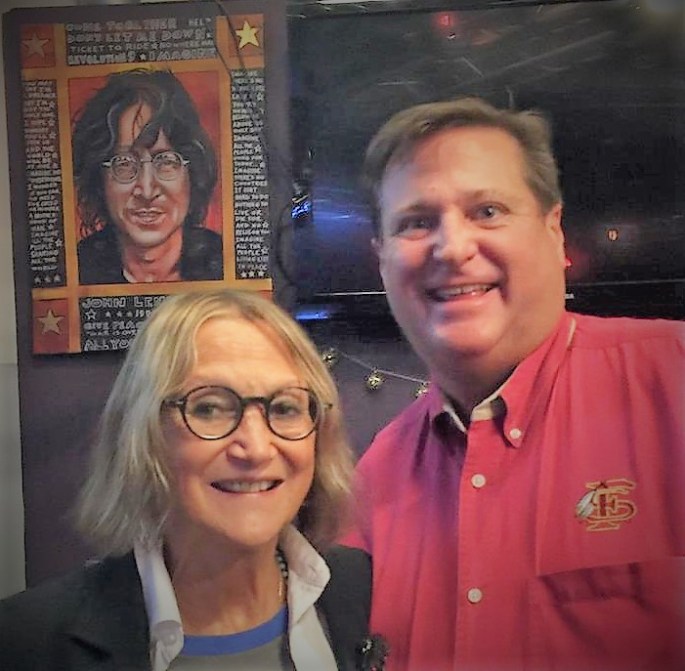
Julia Lennon and JC Bowman at Beatles Tribute

I was too young to really appreciate the British Music Invasion.  However, I became a die-hard Beatles fan in 4th grade, a tradition that I passed down to my children.  Later, I listened and enjoyed the different directions and songs of the individual members of the Beatles.  One of my favorite John Lennon tunes was Mind Games. Lennon nailed it, about how ideologues betray themselves in the clash of competing ideas.

Penny Lane has barbers with photographs, but today trends come with charts and graphs.  Pharisees today would rather stifle debate and only present one side of an issue.  These are people who would sooner ridicule someone, rather than pushing barriers or planting seeds.  In Mind Games, Lennon coined the term mind guerrillas, which was absolutely brilliant.  The mind guerrillas are alive and well. They talk a good game. Unfortunately, a few of them are in our classrooms with captive audience and captive minds.

On both the political right and the left, academic freedom is sometimes erroneously confused with complete autonomy, with thought and speech freed from all constraints. There are definitely limits, and educators have responsibilities.  Students have the freedom to form independent judgments on subjects.  In education, as in life, we must engage differences of opinion, evaluate the evidence, and then form our own individual opinions.  Students have the right to hear and assess diverse views, as long as they are age appropriate and not merely propaganda disguised as information.   American’s have debated the issue historically.  Because of this, in 1840 the Massachusetts Legislature debated the increasing government control over education.

We often see in the media egregious examples of taxpayer dollars being used in ways that seem more in line with indoctrination, rather than mere encouraging independent thought.  We suggest to teachers to be careful in their lessons, unless they are not afraid of it appearing in the local newspaper or nightly news.  In fairness, most educators never have to worry about this issue.  However, let me give you an example of one instance, paraphrased and sent to me by a well-respected classroom teacher:

A local high school was registering students to vote.  This in of itself is a positive step.  It was designed for students to get informed and vote.  However, the person promoting the event didn’t stop there.  She went on a rant about the electoral college system and she said that she thinks it is archaic.  She then proceeded to talk about medical marijuana and said that Tennessee is still Tennessee and that medical pot legalization won’t happen anytime soon. Then, she further highlighted a specific political race between a conservative and a liberal candidate.   Pointing out the virtues of the liberal candidate, and criticizing the conservative.

The teacher closed her email by saying: “I could give many more specific examples, but, again, my goal is not to get anyone in trouble, just to make sure parents aren’t entrusting their children to an institution that is going to push their beliefs in one direction only.”  She then added: “Obviously teachers are going to have diverse political opinions, even strong ones, about all types of issues. My problem is with them pushing those opinions on public school students and the one-sided nature of it.”  That is the heart of the issue, whether it is conservative or liberal.

As educators, it is often hard to keep private personal views out of our public lives—yet we should exercise restraint.  Our education system is not intended for political goals and political purposes, it is intended so that all students are equipped with the knowledge and skills to successfully embark upon their chosen path in life.  We benefit as a society when we develop children with independent critical judgment.  Martin Luther King Jr. poignantly stated: “The function of education, therefore, is to teach one to think intensively and to think critically.”

Chinese leader Mao Zedong wrote:  Politics is war without bloodshed, while war is politics with bloodshed.  When it came to education, Mao stressed that students should have a “correct political point of view.”  That collectivist thought sounds like indoctrination.  John Lennon had a message for that in Revolution, “If you go carrying pictures of Chairman Mao, you ain’t going to make it with anyone anyhow.”

Educators are entitled to their own political opinions.  However, when they are performing official duties they should remain politically neutral.  The youngest citizens of our state and nation who walk through our classroom doors each day deserve to develop their own opinions, be taught to discuss issues respectfully, and not be ridiculed for have a different political or religious belief.  There is a fine line between a teacher sharing their view, or forcing their view on students. It is not the job of the educator to force their point of view on anyone in a classroom or school.

##

JC Bowman is the Executive Director of Professional Educators of Tennessee, a non-partisan teacher association headquartered in Nashville, Tennessee. Permission to reprint in whole or in part is hereby granted, provided that the author and the association are properly cited. For more information on this subject or any education issue please contact Professional Educators of Tennessee.

A Few More Thoughts on Testing in Tennessee…

Icon

Tennessee Commissioner of Education Candice McQueen soundly responded to Metro Nashville Schools Director Shawn Joseph and Shelby County Superintendent Dorsey Hopson very bluntly in a straightforward letter yesterday.  It is doubtful that either Joseph or Hopkins actually wrote the letter, which called for a “pause” in testing and convene a statewide working group of educators to look at testing.  McQueen stated that neither she or Governor Bill Haslam received the letter that got widespread media coverage.  She also pointed out that “both state and federal law require an annual statewide assessment.”

Some may argue that states have more flexibility, which is true to an extent.  We should take a hard look at Tennessee’s ESSA plan and certainly make necessary adjustments.  But we identified our own measures of progress and agreed to take certain actions in order to receive federal monies.  Like that or not, it is how the game is played.  When Tennessee was touting Race to the Top money, the state certainly jumped through even more hoops to get those dollars.

Dr.  McQueen, who serves at the pleasure of the Governor, must follow state and federal laws.    Joseph and Hopson have their own Boards of Education they must listen to on policy issues.  Policy analysts TC Weber and Andy Spears have both weighed in on the subject, as has Sharon Roberts.  Professional Educators of Tennessee added our opinion on the subject.  All stakeholders want to get testing right.  However, the emphasis on testing misses the bigger issue:  student academic growth measured by flawed testing.  Then the results being used in educator evaluations.  This is certainly more problematic to educators than the actual tests themselves.

Once the Tennessee Department of Education gets testing corrected, then we, as a state, can refocus on discussing what should or shouldn’t be included in teacher evaluations.  It is clear:  flawed testing equals faulty evaluations.  This is no way to measure the success or failure of our students, teachers or schools.  This issue isn’t going away.  Stay tuned.

##

 JC Bowman is the Executive Director of Professional Educators of Tennessee, a non-partisan teacher association headquartered in Nashville, Tennessee. Permission to reprint in whole or in part is hereby granted, provided that the author and the association are properly cited. For more information on this subject or any education issue please contact Professional Educators of Tennessee.

Thoughts on Testing

tnready1

In April, 2018, Professional Educators of Tennessee raised the issue on Testing, with a hard-hitting editorial called the Trouble with Testing. Now the Superintendents of two low performing districts, Shelby County and Metro-Nashville Public Schools are eliciting media attention by challenging testing across the state. Welcome to the club.

Testing has taken a wrong turn in public education. I have always tried to keep it simple: testing is like your school picture; it is what you look like on that particular day. Kids go in to take a test. Teachers show up to make sure kids are taking their own test. Parents encourage their children to do their best. However, like Ozzie & Harriet, Leave it to Beaver, and the Lone Ranger, those days are gone.

With an infusion of $501 million federal dollars of Race to the Top money we hurried to increase standards by adopting Common Core, which was soon corrected by moving back to state standards. We then increased testing, changing both format and frequency. Tennessee also adopted new evaluation methods. The teachers’ union supported the incorporation of TVAAS data into the state’s teacher evaluations, which landed Tennessee $501 million from the federal Race to the Top grant in 2010. Professional Educators of Tennessee did NOT support the use of that data on teacher evaluations, nor did they sign a support letter on the original grant submission.

Not everything Tennessee tried was damaging, but it is not debatable that, thus far, the Age of Accountability has failed students, teachers, parents and taxpayers. Since 2012, Tennessee has had one misstep after another in testing. In 2013, our tests were not aligned to our standards. In 2014, the issue was transparency, notably quick scores and test score waivers for final semester grades were the major issue. In 2015, the new TNReady online tests had issues in the post equating formula. In 2016, we fired the vendor, Measurement, Inc. because after the online platform was botched, they were unable to get out a paper version of the test. In 2017, we were again plagued by issues due to scoring discrepancies. This year 2018, had issues related to testing, including the belief by the testing vendor, Questar, that the Questar data center was under attack from an external source, although it is never thought that any student data was compromised.

At no point since 2012 were any of the testing issues the fault of students or educators. However, for educators, they are often the ones who bear the brunt, quite unfairly, of parental anger. Students also suffer, with everything from loss of instruction time to not understanding their educational progress. When we make education decisions on the basis of unreliable or invalid test results, we place students at risk and harm educators professionally. This is especially unfair to the hardworking teachers in our state. To policymakers and stakeholders alike we must ask these questions:

  • Why are we relying so heavily on test scores to make important educational decisions about students, teachers or schools, especially when the process is flawed? For example, when officials thought the Questar data center was under attack from an external source, there should have been no greater priority by the Tennessee Bureau of Investigation to identify and prosecute those individuals guilty of this activity and confirm that no student data was compromised. Fortunately, there was no attack.

  • Should we question the reliability, validity, and accuracy of testing in Tennessee since 2013? Especially when shifting between online to paper tests? Note: Reliability relates to the accuracy of their data. Reliability problems in education often arise when researchers overstate the importance of data drawn from too small or too restricted a sample. Validity refers to the essential truthfulness of a piece of data. By asserting validity, do the data actually measure or reflect what is claimed?

In Tennessee we appreciate straight talk and candor. We unquestionably detest hypocrisy. We understand mistakes are made by individuals, by companies and even by our government. We are not pointing fingers, just stating a fact. Clearly there is a problem with testing in Tennessee. It isn’t our students or our educators. It is a flawed testing system.

Shawn Joseph and Dorsey Hopkins timed the announcement of their joint press release well. A sitting group of mostly outgoing legislators were at the Capitol at the time to discuss education. It is also political season. Their joint letter will momentarily take the attention away from their own issues. However, we welcome the discussion. Unfortunately, simply offering the much-ballyhooed solution of another “blue ribbon” panel to discuss the testing issue is a mere diversion. For teachers, thank Race to the Top which was supported by the previous Superintendents of Shelby County and Metro-Nashville Public Schools and the teachers’ union. I wish both men had offered a solution. We will help you out- Eliminate TVAAS data from teacher evaluations. That would an enormous leap forward.

##

JC Bowman is the Executive Director of Professional Educators of Tennessee, a non-partisan teacher association headquartered in Nashville, Tennessee. Permission to reprint in whole or in part is hereby granted, provided that the author and the association are properly cited. For more information on this subject or any education issue please contact Professional Educators of Tennessee.

Time to Separate PACS from Lobbying

img_20180422_212449-1394880902.jpg

How is it possible to separate organizations’ campaign contributions from their lobbying activities? It may not ever be possible.  Political Action Committee (PAC) is a term for a political committee organized for the purpose of raising and spending money to elect and defeat candidates.  Numerous groups that have a PAC do not have a lobbyist, and many groups that have a lobbyist do not have a PAC.  Perhaps it should be an either/or option and get the political donations completely out of policy issues.

The prevailing opinion is that campaign contributions are integral to lobbying efforts and buying access to elected officials.  Have we really sunk to that level in America?  Nashville?  Lobbying and contributing to political candidates should be completely unrelated activities.  Perhaps the state comptroller should investigate the relationship between PAC donations to specific legislators and the amount of time their lobbyists spent with those legislators. It should reveal interesting findings.  It should also be clear how much lobbying effort was directed at the legislative branch and how much was directed at the executive branch, and those political donations as well.  This would be the only way to measure the extent to which contributions really affect the way that policymakers allocate their time, and whether money as a political resource magnifies and perpetuates political inequalities.

Even though it is an ugly secret, there is little doubt that some organizations obtain votes by making campaign contributions.  Thus, lobbying strategies become dependent upon campaign donation strategies.  What transpires in the meetings between legislators and interest groups with PACs can be a matter of inference and speculation.  However, what is not supposition is that legislation favored by those who contribute political donations succeed on a regular basis. Many politicians also form PACs as a way of raising money to help fund other candidates’ campaigns. A common occurrence is money gets funneled to Candidate A via Candidate B, by other special interests or PACS through this method.   Follow the money.

In reality, groups that command non-monetary resources valued by policymakers —policy expertise, access to voters, and influence may be more important than a campaign check.   As labor unions have seen their influence decline, they could likely discover it to the fact they are spending less on lobbying, and more on political giving.   There are smaller victories, and they are having to write bigger checks to secure even those.  It will only escalate and union dues will increase.  The lesson here is obvious.

Clearly, we believe issue advocacy is good, and it is a First Amendment right to express an opinion to policymakers.  We also have no problem with people making political contributions to the candidates of their choice.  What we would like to see is a clearer separation between these two activities, with better monitoring.  Are political campaigns on behalf of candidates engaging in illegally coordinated activities with PACS?  Nobody can be certain.  Should PACs be forced to immediately disclose their donors and campaign expenditures?  Should people who have PACS be required to register to lobby?  It is essential that citizens know who is financing policymakers’ elections.

Professional Educators of Tennessee will continue to lobby for public education.  However, we will never endorse political parties or candidates as an organization on behalf of our members.  We also do not have a PAC, nor do we plan to ever start one.  It would harm our effectiveness.  We must advance public education without the divisive tribalism of partisan politics, and we will only get involved in education related issues.

##

JC Bowman is the Executive Director of Professional Educators of Tennessee, a non-partisan teacher association headquartered in Nashville, Tennessee.  Permission to reprint in whole or in part is hereby granted, provided that the author and the association are properly cited. For more information on this subject or any education issue please contact Professional Educators of Tennessee.