Dr. Ryan Jackson from Mt. Pleasant High School in Maury County, TN, “The Mount,” shares real life examples as he talks about educators being advocates for the “underdog.”


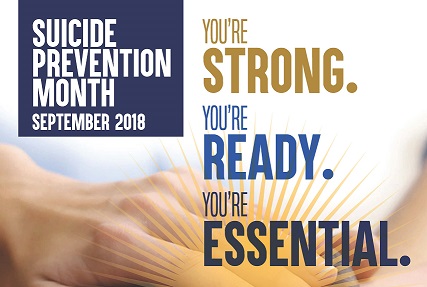
Every day we lose three people to suicide in the state of Tennessee. Here are a few more facts for the Volunteer state:
What can you do?
1) Be aware of the warning signs:
2) Take the following steps if someone you know is contemplating suicide.
Eighty-thousand Tennessee teachers can do everything right at their school and in their classes, and one teacher can do something horrendous and give the other 79,999 a bad name. It takes just one teacher to cause irreparable damage. In 2018 we saw legislative changes directed at helping curb inappropriate student-teacher activity. One teacher can create problems for the family of the student, his own family, his community, his school, and his peers.
Unfortunately, we know that sexual abuse and exploitation of children is a growing problem in our society. We should not be shocked when sex offenders seek employment in jobs where they have contact with children such as churches, schools, youth groups, hospitals, and social services. We have to do a better job of screening applicants in those fields. Jennifer Fraser, an abuse survivor herself wrote: “If adults can’t recognize abusers, children are even less likely to realize that what’s happening is abuse and that it is doing damage of a kind they can’t see.”
We must carefully make sure that we are protecting all of our minor children in public education. However, we have seen many false claims made against a teacher, and once an accusation is made it is nearly impossible to restore a teacher’s reputation. It is a difficult balancing act. There will never be a perfect system.
ABC News reported that the “FBI and the Justice Department do not keep statistics on the frequency of sex-related assaults involving teachers and students.” However, the “most recent statistics from the Bureau of Justice on school violence show that students are more likely to be sexually assaulted outside school grounds.”
It is atypical for victims, especially children, to disclose sexual abuse at the time it is happening. They fear being blamed for their supposed consent to the abuse. In addition, they fear losing the “approval” of their abuser. They also do not want to disappoint their parents. Many victims wait years, if they report the abuse at all, to talk about what happened to them.
Dr. Kit Richert identified physical indicators of sexual abuse such as pain, itching, bleeding, swelling, or bruising in the genital or anal area; blood in the child’s underwear; frequent bladder infections; STDs; pregnancy in pre-teen girls; and complaints about headaches and sickness. The behavioral indicators of sexual abuse are: sudden change in the child’s normal behavior, starts acting differently; depression or suicidality; running away; regression to more childlike behavior; changes in relationships to adults, such as becoming more clingy or more avoidant; lower school engagement and lower achievement; exhibits sexually provocative behavior or becomes promiscuous; the child has or talks about friends that are unusually older; the child talks about having sex or being touched; and the child is extremely avoidant of undressing or physical contact at school.
The good news is that there are a number of resources available to empower stakeholders to prevent sexual misconduct and abuse in schools. One organization, Stop Educator Sexual Abuse, Misconduct and Exploitation (SESAME) is the national voice for the prevention of sexual exploitation, abuse, and harassment of students by teachers and other school staff. Their 5-point strategy includes:
It takes one teacher to give all teachers a bad name, especially if it involves an adult sexually abusing a child. We all are victims when one teacher betrays the trust bestowed upon them by a community to educate our children. There are many survivors in our midst. We simply have to do a better job of protecting our children.
###
JC Bowman is the Executive Director of Professional Educators of Tennessee, a non-partisan teacher association headquartered in Nashville, Tennessee. Permission to reprint in whole or in part is hereby granted, provided that the author and the association are properly cited. For more information on this subject or any education issue please contact Professional Educators of Tennessee.
Christy Ballard is the long time General Counsel of Tennessee Department of Education. Nobody in the state knows Education Law better than Christy Ballard. And she shares her vast knowledge. She regularly assists in the implementation and enforcement of Tennessee’s education laws and regulations by providing legal technical assistance to local school board attorneys, other state agency staff, legislators, LEA officials, teachers and the general public by providing the TDOE’s position on school related laws and regulations.
Our nation was attacked on September 11, 2001 and our world changed. Terrorists called al-Qaeda, with training camps all around the world were responsible for the death of the more than 3,000 victims. This is an enemy unlike any we have ever faced. There are multiple countries, multiple fronts and multiple threats.
This enemy is committed to the absolute destruction of the American way of life and imposing their beliefs and values upon the world. In their world, law is determined by force—those with power—whether military strength or political dominance—make the rules. It is our belief in freedom, human rights, idealism, personal responsibility and economic opportunity that extremists dislike the most.
If you were a classroom teacher today how would you address the events of September 11, 2001 with your students? Would you blame the incident on the very people who lost their lives? Would you blame those with a misguided ideology for killing innocent people? To me, the answer is very apparent. And those who would blame victims or our nation are siding with evil-doers and promoting savagery.
Since Jeremiah Wright first shocked our nation with his comment in 2008, parroting a Malcolm X phrase, that “America’s chickens are coming home to roost,” which was widely understood as meaning that America brought the September 11 attacks upon itself. Every year that has passed since 2001 that sentiment has been voiced in one manner or another. Eventually that will end up in our classrooms and textbooks. My fear is that the victims will be posthumously put on trial while the terrorists are seen as genial freedom fighters. Nothing could be further from the truth.
It seems to many that we treat perpetrators of evil kinder than we treat their victims in our society. It is an obvious assault on law and order. It is law which enables man to live together, and creates order out of chaos. We first and foremost a nation of laws. Founding Father and future president John Adams called America “a nation of laws, not of men.” These rules should not be subject to the whims of those in power. And those who fail to understand history in the proper context will write textbooks to inform future generations. It is why curriculum has been such a highly debated issue.
Historian Bruce Kauffmann wrote about “the Soviet Union’s infamous dictator, Josef Stalin, who in the late 1930s had millions of innocent people incarcerated and murdered after they underwent show trials, or no trials, in which the “nature and cause of the accusation” against them were such specifically identified and legally provable crimes as being “foreign agents,” “counterrevolutionaries,” “enemies of the people” or “enemies of the state.” Have we become so politically correct that only one opinion is allowed?
I accept that countries lie to their citizens, and that we are, regrettably, governed by men and women who are sometimes corrupt. That is undesirable, but it is a fact of life. Often choices made by government is not between good and bad, but between bad and worse. We have done exactly what George Washington warned us against by embracing entangling alliances. We have largely abandoned our Judeo-Christian heritage, in fear of lawsuits and in the name of inclusion. However, we still have the rule of law, right?
I am reminded of Robert Kennedy’s speech in which he was discussing the law. He said about the law: “The road ahead is full of difficulties and discomforts. But as for me, I welcome the challenge. I welcome the opportunity, and I pledge to you my best effort — all I have in material things and physical strength and spirit to see that freedom shall advance and that our children will grow old under the rule of law.”
People of reason can disagree with issues and have civil discourse. “Everyone is entitled to his own opinion, but not to his own facts,” according to the late Daniel Patrick Moynihan. Who also reminded us that culture, not politics, determines the success of society. Respect of our fellow human beings is the core outgrowth of a nation committed under a rule of law. It is our shared history in America, and one in which we must be personally committed to follow. That is the real lesson to teach. If we fail to pass that to the next generation, freedom, the political process, civil liberties, individual rights and media independence will be lost to the dustbin of history and no longer tolerated.
We must remember September 11th in our homes and in our classrooms and engage in this important dialogue. Never let it be said that the flame of freedom was extinguished on our watch. That can be summed up in two words: We Remember.
##
JC Bowman is the Executive Director of Professional Educators of Tennessee, a non-partisan teacher association headquartered in Nashville, Tennessee. Permission to reprint in whole or in part is hereby granted, provided that the author and the association are properly cited. For more information on this subject or any education issue please contact Professional Educators of Tennessee.
This Is Only A Test? (www.proedtn.org) Are tests in our schools making the grade? JC Bowman from the Professional Educators of Tennessee joins us for an in- depth conversation about challenges with current grade assessment tests and Tennessee Ready. Interview. Listen to iHeart Radio, Tennessee Matters here.
Link: https://www.iheart.com/podcast/1021-Tennessee-Matters-28732380/episode/tennessee-matters-29762167/
“If you don’t understand — from the school district to the superintendents — that we want our teachers held harmless, then I’m sorry, you’re tone-deaf.” ~State Representative Eddie Smith (Knoxville)

That message was heard and understood statewide, right? Apparently not. We are receiving reports from across the state that some districts are denying their teachers their justified and earned bonuses, which harms the educator. The language from the Public Chapter Number 881 reads “LEAs shall not base compensation decisions for teachers on data generated by statewide assessments administered in the 2017-18 school year” Public Chapter Number 1026 adds: “no adverse action may be taken against any student, teacher, school, or LEA based, in whole or in part, on student achievement data generated from the 2017-2018 TNReady assessment.” (emphasis added)
The Tennessee Department of Education, anticipating this problem, understood this could negatively impact teachers that did well on TNReady in the 2017-18 school year so they provided this guidance to school districts across the state: “All currently approved alternative salary schedules and differentiated pay plans are based on 2016-2017 school year data and may remain in effect because they are not impacted by the Legislation. Districts should consult closely with their board attorneys to ensure that any other strategic compensation policies do not result in an action being taken concerning a teacher in the 2017-18 school year based on 2017-18 data. As always, teachers may not earn less than they did the previous year unless there is a change in the teacher’s duties or position.” (emphasis added)
However, at least one school district, Greene County Schools, sent an email to all principals. The message to all Greene County Administrators was from Bill Ripley, the Assistant Director of Academics.
Ripley wrote:
This message is in response to questions we have received. Several months ago the state legislature passed an act preventing districts from affecting any teacher’s pay based on 2017-18 test results. Therefore, the Greene County Schools district plan to pay a bonus for level 4 or 5 TVAAS cannot be implemented this year. We realize this is disappointing to the 105 teachers who attained a level 4 or 5 last year, however, this is an action of lawmakers in Nashville, not your local Board of Education.
A first-year law student could probably make the case that any school district that withholds paying a bonus based on actions taken by the Tennessee General Assembly are not understanding the law or the intent of the state law. Denying educators their rightful bonus based on positive student achievement or student growth is indeed having an adverse action on educators, especially their compensation. It can be argued that the legislation that passed is vague and that districts should work closely with their board attorney when making these types of decisions. However, discussion on the floor on the legislation, as well as comments from the Bill Sponsor Rep. Eddie Smith, was clear: that districts could not take adverse actions.
The state issued two very important guidance documents that make clear that message, which was released by the Tennessee Department of Education. Professional Educators of Tennessee, along with many others worked with the Department of Education and added our input. The guidance that the Department developed was a result of thoughtful and collaborative efforts to ensure that our state follows all state and federal laws. The new legislation that states that no adverse actions for students, teachers or schools will result from the 2017-18 TNReady administration. These two key documents, which were shared with districts and schools are posted on the state website, along with a list of initial improvements the state is making to the state assessment program:
If educators feel that their district is withholding a bonus in which they are entitled, it would be helpful for those educators to write their school district and ask them for a written explanation on why the bonus is being denied. If a school district wants to be tone deaf, I know several state legislators and folks at the Department of Education who would be very interested in why an adverse action is being taken against you. I know that Professional Educators of Tennessee wants to hear if compensation decisions for teachers on data generated by statewide assessments administered in the 2017-18 school year have kept you from receiving compensation, or your bonus. Just drop us an email at advocacy@proedtn.org.
###
JC Bowman is the Executive Director of Professional Educators of Tennessee, a non-partisan teacher association headquartered in Nashville, Tennessee. Permission to reprint in whole or in part is hereby granted, provided that the author and the association are properly cited. For more information on this subject or any education issue please contact Professional Educators of Tennessee.
I have grown fatigued with blue ribbon panels or listening tours. I have never found either strategy very useful in formulating public policy. Especially when that policy is agenda-driven, with pre-determined outcomes. I am also not a gambler (sorry Kenny Rogers). I understand that the house always comes out the winner in the end. A casino has a business model premeditated to ensure its success. Much like a blue-ribbon panel, or a listening tour.
From a political standpoint, why would the state of Tennessee try to conduct a listening tour at this time? We are in the middle of election season and the Governor is in his final days. What more can he add to the education debate after 8 years, that he hasn’t already tried? All stakeholders want to get testing right. We have already had an Assessment Task Force, which has done a pretty good job of collecting input and holding serious discussions. The state has already been engaged in an open conversation about assessment and ways to improve administration of tests. We have already gathered feedback on the delivery of state assessments. We simply have not executed the plan. There are just a few vendors across the nation who have the resources and ability to be selected as the state’s next assessment partner. We have been through several of those vendors already—and were disappointed by those results.
If the state wants to discuss how to better provide schools, educators, parents and students with meaningful and timely results from assessments, then we better figure out how to get the results back to those in the classrooms capable of making better academic decisions for students. We will want to provide baseline assessments of learning/study skills, identify areas of potential academic concerns, highlight learning strengths/weaknesses, and provide effective and efficient strategies in getting academic intervention when needed by students. This is something unlikely to occur on a listening tour and is already known by the K-12 Community.
We can and should discuss the value that assessments can provide. We must also discuss how the emphasis on testing is missing the bigger issue: student academic growth measured by flawed testing. Then the results being used in educator evaluations. This is certainly more problematic to educators than the actual tests themselves. It should be problematic to parents as well. When two superintendents raised the testing issue and requested a pause in testing, Commissioner McQueen correctly pointed out that as a condition of receiving federal funds, the feds through Every Student Succeeds Act (ESSA) requires state education agencies to implement statewide assessments. Many states exceed federal requirements.
McQueen pointed out that “both state and federal law require an annual statewide assessment.” So, if we want a discussion on testing perhaps we should be directing at the Federal Branch as well? Should we not also look at our ESSA Plan while doing this pointless tour? The initial ESSA plan was based on feedback from thousands of Tennesseans over the course of a year.
How did we get here? With an infusion of $501 million federal dollars of Race to the Top money our state hurried to increase standards by adopting Common Core, which was soon corrected by moving back to state standards. We then increased testing, changing both format and frequency. Tennessee also adopted new evaluation methods. The teachers’ union supported the incorporation of TVAAS data into the state’s teacher evaluations, which landed Tennessee $501 million from the federal Race to the Top grant in 2010.
Former Governor, Phil Bredesen, said that former Senator Bill Frist had contributed a lot to the state’s proposal, but that his own role in persuading the Tennessee Education Association, a teachers’ union, to sign on had been important, too.
So, how do we get out of this mess? It probably won’t be the result of a listening tour. And our next Governor had better put forth policy ideas pretty quickly, or he will be saddled with an unworkable plan right out of the gate—just like Governor Bredesen and Governor Haslam. The people who got us into this mess, probably aren’t the people to get us out of it.
##
JC Bowman is the Executive Director of Professional Educators of Tennessee, a non-partisan teacher association headquartered in Nashville, Tennessee. Permission to reprint in whole or in part is hereby granted, provided that the author and the association are properly cited. For more information on this subject or any education issue please contact Professional Educators of Tennessee.

I was too young to really appreciate the British Music Invasion. However, I became a die-hard Beatles fan in 4th grade, a tradition that I passed down to my children. Later, I listened and enjoyed the different directions and songs of the individual members of the Beatles. One of my favorite John Lennon tunes was Mind Games. Lennon nailed it, about how ideologues betray themselves in the clash of competing ideas.
Penny Lane has barbers with photographs, but today trends come with charts and graphs. Pharisees today would rather stifle debate and only present one side of an issue. These are people who would sooner ridicule someone, rather than pushing barriers or planting seeds. In Mind Games, Lennon coined the term mind guerrillas, which was absolutely brilliant. The mind guerrillas are alive and well. They talk a good game. Unfortunately, a few of them are in our classrooms with captive audience and captive minds.
On both the political right and the left, academic freedom is sometimes erroneously confused with complete autonomy, with thought and speech freed from all constraints. There are definitely limits, and educators have responsibilities. Students have the freedom to form independent judgments on subjects. In education, as in life, we must engage differences of opinion, evaluate the evidence, and then form our own individual opinions. Students have the right to hear and assess diverse views, as long as they are age appropriate and not merely propaganda disguised as information. American’s have debated the issue historically. Because of this, in 1840 the Massachusetts Legislature debated the increasing government control over education.
We often see in the media egregious examples of taxpayer dollars being used in ways that seem more in line with indoctrination, rather than mere encouraging independent thought. We suggest to teachers to be careful in their lessons, unless they are not afraid of it appearing in the local newspaper or nightly news. In fairness, most educators never have to worry about this issue. However, let me give you an example of one instance, paraphrased and sent to me by a well-respected classroom teacher:
A local high school was registering students to vote. This in of itself is a positive step. It was designed for students to get informed and vote. However, the person promoting the event didn’t stop there. She went on a rant about the electoral college system and she said that she thinks it is archaic. She then proceeded to talk about medical marijuana and said that Tennessee is still Tennessee and that medical pot legalization won’t happen anytime soon. Then, she further highlighted a specific political race between a conservative and a liberal candidate. Pointing out the virtues of the liberal candidate, and criticizing the conservative.
The teacher closed her email by saying: “I could give many more specific examples, but, again, my goal is not to get anyone in trouble, just to make sure parents aren’t entrusting their children to an institution that is going to push their beliefs in one direction only.” She then added: “Obviously teachers are going to have diverse political opinions, even strong ones, about all types of issues. My problem is with them pushing those opinions on public school students and the one-sided nature of it.” That is the heart of the issue, whether it is conservative or liberal.
As educators, it is often hard to keep private personal views out of our public lives—yet we should exercise restraint. Our education system is not intended for political goals and political purposes, it is intended so that all students are equipped with the knowledge and skills to successfully embark upon their chosen path in life. We benefit as a society when we develop children with independent critical judgment. Martin Luther King Jr. poignantly stated: “The function of education, therefore, is to teach one to think intensively and to think critically.”
Chinese leader Mao Zedong wrote: Politics is war without bloodshed, while war is politics with bloodshed. When it came to education, Mao stressed that students should have a “correct political point of view.” That collectivist thought sounds like indoctrination. John Lennon had a message for that in Revolution, “If you go carrying pictures of Chairman Mao, you ain’t going to make it with anyone anyhow.”
Educators are entitled to their own political opinions. However, when they are performing official duties they should remain politically neutral. The youngest citizens of our state and nation who walk through our classroom doors each day deserve to develop their own opinions, be taught to discuss issues respectfully, and not be ridiculed for have a different political or religious belief. There is a fine line between a teacher sharing their view, or forcing their view on students. It is not the job of the educator to force their point of view on anyone in a classroom or school.
##
JC Bowman is the Executive Director of Professional Educators of Tennessee, a non-partisan teacher association headquartered in Nashville, Tennessee. Permission to reprint in whole or in part is hereby granted, provided that the author and the association are properly cited. For more information on this subject or any education issue please contact Professional Educators of Tennessee.
You must be logged in to post a comment.