
Special Education Teachers Face More Challenges

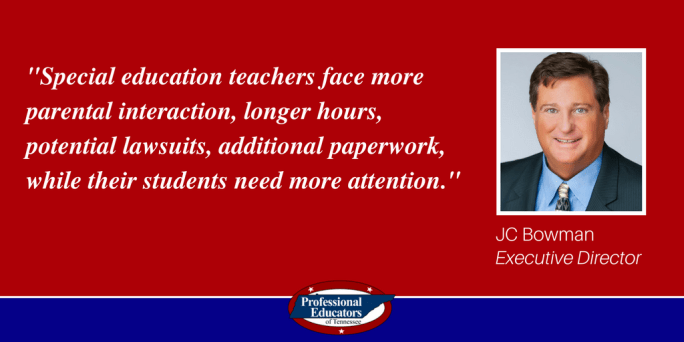
Special education teachers face more challenges today then ever before…..

JC's Blurb 8

Provisional Endorsements for Special Education

As a reminder, last year the State Board of Education approved an additional pathway for educators seeking to add a special education endorsement to their license. Click here for more information on how educators may attain a provisional endorsement for special education.

Never a Wrong Time to Do the Right Thing

Supreme-Court

The United States Supreme Court has been busy this week.  I have only been focused on the Janus Case.  The justices ruled 5-4 to prohibit unions from collecting fees in Janus v. American Federation of State, County, and Municipal Employees Council 31. The justices also ruled that workers must affirmatively opt into the union before fees can be taken out of their paychecks.

It will effectively break the cycle where government unions can collect compulsory fees from government workers and then use it to help elect pro-union politicians to achieve and maintain political power — who then empower and enrich the government employee unions.  Think about this for a minute, the unions were arguing in this case: “that government has a duty to financially prop up a private enterprise.”  “In what universe?” the Supreme Court Justices must have thought.  The legal rationale was questionable at best.

Justice Samuel A. Alito Jr. wrote in the majority opinion and addressed that directly: “It is hard to estimate how many billions of dollars have been taken from nonmembers and transferred to public-sector unions in violation of the First Amendment. Those unconstitutional exactions cannot be allowed to continue indefinitely.”  Justice Alito then added: “We conclude that this arrangement violates the free speech rights of nonmembers by compelling them to subsidize private speech on matters of substantial public concern.”

The opinion added: “The First Amendment is violated when money is taken from nonconsenting employees for a public-sector union; employees must choose to support the union before anything is taken from them. Accordingly, neither an agency fee nor any other form of payment to a public-sector union may be deducted from an employee, nor may any other attempt be made to collect such a payment, unless the employee affirmatively consents to pay.”

The Tennessee branch of the National Education Association is already saying the ruling will not impact them.  They have already lost almost 35% of their members in the last five years according to the Education Intelligence Agency.  However, the Janus ruling will have an indirect impact, as the unions will have fewer resources, and will undoubtedly be focused (in the short-term) on simply keeping the members they have. The NEA has projected a loss of some 307,000 members over two years if the Janus decision went against public-employee unions, with an expected $50 million two-year budget cut, or 13 percent.  Today’s decision will ultimately reduce the political activity of public sector unions.

Referenced by the Education Intelligence Agency, former Tennessee Education Association employee and Uniserv Coordinator Chris Brooks wrote about the unions: “Many state associations are run by their staffs. Rarely do they engage in meaningful fights at the school or district level. Annual lobby days mobilize a tiny fraction of members. Teachers and school support staff feel only loosely connected to the union.”  Brooks’s former union bosses cannot be happy with his comments.  However, it proves that educators need more effective voices and other organizations to speak up for their interests.

“The unions will call this tortious interference with their business expectancies. Disinterested people will call it an affirmation of individuals’ constitutional rights” according to Pulitzer Prize–winning syndicated columnist George Will.  No American worker should be forced to become or remain a union member. People should be free to join, or not join any organization or union they want, without losing their job or be forced to pay for political agendas with which they disagree based on political or ideological purposes.

The Janus Decision will not create drastic structural changes to unions.  It will simply make them more accountable to their own members.  And in the case of teacher unions, this greater accountability should focus on making the quality of education front and center, help public education rebuild support from the public for issues like raising teacher pay and school funding, and work for the common good of all students and educators. There is never a wrong time to do the right thing.  The Supreme Court Decision in the Janus Case was the right thing.

##

JC Bowman is the Executive Director of Professional Educators of Tennessee, a non-partisan teacher association headquartered in Nashville, Tennessee.  Permission to reprint in whole or in part is hereby granted, provided that the author and the association are properly cited. For more information on this subject or any education issue please contact Professional Educators of Tennessee.

Thomas Jefferson & American Education

thomas jefferson

The lives of our citizens are enriched through public policies that enhance economic opportunity and freedom. However, some policymakers lack basic understanding of sound economic principles, as well as the fundamental principles of our free enterprise system which include individual initiative, personal responsibility, limited government, respect for private property and the rule of law, economic freedom, and an educated citizenry –the same shared principles that inspired our Founding Fathers.

Most citizens have now started to fully understand that as government growth increases, liberty decreases. They agree it is a shared responsibility of all, stakeholders and policymakers alike, to ensure our tax dollars are wisely spent. In education we need to make sure tax dollars are utilized on programs that benefit students and those who teach them. An essential objective in public education is, and must be, an educated citizenry that creates an informed electorate.

Many have attributed to Thomas Jefferson the genesis of the belief that an educated citizenry is a vital requisite for our survival as a free people. Whether Jefferson ought to be given credit is arguable. However, it is a worthy goal to have an educated citizenry to both secure the future of our democracy and for our citizens to be competitive globally.

To some extent, in education we have abandoned Jefferson’s advocacy that an “enlightened people and an energetic public opinion” should keep the “aristocratic spirit of the government” under control. Jefferson feared the power of the federal government. Government is not the driving force for excellence. The motivation that drives excellence comes from within the individual. Jefferson understood that in order for citizens to lead in the future they must have virtues and talent. It should be by our achievements in life, not an accident of birth, that determine our future. Education is and was the great equalizer.

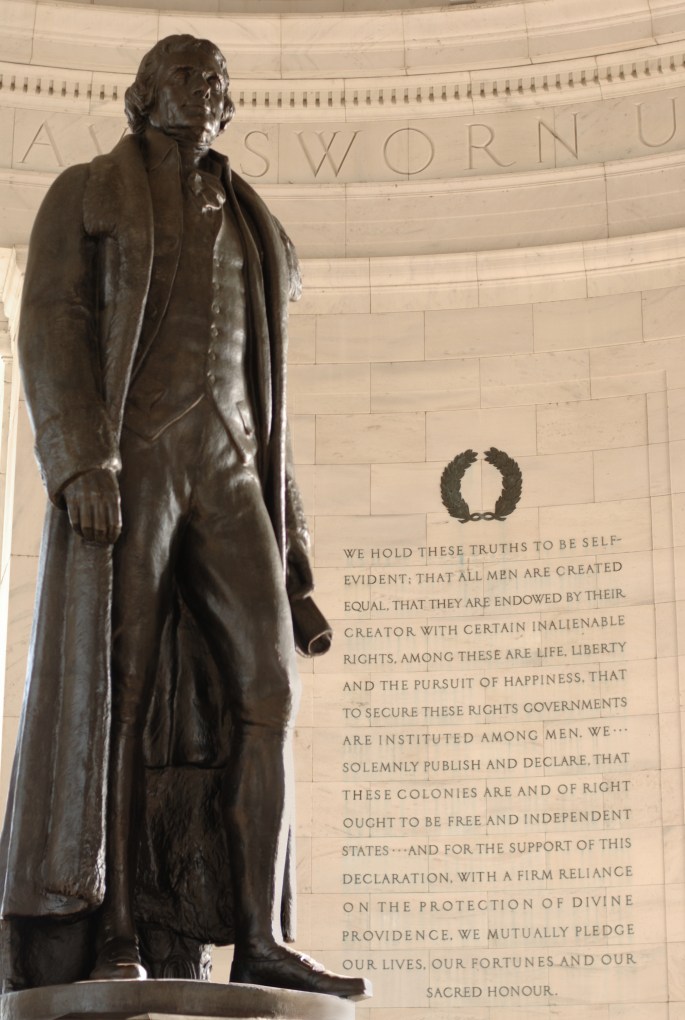
Jefferson, who is embraced on both the left and the right politically, certainly understood that it was essential that a suitable education be provided for all its citizens. In fact, Jefferson expressed to James Madison, as early as 1787, “Above all things I hope the education of the common people will be attended to, convinced that on their good sense we may rely with the most security for the preservation of a due degree of liberty.” Jefferson virtually echoed the conviction of Montesquieu in Spirit of the Laws, that “virtue may be defined as the love of the laws and of our country” as a principal business of education.

There is no dispute that Jefferson, as a Founding Father, understood the need of public education. He wrote, “a system of general instruction, which shall reach every description of our citizens from the richest to the poorest, as it was the earliest, so will it be the latest of all the public concerns in which I shall permit myself to take an interest.” As if peering into the future, Jefferson also wrote, “If the children are untaught, their ignorance and vices will in future life cost us much dearer in their consequences than it would have done in their correction by a good education.”

A current catchphrase in public education is “college and career ready.” In contrast, in 1814, Thomas Jefferson used a similar comparison, “the laboring and the learned.” He detailed to Peter Carr, “The mass of our citizens may be divided into two classes — the laboring and the learned. The laboring will need the first grade of education to qualify them for their pursuits and duties; the learned will need it as a foundation for further acquirements.” We really have not changed the identified groups; we just use different labels.

Understanding Jefferson’s view challenges the principle that a number of policymakers have embraced that education is merely about job readiness and employment (laboring class). Unmistakably, the imperative of being educated (the learned) is exceedingly indispensable in a knowledge-based economy and for dealing with an evolving interdependent, multipolar world.

In 1816, Jefferson sent a letter to Pierre Du Pont de Nemours in which he favored an idea he thought might secure education without compulsion. It was, according to Jefferson, a Spanish proposal that nobody “should ever acquire the rights of citizenship until he could read and write.” Jefferson said, “It is impossible sufficiently to estimate the wisdom of this provision.” However, Jefferson did not support making parents put their children in school, suggesting that “it is better to tolerate the rare instance of a parent refusing to let his child be educated, than to shock the common feelings and ideas by the forcible transportation and education of the infant against the will of the father.”

By every account, it is clear that Jefferson approved of a tax-supported, public educational system that would enable citizens to express their opinions and understand complex issues that can inform decisions the electorate must make as they cast their votes. In 1824, Jefferson added “a republican nation whose citizens are to be led by reason and persuasion and not by force, the art of reasoning becomes of first importance.”

How public education is to occur and the financial mechanism to leverage those tax dollars can be debated as they were in Jefferson’s day. However, we believe in public education, and when local school systems work in partnership with communities they serve, they can and will educate students successfully. Public education enables students to access opportunities in a rapidly changing, diverse, global society.

The evidence is clear that Jefferson was correct in the importance of public education for the future of democracy and the United States of America. Jefferson believed that “no other sure foundation can be devised for the preservation of freedom and happiness,” and that failing to provide public education would “leave the people in ignorance.” Our job is to make sure we build on that foundation.

##

JC Bowman is the Executive Director of Professional Educators of Tennessee, a non-partisan teacher association headquartered in Brentwood, Tennessee.

Tennessee Making Necessary Changes to Testing

testing 6

The Tennessee Department of Education announced at a noon press conference on Thursday some necessary changes to the state TNReady test that teachers, administrators and superintendents have been asking the state to make. Among the changes include rebidding the testing contract, refining the current Questar contract, revising timeline for online testing, and engaging more teachers. These steps complement additional actions already in the works, including eliminating two TNReady end-of-course exams, eliminating the March stand-alone field test for the next two years, simplifying and streamlining test administration, bringing in a third party to perform an independent review of Questar’s technological capabilities, improving customer service, and engaging dozens of additional Tennessee teachers, content experts, and testing coordinators to look at every part of our state testing program.

Dale Lynch from the Tennessee Organization of School Superintendents and JC Bowman from Professional Educators of Tennessee were in attendance at the announcement. Both praised the Tennessee Department of Education for taking proactive steps to address the issue. Bowman added: “Leadership collects input from those on the ground, makes the process better for all, and then tweaks the product as needed. We firmly believe that changes needed to be made, and we are pleased that Commissioner McQueen and her team heard our message and made the necessary changes to improve student assessment in Tennessee.”

Education Commissioner Candice McQueen said at the press conference: “improvements are being made after ongoing conversations with teachers, parents, education leaders, and policymakers over the past several weeks and are aimed at addressing a number of areas of concern.” She added: “Teachers, students and families deserve a testing process they can have confidence in, and we are doing everything possible to meet that responsibility,” Commissioner McQueen said. “We are always committed to listening and improving, and we’ll continue to do just that.”

The multi-faceted changes announced today will immediately improve the state assessment—TNReady—and establish a longer-term framework for success. The steps being taken to improve TNReady include:

  • Releasing a new Request for Proposals (RFP) to identify the assessment vendor or vendors that can successfully administer the state test in 2019-20 and beyond.  The RFP process will better ensure that students can take TNReady seamlessly and without disruption.
  • Amending the state’s current contract and relationship with Questar to improve the assessment experience in 2018-19
  • Adjusting the pace of the state’s transition to online testing

In May, a national study recognized Tennessee as the No. 1 state in the country for improvement in the quality of its academic standards, going from an “F” rating in 2007 to an “A” in 2017. TNReady is designed to measure those standards, and it has a variety of different types of questions to look for the depth of students’ knowledge.

Tennessee is one of less than 10 states that still has a paper test in middle school—and both state and district leaders recognize that the workforce of the 21st century is increasingly online. We also want every student to have a positive testing experience, and we want to maximize the ability to have a seamless online administration. Accordingly, the state is adjusting the timeline to continue the transition to online but at a modified pace. For 2018-19:

  • Students in grades 3-8 will take TNReady on paper for math, English, and social studies.
  • Students in grades 3-4 will take their TNReady science test on paper, and students in grades 5-8 will take their science test online. Science is a field test in 2018-19 because the state is transitioning to new academic standards; therefore, the results will not count for students, teachers, or schools, nor will any public scores be released. This provides an option for all students to experience the online platform and do so in an environment that is low-risk for them.
  • Students in high school and those taking end-of-course exams will continue to test online.

Further, the department will improve paper administration, as well. In addition to having Tennessee teachers review all test questions, scripts, and test forms, the department is streamlining test logistics to have fewer versions of the test distributed across the state. This makes it much easier on testing coordinators and proctors to administer. The state has also combined the answer document and test questions into one test booklet in lower grades so it is easier for students to take the test.

For more information on the additional TNReady improvements  you can visit the Tennessee Department of Education website.


Called to Teach?

Henry and Brittany

Why do people teach?  The major reason someone says they teach is the ability to make a real difference in the lives of children.  There are other reasons, including the fact that someone believes they are “called” to teach.  Almost all teachers are linked together by a passion for educating children.  The passion is innate and has to come from within.

Commissioner Candice McQueen reminded a group of educators in a presentation that we were set apart in our mission.  She pointed out the gifts that educators have are special talents and abilities.  Educators are born for the mission that is being given for us.  Dr. McQueen emphasized the profession is a special calling.

We are all on a search for significance. We desire to make a difference.   Educators are making a huge difference. That is why it is important that we honor them.  It is the English social critic, Os Guinness, who stated: “Calling is not only a matter of being and doing what we are, but also of becoming what we are not yet but are called by God to be.”  He then adds:  “Deep in our hearts, we all want to find and fulfill a purpose bigger than ourselves.”  Education of the next generation is one of the most important occupations we could ever do.  Belief that one is “called to teach” keeps women and men in education, even with all the unwanted public scrutiny.

Matthew Lynch writes about teaching as a calling: “A calling implies a deep-seated belief that teaching is the only profession that makes sense for you to pursue…”  Dylan Fenton, an English teacher and writer does not like the term “calling,” as it creates to him an “idea that good teachers are born, not made and, as a result, allow themselves to stagnate.”   I would argue that Lynch is more accurate than Fenton, as a passionate teacher never stops honing their craft.  John Hunter, an award-winning teacher and educational consultant wrote: “I used to think teaching was a job.  And then I thought it was a profession.  And now I’m of the opinion that it’s a calling.  It’s a very noble calling.”

Henry David Thoreau said, “Most men lead lives of quiet desperation.”  John Keating, in the movie Dead Poets Society challenged his students to not be resigned to that type of life.  Yes, John Keating was subsequently fired, and probably never taught another class the rest of his life.  However, he taught his students to find their own voice.   It was his calling.  If you have profession that brings you passion, gives you someone other than yourself to care for, and is something that makes you want to get up in the morning to accomplish, you will not live a life of quiet desperation.

Teaching is indeed an imposing, self-sacrificing, but also a magnanimous calling.  Going through the process to get certified, whether through traditional means or an alternative route is sometimes difficult.  The creativity aspect of the profession has slowly been eroded.  There is persistent negativity by some lawmakers and the media of public education.  Compared to other professions, educators can expect modest salary and sometimes extremely difficult working conditions.  However, if you are called to teach, you will never find a happier place than in a classroom or serving students.  Educators are set apart to make a difference.  There is no other profession, except perhaps the clergy, that can change lives like a public-school teacher.

##

JC Bowman is the Executive Director of Professional Educators of Tennessee, a non-partisan teacher association headquartered in Nashville, Tennessee.  Permission to reprint in whole or in part is hereby granted, provided that the author and the association are properly cited. For more information on this subject or any education issue please contact Professional Educators of Tennessee.

It’s Your Money

Dark-Money-2.jpg

“To compel a man to furnish contributions of money for the propagation of opinions which he disbelieves and abhors, is sinful and tyrannical” is a quote usually attributed to Thomas Jefferson, which surfaced in the Virginia Statute for Religious Freedom. James Madison and George Wythe also championed the statute. Wythe was a signer of the Declaration of Independence. Madison later played a critical role in drafting the U.S. Constitution and our Bill of Rights. No doubt that concept was prevalent among our founders.

That position has been one of my guiding principles, as both a classroom teacher in public schools and now as the executive director of our association. Our members continually reiterate to us they do not want their dues money going to political candidates or parties, nor do they want us in the endorsement business. We respect that position. We work with legislators regardless of their political affiliation, and that has helped us build bridges in addressing key education issues.

This election cycle we have already seen an influx of unaccountable cash, known as dark money, which pours into our state. The Nashville Scene’s Steve Cavendish did an excellent article on the subject of dark money in politics. Frank Daniels III of the Tennessean also did a terrific analysis. Daniel’s conclusion: outside money hurts more than it helps. Daniels wrote: “Tennessee voters were not swayed by big spending outsiders.” It is worth noting the message the outsiders bring is almost always negative. The point raised by Cavendish was: “If you don’t think this is an erosion of democracy, you’re not thinking about it hard enough.” Cavendish referenced Walmart and Microsoft billionaires, as well as unions, as the main culprits. We agree.

Our commitment to our members is simple. We are completely funded by the dues of our members. Our members are educators from the state of Tennessee. No other teachers’ association in this state is as well-respected in the legislature as Professional Educators of Tennessee for what we stand for, and how we go about our business on your behalf.

When we take your message to policymakers, understand this: we fight for public schools, because we understand the historical and philosophical basis of why public education exists. If public education is to continue to be successful, it will take all the policymakers and stakeholders working together. And we want to be your voice in Tennessee.

We encourage you to register to vote. We encourage you to vote. We encourage you to campaign for the candidates that reflect your values or beliefs. What we will not do is tell you who to vote for in this or any other election. A strong public education system is a key to our democracy, a foundation to build our economy, and the means by which we can help all Tennessee children achieve their dreams.

##

JC Bowman is the Executive Director of Professional Educators of Tennessee, a non-partisan teacher association headquartered in Nashville, Tennessee. Follow him on Twitter @jcbowman. Permission to reprint in whole or in part is hereby granted, provided that the author and the association are properly cited.
Why I Honor Memorial Day

101026-M-8682Y-003“Courage, of all national qualities, is the most precarious; because it is exerted only at intervals, and by a few in every nation” wrote David Hume.  It takes courage to risk life and limb for our state and country. Norman Schwarzkopf said “It doesn’t take a hero to order men into battle. It takes a hero to be one of those men who goes into battle.”

It is fitting then, that we set aside a day to remember those who have given their lives in service for our country. The least we can do as a nation is to honor these heroes. These brave few who became legends meeting their end on a battlefield, fighting our nation’s enemies.

According to the book Roster of Soldiers and Patriots of the American Revolution Buried in Tennessee, there are about 4,500 veterans of the American Revolution interred in Tennessee.  One is my 4th great-grandfather, Colonel James Taylor, who is buried at Centenary Baptist Church in Blount County, Tennessee. Fortunately, he was able to come home and raise a family.   A privilege that was denied to many.

The first casualty of the American Revolution was Crispus Attucks.  He was killed during the Boston Massacre on March 5, 1770.  Attucks was believed to be the son of a slave and a Native American woman.  As hostilities intensified between the colonists and British soldiers, the British confronted a group of unruly colonists by opening fire and killing five men including Attucks, who was the first to die.  In his 1964 book Why We Can’t Wait, Dr. Martin Luther King Jr. praised Attucks for his part in American history. It is worth noting that Attucks was displayed with the others at Faneuil Hall, where it lay in state.  The men were then entombed in a common sepulcher.  There was no segregation for Patriots.

Traditionally, Americans observed Memorial Day by visiting cemeteries and memorials of our fallen war heroes. In recent years, it has become more of a party celebrating the launch of summer, thus losing the original purpose and meaning.  I think we must remind ourselves to honor those courageous men and women who have served and then given their lives for the cause of freedom.  Freedom cannot guarantee a meaningful life, merely the possibility of having one. To keep that possibility, we need to embrace and strengthen freedom. It was Thomas Jefferson who reminded us: “The tree of liberty must be refreshed from time to time with the blood of patriots and tyrants.”

We need to take a minute to THANK those veterans who gave their lives so we Americans can enjoy our liberty.  Life is so precious.  No doubt those who made the ultimate sacrifice had their hopes and dreams as well for our country.  We should also ask our politicians to remember those veterans who made it back and ensure that they get the benefits they were promised, and the highest quality medical care available—including mental health.

Thomas Smith wrote one of the best tributes to those who died for our nation: ““This country has not seen and probably will never know the true level of sacrifice of our veterans. As a civilian I owe an unpayable debt to all our military. Going forward let’s not send our servicemen and women off to war or conflict zones unless it is overwhelmingly justifiable and on moral high ground. The men of WWII were the greatest generation, perhaps Korea the forgotten, Vietnam the trampled, Cold War unsung and Iraqi Freedom and Afghanistan vets underestimated. Every generation has proved itself to be worthy to stand up to the precedent of the greatest generation. Going back to the Revolution American soldiers have been the best in the world. Let’s all take a remembrance for all veterans who served or are serving, peace time or wartime and gone or still with us. God Bless America and All Veterans.”  I remember their sacrifice.  George Patton added: “It is foolish and wrong to mourn the men who died. Rather we should thank God that such men lived.” That is why I honor Memorial Day.

##

JC Bowman is the Executive Director of Professional Educators of Tennessee, a non-partisan teacher association headquartered in Nashville, Tennessee. Follow him on Twitter @jcbowman. Permission to reprint in whole or in part is hereby granted, provided that the author and the association are properly cited. 
Political Endorsements? Values Still Matter

janus21

French writer André Gide penned one of the most notable quotes when he wrote: “It is better to be hated for what you are than to be loved for what you are not.” Gide was a depraved man, according to the standards of that day, and even as well as our own standards today.  His quote was indicative of someone searching to be himself, without betraying his personal battle over his lack of ethics.  It is similar today to many political endorsements.

I am always astounded at candidates that some groups choose to endorse, or groups who endorse certain political candidates.  Some endorsements can be very damaging to political candidates.  This leads to the question, why would the political candidate seek such an endorsement or accept money from an organization in which they do not share values?  Perhaps that candidate is in a failing political campaign and needs the money for a fledgling campaign?  Perhaps they are finally embracing their true values.  Is it a betrayal of values to even seek such an endorsement if you do not agree with the goals and objectives of the organization?  Most people probably would think so.   A pro-life candidate, for example, would probably not seek an endorsement from a pro-abortion organization or vice-versa.  Such a candidate would be branded a hypocrite.

The personal character of a candidate still matters.  Values such as honesty, reliability, and sincerity matter in life, and they matter on the campaign trial, especially when we elect people.  We need to elect politicians who say what they mean and mean what they say.  Elected officials who sell out their own values create cynical and dismayed citizens, alienate voters, and undercut their own credibility.  It is akin to the fruit of the poisonous tree analogy in the legal world.

Not only are many candidates willing to sell out their own values to the highest bidder, they are also likely to sell out their constituents once elected.  The insider game of election funding has impacted the well-being of our government.  The public policies that gets enacted if we keep electing these types of candidates, will only worsen.   We have seen good legislation stymied for untold reasons and transparency is no longer an option.   A vigorous competition of ideas should be welcome as it is a symbol of an effective system of government. When we fail to elect men and women of character, we get politicians committed to upholding the status quo and their own political preservation.  If that is the case both the fruit and the tree are poison.

Professional Educators of Tennessee does not endorse political candidates.  We work with everybody to strengthen public education.  Our members will choose, who they believe is the most qualified candidate at the ballot box.  They also know that we will never use dues dollars to fund the advancement of any politician, political party or agenda. While we may inform our members of candidates’ positions on educational issues, we do not tell our members how to vote or use our members’ dues dollars to pay for political campaigns. However, we do routinely monitor and inform our members of education-related legislative issues, and alert them of any legislation that has a direct impact.  We testify on legislation and work with agencies, elected officials and policymakers to develop and implement comprehensive strategies that address complex legislative, legal and regulatory problems impacting education statewide on behalf of our members. We do not spend tens of thousands of dollars to push for the advancement of non-educational causes.

Our political process must be welcoming to all citizens, resulting in representative, receptive and responsible government.  Politicians must be honest in who they are, and who they will be in public life.   We must ask those who are seeking political office if they really are who they say they are, or is it just a mask that can be stripped away?  Values still matter.

##

JC Bowman is the Executive Director of Professional Educators of Tennessee, a non-partisan teacher association headquartered in Nashville, Tennessee. Follow him on Twitter @jcbowman. Permission to reprint in whole or in part is hereby granted, provided that the author and the association are properly cited. 

Don’t Fire The Teacher

4ef91294e22d5f56649fababaa7bb3af~2399006406..jpg

Why are teachers dismissed? Sometimes teachers are not a good fit at a particular school. Despite well-meaning efforts and good intentions, it just doesn’t work out. What is an administrator to do?

Many times, in fact, the teacher is simply just dismissed. I think this is a poor strategy and reflective of mediocre management, especially if an administrator’s first reaction is to simply get rid of a teacher. Keep in mind we are not talking about an incompetent teacher. As an organization, we understand teacher quality matters.

Often the problem is not about ability. Sometimes it is that a new teacher doesn’t fit in socially. And schools can be cliquish. It takes some time for a new teacher or a veteran teacher relocating to a school to make new friends or build a relationship with other faculty members.

Think about it like this:  if a teacher does not get quickly embedded into a school culture, he or she jeopardizes his or her entire career over social factors. That doesn’t seem fair.

There is little doubt that many teacher dismissals are arbitrary. Too much of public education is still subjective, rather than objective. Teacher assessment is a difficult task and generally is not done with exacting measures. That means we are letting good teachers walk out of our schools, never to return. This may be due to bad luck of an inappropriate school assignment, lack of support by other educators or unreasonable but influential parents/guardians. It could also be bad management by school administrators who fail to create a manner in which teacher improvement is attainable, or some other unknown factor.

Another scenario that is beginning to escalate is the loss of veteran educators. Some districts may be targeting veteran educators for dismissal or simply encouraging them to retire or move on. This leaves a greater number of less-experienced teachers in some schools. This could prove to be harmful to students, particularly in socio-economically disadvantaged and urban schools.

Of course, teacher burnout is often higher at socio-economically disadvantaged and urban schools/districts. And if we are truthful, we must acknowledge that problems that go along with poverty undeniably make some kids harder to educate and are not so easy to address—especially for beginning teachers. The problem is much greater than who the teachers in a school may be.

Research points out that people who suffer job loss may go through some predictable emotional stages that may include lowered self-esteem, despair, shame, anger and feelings of rejection. Teachers are no different. We need to examine ways to intercede and work to give our educators the benefit of time to improve. Yet we must recognize that the most important task of a teacher is the education of the student. A school district must start with support before it moves to accountability.

At Professional Educators of Tennessee, we regularly seek input of our members to design necessary professional learning opportunities to help the teacher in the classroom, as well as the administrator who wants to assist their staff. We have developed a collaborative relationship with many districts built on this premise and want to make sure all children have great teachers.

Education is not as simple as manufacturing widgets. It cannot be measured by charts, graphs or standardized tests, despite the fact that many believe it can. So, before you fire a teacher or damage a career or a person, we hope that an administrator has exhausted every means at their disposal to invest in that educator and help them reach their full potential. In our opinion, an administrator’s number one objective outside the education of children is to provide support to our teachers.

##

JC Bowman is the Executive Director of Professional Educators of Tennessee, a non-partisan teacher association headquartered in Nashville, Tennessee.