The Role of a School Board

Fotolia_1877783_Subscription_XL.jpg

Education is primarily a state and local responsibility in the United States. Most Tennesseans support local control of public education by the district board of education. This includes the autonomy of the local school district to adopt curriculum, assessments and programs to meet recognized educational goals and objectives. The most important role of a board of education is to hire its superintendent.

It is clear in the Tennessee Constitution that the responsibility for control and support of public schools is delegated in the Tennessee General Assembly, while in large measure the operation is entrusted to local school boards. The school board is the community’s watchdog on public education, thus ensuring that taxpayers get the most for their tax dollars. Taxpayers must hold school board members accountable for spending and results. School boards represent the public’s voice in public education.

Local school boards reflect the needs and aspirations of the communities as well as the interests and concerns of professional and nonprofessional employees. We believe non-partisan control is what is best for our communities. This is best ensured when educational policy is made by representatives vested in the community they live, and whose undivided attention and interests are devoted strictly to education of the children in that district. What we stress in a nutshell: Public education is a federal concern, a state responsibility, and a local operation.

State and federal education policies should be designed to assist local school districts in improving student achievement for all children and not be disguised as a means to label public schools as failures. Prior to any state or federal intervention based on a school’s or district’s failure to meet performance or accountability standards, governments should ensure that local schools and districts receive the necessary resources, support and time to improve. Tennessee, to its credit, has done a lot right in public education. However, no system is perfect.

The authority of the local school board is established in code, and this authority should not be delegated to others. Local boards of education must not relinquish their governance responsibilities in any situation, especially in management and oversight. We believe all children should have equal access to an education that maximizes his or her individual potential.

School boards are subject to the requirements of existing law are the governing and policymaking bodies for schools in their district. They should refrain from agreements that compromise their responsibility for representing general public interest in education. Local boards (should) know the unique and varied needs of their communities. They must also work with local governance to further the goals of the school district. Professional Educators of Tennessee are also glad to assist school board members when they reach out for assistance.

School boards must embody the community’s beliefs and values. School board members should be as diverse as the citizens they serve. We should thank the men and women who are serving our communities as school board members. They are too often unappreciated, and it is often a thankless but needed job.

Unfortunately, there are some people who end up on school boards who do not understand their unique role, and we should look at increased training to assist them in increasing their knowledge. The Tennessee School Board Association can play a significant function in that effort.

We should also encourage high character men and women in that want to serve the community to consider seeking a position on the school board. We need passionate people committed to children and those who teach them, looking out for each community’s interest. Are you ready to serve?

##

JC Bowman is the Executive Director of Professional Educators of Tennessee, a non-partisan teacher association headquartered in Nashville, Tennessee. Follow him on Twitter @jcbowman. Permission to reprint in whole or in part is hereby granted, provided that the author and the association are properly cited.
Betray the Age

Quotefancy-2823916-3840x2160

One of my musical heroes, Bono, the singer for the rock group U2, shares the story of the Irish poet, Brendan Kennelly. He relates that Kennelly has a memorable poem called The Book of Judas, and there’s a line in it that says: “If you want to serve the age, betray it.”

Then Bono asks: “What does that mean, to betray the age?”

Answering the question, Bono says: “Well to me betraying the Age means exposing its conceits, its foibles, its phony moral certitudes. It means telling the secrets of the age and facing harsher truths.”

Prevailing wisdom says that it is no measure of mental health to be well adjusted to a profoundly sick society. Every day in Tennessee, educators are challenged by a wide-ranging mixture of social, psychological, and physical problems that impede the improvement of so many students entrusted into their care.

Unfortunately for educators, policymakers worry about the results of a test given at the end of every school the year, used so that we can measure the effectiveness of those teachers educating children. We have made textbook companies and test publishers prosperous, while we engage in a rigorous debate over trivial items.

We eagerly listen to wealthy philanthropists (or organizations representing them) that lack the prerequisite background in the policy areas that they are influencing. By virtue of their wealth, they have gained an unfair advantage, as well as access to policymakers. They then promote public policies by the access of their political donations and may not even understand the problems average people face. In education, they certainly do not understand the challenges confronting public school educators.

For example, Tennessee is the 12th poorest state based on the last US Census figures. Even more startling is that the child poverty rate is 26%. So when the philanthropist experiences donor fatigue and migrates to their next passing interest, educators will still be here to do what God has gifted them to do — which is to educate and demonstrate compassion for the children of our state.

The late political theorist Hannah Arendt wrote, “No cause is left but the most ancient of all, the one, in fact, that from the beginning of our history, has determined the very existence of politics, the cause of freedom versus tyranny.” When political donations replace the contributions of men and women from controlling their own destiny, tyranny will gain a stranglehold in our society.

If we oppose state control of the means of production, it stands to reason that production in the hands of a few would also be undesirable. Politicians understand it is much easier to make laws than repeal them. Too often the extremes on both ends of the political spectrum are heard and the majority of people get silenced.

Every age has moral blind spots, with issues such as slavery, discrimination, unequal pay between sexes, and religious intolerance. Still, my Irish heritage compels me to believe in the idea that anything is possible when we embrace freedom.

The question for educators is this: where are we willing to spend our moral and intellectual capital, our money, or our sweat equity outside of the walls of our classroom or homes?

In a field as diverse as public education, we must all collaborate together to foster a more constructive dialogue among education stakeholders and policymakers. We share a common destiny. We have the power to create amazing change in this world and be champions for the vulnerable who cannot speak for themselves when they need us the most.

This is the time for bold measures. This is Tennessee and we are the generation of Educators to bring change, not only to our profession but to all of our society. Betray the Age.

##

JC Bowman is the Executive Director of Professional Educators of Tennessee, a non-partisan teacher association headquartered in Nashville, Tennessee. Follow him on Twitter @jcbowman. Permission to reprint in whole or in part is hereby granted, provided that the author and the association are properly cited.  His Blog is at http://www.jcbowman.com 

Legislators: One Last Thing Before You Go!

Capitol

The 110th Tennessee General Assembly is nearing the end, and for many, the end cannot come soon enough.  There are political races waiting and they are ready to hit the campaign trail as election season is about to launch in earnest. But before they exit Nashville, there is one last thing left for them to do: finish protecting our educators.  Unfortunately, these flawed test scores can, and will, impact teacher evaluations.

The Tennessee General prudently and quickly stepped in after the latest testing failure.  Let’s make clear, this was the result of concerned stakeholders to make sure students, educators and districts are held harmless for this year’s TNReady invalid results.  Our legislators deserve the recognition and the acclaim for their effort.  Senate Bill 1623 was sponsored by Senator Dolores Gresham, along with Senators Bowling, Massey, and Pody.  House Bill 1981 was sponsored by Representative Eddie Smith, along with Representatives Hardaway, Daniel, and Parkinson.

Educators wanted to ensure that school districts could not base employment termination and compensation decisions for teachers on data generated by these statewide assessments.  This was accentuated in SB 1623/HB1981.  It must be noted that local districts have always had complete discretion in how they choose to factor test data into employment decisions like promotion, retention, termination, and compensation.  Local school districts have considerable flexibility to pause any policies or programs that emphasize the use of TNReady results in these types of personnel decisions.

Previous legislation, now law:  The Tennessee Teaching Evaluation Enhancement Act (T.C.A. § 49-1-302) adjusted the weighting of student growth data in an educator’s evaluation to lessen impact of TNReady on evaluation scores. TNReady factored into evaluation scores at 10 percent for the 2016-17 school year and will factor into evaluation scores at 20 percent for the 2017-18 school year and 35 percent for the 2018-19 school year and thereafter. Additionally, growth data from year one of TNReady will only be used if it benefits the educator. If it does not, the qualitative component of the evaluation composite will increase.

So, despite the incredible work of Tennessee Legislators, they needed to make sure the excluded test scores from this year does not impact teacher evaluations.  It seems clear that the intent of the legislature was to ensure that the scores couldn’t harm teachers or students in any way, so we think this is an important part. However, they just missed a critical component.  Even if employment decisions shouldn’t be based on them, the test results from this year still affect their scores and 3-year averages.

We first raised these concerns on passage of the SB 1623/HB1981 Conference Committee report with a few policymakers.  One teacher who contacted us really does want to be able to use her scores – her students are taking the paper and pencil science test next week, so they haven’t been affected by any of the issues this week. And they have worked really hard to be ready for the test. Others who may be affected negatively certainly would not want the test scores to be used.

To solve the issue, it would be beneficial to teachers to replicate what was done in 2016 with the Evaluation Flexibility Act – SB2508/HB1419 (PC No. 172) – which stated that student growth composites would be excluded unless they resulted in higher evaluation scores, with the qualitative portion of the evaluation score increased in its place. Section 3 describes a similar provision for teachers without access to individual growth data.

“For the 2015-2016 through 2017-2018 school years, student growth evaluation composites generated by assessments administered in the 2015-2016 school year shall be excluded from the student growth measure as specified in subdivision (d)(2)(B)(ii) if such exclusion results in a higher evaluation score for the teacher or principal. The qualitative portion of the evaluation shall be increased to account for any necessary reduction to the student growth measure.”

All the legislature would have to do is take the previous language from Sections 1 & 3 and change 2015-2016 to 2017-2018, and 2017-2018 to 2019-2020. Section 2 doesn’t need to be changed unless the phased in percentage schedule of (d)(2)(E)(i) – (d)(2)(E)(iii) is being updated.  We don’t think that 49-1-302(d)(2)(E)(ii) needs to be adjusted or referenced, since it’s essentially just a circular reference to (d)(2)(B)(ii). Although we think this would make (d)(2)(E)(ii) obsolete, since if the test results would help they would probably just want to go ahead and use it for the full 35% as provided in (d)(2)(E)(iv).

The continued feasibility of using a complicated statistical method as an evaluation tool for teachers will certainly be further debated by stakeholders and policymakers in the foreseeable future.  However, the issue that members of the 110th Tennessee General Assembly must address before leaving for home is making sure our teachers are not penalized by flawed test results and scores from this year on a teacher’s 3-year average.   We know legislators can take action when they focus.  The goal of the legislature is to ensure these flawed scores don’t harm our educators.  We need legislators to finish the job and end what they started.

##

Audrey Shores is the Chief Operating Officer of Professional Educators of Tennessee.   JC Bowman is the Executive Director of Professional Educators of Tennessee, a non-partisan teacher association headquartered in Nashville, Tennessee. Permission to reprint in whole or in part is hereby granted, provided that the author and the association are properly cited. For more information on this subject or any education issue please contact Professional Educators of Tennessee.

The Changing Face of Advocacy

hellios

According to the Greek Mythology, the god, Helios, would put the Sun in a chariot and drive it through the sky each day.  That is how the Sun would rise and set.  Today, we would scoff at such a notion and understand that such a feat would be impossible.  We would think that people who would believe such a notion probably were not very intelligent and extremely gullible.  Such is the story of modern day lobbyists and advocates.

Frank R. Baumgartner, a Professor of Political Science at the University of North Carolina at Chapel Hill says there is no consistent correlation between money spent on lobbying and outcomes.  In his book, Lobbying and Policy Change: Who Wins, Who Loses, and Why, Baumgartner effectively proves that lobbyists are far less influential than political rhetoric suggests and that they fail to change policy despite millions of dollars spent trying. As to the why?  He points to an “entrenched system” with an enormous “bias in favor of the status quo.”

I have been on the forefront of policy change for over a quarter of a century, advocating for education.  It means that I have witnessed much the last three decades in Tennessee. I have seen policymakers come and go.  I have seen lobbyists come and go.  Next year, in 2019, we will see a new US Senator, a new Governor and perhaps as many as 35 new state legislators.  Campaign contributions, as important as those may be to the candidate, mean very little in the current system.  Money no longer “buys” votes, and it should never have done so in the first place.  Politicians now often receive contributions from interests on both sides of any issue.

It is amazing with the vast array of people lobbying on an issue that anyone or any group should take credit for the passage of any legislation.  The truth is that it is always a coalition of stakeholders building a compelling case on a political issue.  In the end, only the legislator votes.  So, any person or group who claims credit for a passage of legislation needs to be reminded of that truth.

In the end, we build coalitions work together, educate legislators on issues and count votes.  The legislator is the decisionmaker.  Advocates have three numbers you have to reach – 50, 17 and one:  50 votes in the House of Representatives, 17 in the Senate, and one from the Governor.  Only the Tennessee General Assembly deserves credit or blame for the passage of legislation.  In all the years that I have worked with legislators, I truthfully have found most to be honest, hard working people who want to do the right thing for their constituents.  I have also seen some who really do not listen, and these usually do not last long in the political arena.

The key to effective advocacy is relationships, which must be developed and also sustained.  Building relationships with lawmakers and other stakeholders means getting to know them, their personal interests and histories, and even their families. Having a relationship never guarantees support, but it does help to ensure that others will listen to you.  We must build networks and coalitions, around the objective of helping those you serve.  Stakeholders know what is likely to be taken serious by policymakers, sometimes just by whom introduces it, or who carries the legislation for the lobbyists.  We must also know how to correctly draft legislation to assist lawmakers who are overwhelmed during session.  We frequently see people try to put things in the wrong part of the code or use the wrong terminology. Advocates must identify people who support changing a policy and are willing to testify.  Those who advocate or lobby have to be taken seriously at the Capitol.  Then there is media coverage, which is a whole separate issue.  The media will cover an issue if they think voters or their audience are interested in the subject.

In advocacy, we have to be honest and transparent.  We have to tell the truth.  People can spot a snake-oil salesman a mile away.  A Cheshire cat grin and a fake tan will only take you so far.  Legislators do not like being lectured to when you testify.  The biggest mistake I see is when a know-it-all goes before a committee arrogantly and moralizes and lectures legislators.  People talk.  Just answer the question when asked, and don’t pontificate to hear your own voice by expounding on unrelated issues.  Conceit, excessive pride, combined with arrogance is called hubris.

When we engage in grassroots and direct advocacy with policymakers and key influencers around the state on behalf of public education policies, it reminds us that we live for a far greater purpose than just ourselves. Our impact is immeasurable and transforming.  It not only matters to the profession and our educators, it also matters to children and families across Tennessee.

Our experience here in Tennessee ensures our members’ concerns are heard at the Tennessee General Assembly and by other stakeholder groups. It also means we work with other groups on goals we want to achieve: some long-term, some short-term.  By doing this, we witness and help facilitate minor and major shifts in education policies and observe and work with changing political leaders.  And we must remember, these new education policies can have a positive or negative impact on educators or children.  We work the entire year focused on the priorities of our organization and our members.  However, we do not do it alone.  We accomplish our goals by working with others and through elected officials.

Leaders also need mountains to climb.  We and they also realize that they cannot solve every problem on our own. Leadership is about giving.  Great leaders understand that leading others means serving others.  The one question leaders must ask themselves: are you interested in finding solutions for today’s challenges? Then learn to work with others to benefit those you serve, without worrying about who gets credit.  It is a hard lesson to learn for some.  The sun will still come up, even if you don’t get the recognition.

##

JC Bowman is the Executive Director of Professional Educators of Tennessee, a non-partisan teacher association headquartered in Nashville, Tennessee. Permission to reprint in whole or in part is hereby granted, provided that the author and the association are properly cited. For more information on this subject or any education issue please contact Professional Educators of Tennessee.

Champions for Children

Respected teacher leaders and presenters from across the state of Tennessee lead professional development  at Professional Educators of Tennessee.  Register here:  http://www.proedtn.org/page/LeaderU2018 

JC's Twitter Post 5


The Trouble with Testing

Testing has taken a wrong turn in public education. I have always tried to keep it simple: testing is like your school picture; it is what you look like on that particular day. Kids go in to take a test. Teachers show up to make sure kids are taking their own test. Parents encourage their children to do their best. However, like Ozzie & Harriet, Leave it to Beaver, and the Lone Ranger, those days are gone.

With an infusion of $501 million federal dollars of Race to the Top money we hurried to increase standards by adopting Common Core, which we corrected by moving back to state standards. We also increased testing, changing both format and frequency. Tennessee also adopted new evaluation methods. The teacher union supported the incorporation of TVAAS data into the state’s teacher evaluations, which landed Tennessee $501 million from the federal Race to the Top grant in 2010. Professional Educators of Tennessee did not support the use of that data on teacher evaluations, nor did they sign a support letter on the original grant submission.

Not everything Tennessee tried was damaging, but it is not debatable that thus far the Age of Accountability has failed students, teachers, parents and taxpayers. Since 2012 Tennessee has had one misstep after another in testing. In 2013, our tests were not aligned to our standards. In 2014, the issue was transparency, notably quick scores and test score waivers for final semester grades were the major issue. In 2015, the new TNReady online tests had issues in the post equating formula. In 2016, we fired the vender Measurement, Inc because after the online platform was botched and they were unable to get out a paper version of the test. In 2017, we were again plagued by issues due to scoring discrepancies. This year 2018, we have already had issues related to testing, including the belief by the testing vendor Questar that the Questar data center is under attack from an external source, although it is not believed at this time that any student data was compromised.

At no point since 2012 were any of the testing issues the fault of students or educators. However, for educators they are often the ones who bear the brunt, quite unfairly, of parental anger. Students also suffer, with everything from loss of instruction time to not understanding their educational progress. When we make education decisions on the basis of unreliable or invalid test results, we place students at risk and harm educators professionally. This is especially unfair to the hardworking teachers in our state. To policymakers and stakeholders alike we must ask these questions:

  • Why are we relying so heavily on test scores to make important educational decisions about students, teachers or schools, especially when the process is flawed?
  • If the Questar data center was under attack from an external source, there should be no greater priority by the Tennessee Bureau of Investigation to identify and prosecute those individuals guilty of this activity and confirm that no student data was compromised.
  • Should we question the reliability, validity, and accuracy of testing in Tennessee since 2013? Especially when shifting between online to paper tests? Note: Reliability relates to the accuracy of their data. Reliability problems in education often arise when researchers overstate the importance of data drawn from too small or too restricted a sample. Validity refers to the essential truthfulness of a piece of data. By asserting validity, does the data actually measure or reflect what is claimed?

In Tennessee we appreciate straight talk and candor. We unquestionably detest hypocrisy. We understand mistakes are made by individuals, by companies and even by our government. We are not pointing fingers; just stating a fact. Clearly there is a problem with testing in Tennessee. It isn’t our students or our educators. It is a flawed testing system.

##

JC Bowman is the Executive Director of Professional Educators of Tennessee, a non-partisan teacher association headquartered in Nashville, Tennessee. Permission to reprint in whole or in part is hereby granted, provided that the author and the association are properly cited. For more information on this subject or any education issue please contact Professional Educators of Tennessee.
School Safety and Security Town Hall

Sheriff-and-Bowman-East-Hamilton

A School Safety and Security Town Hall open to the public will be held Monday at East Hamilton Middle High School to continue a day focused on school safety in Hamilton County.

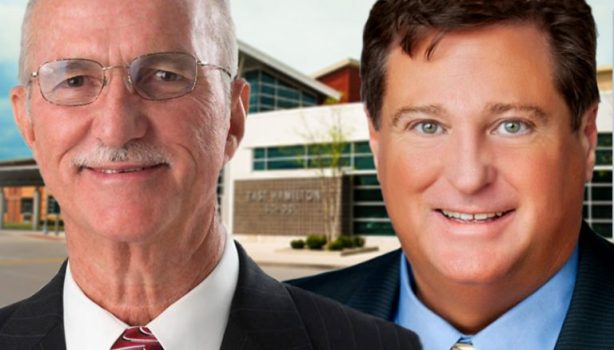
Hamilton County Sheriff Jim Hammond and Professional Educators of Tennessee are partnering to stage the Town Hall, which will take place 4 p.m. – 5:30 p.m. Monday, April 16, at the school complex in Ooltewah.

In addition to Sheriff Hammond, Chattanooga Police Chief David Roddy, Hamilton County Schools Superintendent Dr. Bryan Johnson, National School Security Expert Michael Yorio, and Dr. J.C. Bowman, Executive Director of Professional Educators of Tennessee, will serve as panelists. Businessman and radio host Weston Wamp will facilitate the Town Hall.

“The Town Hall will give parents, teachers and other stakeholders in public education the chance to offer their views on school safety,” said Sheriff Hammond. “Also, we will be able to share information about the Monday morning discussion with elected and community leaders.”

Dr. Bowman said teachers from counties surrounding Hamilton County will be informed of the timely event. He will also discuss research on school safety which the Professional Educators of Tennessee has completed with its membership.

“We are grateful to join with Sheriff Hammond and other strong leaders in Hamilton County to have timely, orderly discussion about an issue front and center in Hamilton County, the state and the nation,” said Dr. Bowman. “This is a wonderful opportunity for teachers, including our members in Southeast Tennessee.”

Yorio serves as president of SSI Guardian, LLC, and is senior vice president of security for School Specialty, Inc. As he will do in the morning meeting with area leaders, Yorio will bring a national perspective on school safety.

Wamp said the event will be recorded and made available to Professional Educators of Tennessee’s 8,000 members and others. Wamp, a Chattanooga businessman, will facilitate the forum. After brief opening remarks, questions will begin. Partisan, political speech will be stopped from stage, and Wamp urges attendees attending to have prepared, concise questions. Questions will end promptly at 5:30. The theater at East Hamilton has an estimated seating capacity of 300.

About Sheriff Jim Hammond: Sheriff Jim Hammond is the current Sheriff of Hamilton County and has been since August of 2008. His Sheriff’s office personnel consist of 386 full-time and 33 part-time employees. His area of coverage is Hamilton County, which is the fourth largest county in the state of Tennessee. As a Constitutional Elected Official of the State of Tennessee, Sheriff Hammond brings over 54 years of law enforcement experience to his credit, including 15 Years as Chief Deputy. He is also a veteran of the US Navy, an international police instructor, and former adjunct instructor for the University of Tennessee at Chattanooga.

About Professional Educators of Tennessee: Professional Educators of Tennessee is a non-partisan statewide professional association whose members come from all aspects of the educational systems in Tennessee. Their 8,000 statewide members include teachers, administrators and non-certified staff from kindergarten to graduate school level, public and private.

About Michael Yorio and SSI Guardian: National School Security Expert Michael A. Yorio is a former defense industry executive who is credited with founding SSI Guardian, the nation’s leading school safety and security firm and wholly owned subsidiary of School Specialty Inc. He has led the 21st Century Safe School initiative addressing institutional safety from an evidence based best practice approach focusing on the social, emotional, mental and physical factors.

About Weston Wamp: Weston Wamp has worked to promote best-practice guidelines for school safety across the country for two years, and he is currently involved in an effort of a national, non-profit organization that will address gaps in modernizing security in 21st century classrooms. He has hosted “The Pitch” on ESPN Chattanooga (105.1 FM) each Saturday morning for the past two years.

East Hamilton Middle High School is a public high school located in Ooltewah, Tennessee. Established and opened in 2009, it is one of the newest schools in the Hamilton County School district.

Address: 2015 Ooltewah Ringgold Rd, Ooltewah, TN 37363
PrincipalGail Chuy

#####

JC Bowman is the Executive Director of Professional Educators of Tennessee, a non-partisan teacher association headquartered in Nashville, Tennessee. Permission to reprint in whole or in part is hereby granted, provided that the author and the association are properly cited. For more information on this subject or any education issue please contact Professional Educators of Tennessee. To schedule an interview please contact Audrey Shores, Director of Communications, at 1-800-471-4867 ext.102.

JC's Twitter Post 2

Rethinking Driver’s Education

textingteendriving

Ladies and gentlemen, start your engines! 

With that little phrase, we are off to the races to get to our morning destination—work, school or other location.  I have been driving since I was 13 years old, and legally since I was 16.  I have never seen worse drivers in my lifetime, all across the state and nation.  Every time I get behind the wheel I say a silent prayer, “Dear Lord, please don’t let me be run-over by the idiots today and keep me and others safe out there.”

I remember when driving a vehicle was a privilege, first granted to me by my parents and then recognized by those who issued a license.  In fact, driving a car is not a right promised to every person, but rather a privilege granted to people who complete certain requirements. In the legal arena, even the US Supreme Court says that citizens do not have a fundamental “right to drive.” In Dixon v. Love, 431 U.S. 105, 112-16, 97 S.Ct. 1723, 52 L.Ed.2d 172 (1977), the Supreme Court held that a state could summarily suspend or revoke the license of a motorist who had been repeatedly convicted of traffic offenses with due process satisfied by a full administrative hearing available only after the suspension or revocation had taken place. The Court conspicuously did not afford the possession of a driver’s license the weight of a fundamental right.  (See also Mackey v. Montrym, 443 U.S. 1, 10, 99 S.Ct. 2612, 61 L.Ed.2d 321 (1979); Bell v. Burson, 402 U.S. 535, 539, 542-43, 91 S.Ct. 1586, 29 L.Ed.2d 90 (1971).)

Tennessee does mandate that in order to get an Intermediate Driver’s License, a minor must have certified 50 hours of supervised behind-the-wheel experience, including 10 hours at night.  The Tennessee Department of Safety only requires students to complete a driver’s education course if they have been convicted of multiple moving violations while they are operating on their intermediate restricted license.  It is time to re-think that policy.  It is currently not a requirement in order for a minor child to obtain a permit or license to successfully complete a driver’s education course.  Nobody disputes that it is an important resource that can help students become responsible and safe drivers.  Should we restrict student access on our school campuses until they can prove to be responsible and safe drivers?   Should driver’s education course be required?  How can we prove or truly verify the supervised behind the behind-the-wheel or night experience?  

From a school safety perspective, school district policy should require a student pass a driver’s education course before being allowed to drive to/from school or park their vehicle on school grounds. This class could also be offered during the summer or through any of the legitimate driving schools across the state. The objective should not be to save parents a few dollars on auto insurance, it must be to improve driving, reduce accidents and injuries and ultimately save lives.  We all benefit by learning defensive driving techniques and other safe driving skills that will last a lifetime.

distracted

The  rules of the road are also shifting. We all face obstacles in an increasingly challenging driving environment, especially with more inexperienced drivers on the roads.  Texting in driving, is one of the most distracting items a driver can do.  Phone use – particularly calling and texting – while driving is one of the most common distractions. New technologies bring even greater challenges with distracted drivers.  New technology in vehicles is not always to our benefit, “infotainment” dashboards GPS maps and other hands-free technology may actually impede smart driving and safety.  Multitasking technology is about convenience, not safety.  Good driving habits require training and repetition.

A driver’s education course is a beneficial choice for drivers of any age and experience levels.  However, it should be required for all minors navigating our roads.  It is time to re-think our policies before the next generation starts their engines.  Lives most certainly will depend on it.

##

JC Bowman is the Executive Director of Professional Educators of Tennessee, a non-partisan teacher association headquartered in Nashville, Tennessee. Permission to reprint in whole or in part is hereby granted, provided that the author and the association are properly cited. For more information on this subject or any education issue please contact Professional Educators of Tennessee.

 

April is Autism Awareness Month 

april_autism_month-1200x640

Parents making sense of a diagnosis of Autism can sometimes feel overwhelmed and alone. Candy Alford-Price, my longtime friend, made me aware of just how isolated parents of Autistic children can feel.  Autism is one of the fastest-growing developmental disorders in the United States.  Autism spectrum disorder (ASD) is a group of developmental disabilities that can cause significant social, communication and behavioral challenges.

The Centers for Disease Control and Prevention (CDC) reports many children are living with autism spectrum disorder (ASD), and they need services and support, now and as they grow into adolescence and adulthood. There is no better activity for an association than to help policymakers understand what our teachers experience on a daily basis and assist them in helping our educators meet the challenges they see and get the resources they need.

For a number of reasons autism prevalence figures are growing. The definition of autism has been expanded along with a better diagnosis of the disorder.  Autism is a spectrum of behaviors, and every autistic person is different in terms of onset, severity, and types of symptoms.  People with autism have issues with non-verbal communication, a wide range of social interactions, and social activities. Autism is a growing global health priority, and April is National Autism Awareness Month.  The objective is to increase knowledge and understanding of autism; recognize the talents and skills of people with autism, and; generate awareness to the needs of all people with autism.

We know boys are nearly five times more likely than girls to have autism.  The CDC released data on the prevalence of autism in the United States. This surveillance study identified 1 in 68 children (1 in 42 boys and 1 in 189 girls) have some form of autism.

Whether this an accurate assessment or not, Dr. Stephanie Seneff, a senior research scientist at the MIT Computer Science and Artificial Intelligence Laboratory, says by 2025, half the children born in the United States will be diagnosed with autism. If that figure is even partially accurate, society better begin to prepare in earnest.  The Autism Society estimates that the United States is facing almost $90 billion annually in costs for autism.  Autism costs a family $60,000 a year on average.  More importantly, there is no medical detection or cure for autism.

While significant, the data is more than just numbers, it is about real people, real families and our need as a society to address any challenge we meet head on.  We are improving in identifying autistic people, as well as accepting them.  Imagine the impact we can have on those whose lives are touched by autism every single day. We must recognize that all children are created in the image of God and have potential. However, as a culture, we must make certain the support and resources they need to realize that potential is available to educators and parents.

Autism is treatable. However, children do not “outgrow” autism.  Studies show that early diagnosis and intervention lead to significantly improved outcomes.  The CDC believes we must promote early identification of children with ASD.  That burden is likely to fall on pediatricians, children’s hospitals and ultimately on public schools.   We will need to design services for children and families affected by ASD and increase professional learning and development for the professionals who provide services.  Research will continue to be needed in this emerging field, as well as developing policies that promote and align with improved outcomes in health care and education for individuals with ASD.

April is Autism Awareness Month. Blue is the color.  Light it up Blue!

###

JC Bowman is the Executive Director of Professional Educators of Tennessee, a non-partisan teacher association headquartered in Nashville, Tennessee. Permission to reprint in whole or in part is hereby granted, provided that the author and the association are properly cited. For more information on this subject or any education issue please contact Professional Educators of Tennessee.


Just Follow the Law

Uncertain judge

I know that taxpayers see the best and worst of educators. The truth is that the vast majority of educators are incredibly dedicated public servants who deserve our praise. In surveys we conduct, it reveals that working conditions are a bigger issue to teachers than salary.

Let me share one example: We have discovered that several school districts are now using the term “Leaves of Absences” while investigating any allegations against teachers. During the “tell your side” conference, the teacher is informed of the supposed allegations to which he/she is supposed to respond. Soon thereafter, a “Written Reprimand” is issued and at times, the teacher is found responsible of violations of school policy and penalized certain days of pay. This occurs without sufficient notice of the charges or due process rights afforded within an impartial hearing. We believe this is improper and may in fact be actionable. We are very concerned about these methods which in essence dilute, and at times, abuse the due process rights of a tenured educator. The right to be heard before an impartial hearing officer, along with the appeal rights to the Board and Chancery Court are obviated. We believe this to be contrary to the legislative intent of and due process rights provided by Tennessee Code Annotated §49-5-511 and Tennessee Code Annotated §49-5-512.

Let me put it into something more relatable for the average reader. Imagine you walk into your job today and are questioned by a supervisor. You are told you are being sent home because a subordinate told you something. Keep in mind you followed company policy and reported the conversation which involved illegal activities to authorities, as required by company policy. Now the “Leave of Absence” is under media scrutiny, you cannot defend yourself. To make matters worse, the supervisor can take as long as he wants to investigate the issue. The longer you stay at home, the more damaging to your career. Rumors begin to circulate that you must have done something wrong, which you clearly did not. The supervisor purposely skirts company policy, by using the term, “Leave of Absence.” Ask yourself this question, would you want to work for that company? More importantly would anybody want to work for that company?

While this sounds complicated. It is really simple: Follow the Law. People should not play semantics with words. If a teacher or administrator has done something that warrants a reprimand or suspension, then address that issue and allow due process to take place. When districts try to avoid following the law, the recourse will eventually and most certainly end up in court. When that happens students lose, teachers and administrators lose, and most importantly taxpayers lose.

My advice to school districts. You may not like the law. You may not agree with the law. But as long as it is the law…. follow the law.

##

JC Bowman is the Executive Director of Professional Educators of Tennessee, a non-partisan teacher association headquartered in Nashville, Tennessee. Permission to reprint in whole or in part is hereby granted, provided that the author and the association are properly cited. For more information on this subject or any education issue please contact Professional Educators of Tennessee.