We Remember September 11

This slideshow requires JavaScript.

Our nation was attacked on September 11, 2001 and our world changed.  Terrorists called al-Qaeda, with training camps all around the world were responsible for the death of the more than 3,000 victims.  This is an enemy unlike any we have ever faced.  There are multiple countries, multiple fronts and multiple threats.

This enemy is committed to the absolute destruction of the American way of life and imposing their beliefs and values upon the world.  In their world, law is determined by force—those with power—whether military strength or political dominance—make the rules. It is our belief in freedom, human rights, idealism, personal responsibility and economic opportunity that extremists dislike the most.

If you were a classroom teacher today how would you address the events of September 11, 2001 with your students?  Would you blame the incident on the very people who lost their lives?  Would you blame those with a misguided ideology for killing innocent people?  To me, the answer is very apparent.   And those who would blame victims or our nation are siding with evil-doers and promoting savagery.

Since Jeremiah Wright first shocked our nation with his comment in 2008, parroting a Malcolm X phrase, that “America’s chickens are coming home to roost,” which was widely understood as meaning that America brought the September 11 attacks upon itself.  Every year that has passed since 2001 that sentiment has been voiced in one manner or another. Eventually that will end up in our classrooms and textbooks.  My fear is that the victims will be posthumously put on trial while the terrorists are seen as genial freedom fighters.  Nothing could be further from the truth.

It seems to many that we treat perpetrators of evil kinder than we treat their victims in our society.  It is an obvious assault on law and order.  It is law which enables man to live together, and creates order out of chaos.  We first and foremost a nation of laws. Founding Father and future president John Adams called America “a nation of laws, not of men.”  These rules should not be subject to the whims of those in power.   And those who fail to understand history in the proper context will write textbooks to inform future generations.  It is why curriculum has been such a highly debated issue.

Historian Bruce Kauffmann wrote about “the Soviet Union’s infamous dictator, Josef Stalin, who in the late 1930s had millions of innocent people incarcerated and murdered after they underwent show trials, or no trials, in which the “nature and cause of the accusation” against them were such specifically identified and legally provable crimes as being “foreign agents,” “counterrevolutionaries,” “enemies of the people” or “enemies of the state.” Have we become so politically correct that only one opinion is allowed?

I accept that countries lie to their citizens, and that we are, regrettably, governed by men and women who are sometimes corrupt.  That is undesirable, but it is a fact of life.   Often choices made by government is not between good and bad, but between bad and worse.  We have done exactly what George Washington warned us against by embracing entangling alliances.  We have largely abandoned our Judeo-Christian heritage, in fear of lawsuits and in the name of inclusion.  However, we still have the rule of law, right?

I am reminded of Robert Kennedy’s speech in which he was discussing the law.  He said about the law: “The road ahead is full of difficulties and discomforts. But as for me, I welcome the challenge. I welcome the opportunity, and I pledge to you my best effort — all I have in material things and physical strength and spirit to see that freedom shall advance and that our children will grow old under the rule of law.”

People of reason can disagree with issues and have civil discourse.   “Everyone is entitled to his own opinion, but not to his own facts,” according to the late Daniel Patrick Moynihan.  Who also reminded us that culture, not politics, determines the success of society.  Respect of our fellow human beings is the core outgrowth of a nation committed under a rule of law.  It is our shared history in America, and one in which we must be personally committed to follow.  That is the real lesson to teach.  If we fail to pass that to the next generation, freedom, the political process, civil liberties, individual rights and media independence will be lost to the dustbin of history and no longer tolerated.

We must remember September 11th in our homes and in our classrooms and engage in this important dialogue.   Never let it be said that the flame of freedom was extinguished on our watch.   That can be summed up in two words:  We Remember.

##

JC Bowman is the Executive Director of Professional Educators of Tennessee, a non-partisan teacher association headquartered in Nashville, Tennessee. Permission to reprint in whole or in part is hereby granted, provided that the author and the association are properly cited. For more information on this subject or any education issue please contact Professional Educators of Tennessee.

The Richest Place on Earth

the Graveyard
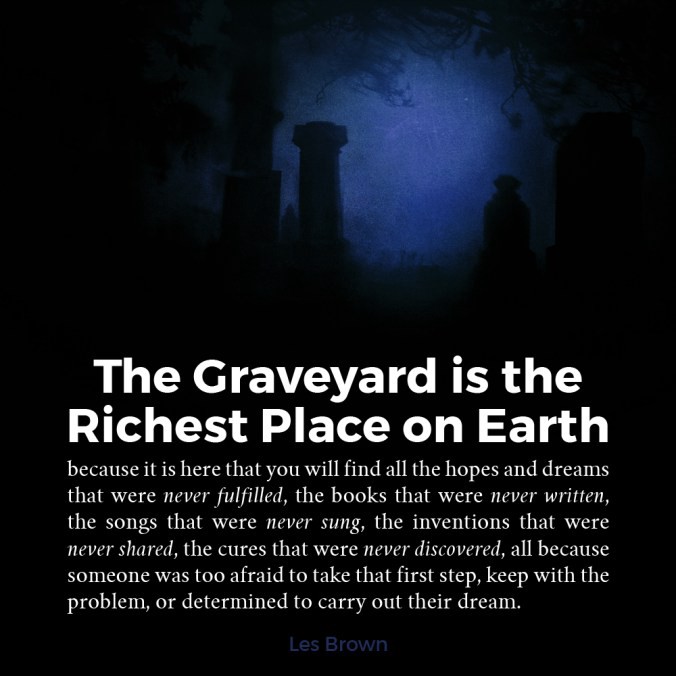
“The graveyard is the richest place on earth, because it is here that you will find all the hopes and dreams that were never fulfilled, the books that were never written, the songs that were never sung, the inventions that were never shared, the cures that were never discovered, all because someone was too afraid to take that first step, keep with the problem, or determined to carry out their dream.”   – Les Brown

“The graveyard is the richest place on earth, because it is here that you will find all the hopes and dreams that were never fulfilled, the books that were never written, the songs that were never sung, the inventions that were never shared, the cures that were never discovered, all because someone was too afraid to take that first step, keep with the problem, or determined to carry out their dream.” – Les Brown

We live in an era of untold wealth. The average person in a first world country today lives many times better than sultans and kings of years past.

We don’t have to worry about where we will find our next meal. We don’t have to worry about finding water that’s drinkable enough not to kill us. We don’t have to worry about constant invasions from other countries or kingdoms. We truly live in a time of comfort and stability.

Yet many of our riches go to waste. I’m not talking about a billionaire’s inheritance. I’m not talking about all the things we throw away or the amount of food that goes to waste. I’m talking about the people who lived in such comfort, but chose to do nothing with all the fortunes of the modern world.

Many of us live in such comfort but never pursue our dreams. We repeat the same two words far too often: someday. “I want to write a book… someday.”, “I’ll learn to play an instrument… someday.”, “I will build my business… someday.”

How do we know we love something unless we do it?

It’s as if we are allergic to doing the work today. We tell ourselves we are ambitious, but never actually pursue the thing we say we love. How do we know we love something unless we do it? How do we pursue our dreams?

By getting over our fears. Stop being afraid of taking that first step. Stop being afraid of finishing that piece you’ve been working on for years. Stop being afraid of releasing your work into the world. Stop being afraid of putting a price tag on your art.

The world doesn’t just want the gifts you have to share, the world needs them.

The world doesn’t just want the gifts you have to share, the world needs them.How many people can you positively affect through your work? How many lives can you touch? How many people can you inspire to do greater things?

Make the world a richer place by sharing your talents with it.

If we want to deprive graveyards of future riches, we must be willing to pursue our creative callings. We must be willing to share our gifts with the world. Don’t live your life filled with regret. Sure, you might fail. We all do. But don’t let that discourage you. Make the world a richer place by sharing your talents with it.

Photo by jimmy brown

This was originally posted on Marketing Your Art the Right Way.

Faith in Public Schools

fa religion

The First Amendment guarantee of religious liberty includes the freedom to believe or not to believe, and to observe one’s faith openly without government interference. The U.S. Department of Education has traditionally provided statements on the role of religion in the public schools.  This has included guidance on school prayer, religious holidays, religious songs and religion in the curriculum.

The relationship between religion and government in the United States is governed by the First Amendment to the Constitution, which both prevents the government from establishing religion and protects privately initiated religious expression and activities from government interference and discrimination.

The Supreme Court has repeatedly held that the First Amendment requires public school officials to be neutral in their treatment of religion, showing neither favoritism toward nor hostility against religious expression such as prayer. Accordingly, the First Amendment forbids religious activity that is sponsored by the government, but protects religious activity that is initiated by private individuals.

The Elementary and Secondary Education Act (ESEA), as reauthorized by the No Child Left Behind Act of 2001 required the Secretary of Education to issue guidance on constitutionally protected prayer in public elementary and secondary schools. The Every Student Succeeds Act (ESSA), P.L. 114-95, was signed by President Obama on December 10, 2015.  ESSA reauthorizes the 50-year-old Elementary and Secondary Education Act (ESEA). It may be time for the United States Department of Education to reissue the guidance offered by then Secretary of Education Rod Paige.

The guidance in 2002, clarifies the rights of students to pray in public schools. As stated in the guidance, “…the First Amendment forbids religious activity that is sponsored by the government but protects religious activity that is initiated by private individuals” such as students. Therefore, “[a]mong other things, students may read their Bibles or other scriptures, say grace before meals, and pray or study religious materials with fellow students during recess, the lunch hour, or other noninstructional time to the same extent that they may engage in nonreligious activities.” Public schools should not be hostile to the religious rights of their students and their families.

At the same time, school officials may not “compel students to participate in prayer or other religious activities.” Nor may teachers, school administrators and other school employees, when acting in their official capacities as representatives of the state, encourage or discourage prayer, or participate in such activities with students.

Former Secretary of Education Richard Riley wrote: “Students may express their beliefs about religion in the form of homework, art-work, and other written and oral assignments free of discrimination based on the religious content of their submissions.  Such home and classroom work should be judged by ordinary academic standards of substance and relevance, and against other legitimate pedagogical concerns identified by the school.”

Educators are also free much like all other citizens to practice their faith. Public school teachers and administrators should be neutral concerning religion while carrying out their official duties. School officials who wish to pray or engage in other religious activities should do so without students present.  For example, if teachers want to meet for prayer or scriptural study in the faculty lounge during free time in the school day or before or after school, they should do it when they have no official duty and without students present.

Under a 1993 Supreme Court ruling, Lamb’s Chapel v. Center Moriches School District, public schools that permit their facilities to be used by community groups are not permitted to discriminate against religious groups. This ruling was reaffirmed in Good News Club v. Milford Central School (2001), in which the context of a religiously-affiliated after-school program that sought to use public school facilities was upheld.

In the age we live in, it is critical to recognize the freedoms we have. Public schools should not be hostile to the religious rights of their students and their families. Policymakers should make certain that school board policy protects privately initiated religious expression and activities from government interference and discrimination.

Surely, it is not hard to fathom the necessity of building a common understanding in regards to the meaning of the First Amendment in the public school setting. Schools should develop their own district-wide policy regarding religious expression and to engage parents, teachers, various faith communities and the broader community.  You have the freedom to believe or not to believe, and to observe your faith openly without government interference.

– – –

JC Bowman is the Executive Director of Professional Educators of Tennessee, a non-partisan teacher association headquartered in Nashville, Tennessee. Permission to reprint in whole or in part is hereby granted, provided that the author and the association are properly cited. Follow him on social media via Twitter at @jcbowman.

Thanking Those Who Built America

robbie webb
Robbie Webb, my great-great grandfather.  Monroe County, TN  1861-1932

Labor Day is a day we set aside for American workers.  It also marks the unofficial end to our Summer.  Labor Day has many meanings, but one meaning is that we must recognize the incredible effort and work it took to build this great country.  It is worth recalling our own history and leadership of President Calvin Coolidge.  A man renown for his silence and wit.

Coolidge acknowledged the importance of workers and Labor Day when he stated that “this high tribute is paid in recognition of the worth and dignity of the men and women who toil.” Coolidge actually valued American labor and the spirit of work and his policies led to job creation and economic expansion in America. Coolidge added:

“I cannot think of anything that represents the American people as a whole so adequately as honest work. We perform different tasks, but the spirit is the same. We are proud of work and ashamed of idleness. With us there is no task which is menial, no service which is degrading. All work is ennobling and all workers are ennobled.”

It seems in this age we may have lost that respect for the worker.  Some of that may be connected to public sector unionism.   Coolidge won national recognition for his handling of the Boston Police Strike, when he intervened and famously stated that “there is no right to strike against the public safety by anybody, anywhere, anytime.”  Many union leaders, not necessarily the union members themselves, continue to embrace political activism over members themselves.  These unions support candidates and causes opposed by many of the workers that union bosses claim to speak for. It is why union membership is in decline across the nation.

Does the end justify the means?  Perhaps the best answer to that question is from the controversial and radical psychoanalyst Wilhelm Reich who wrote: “The meanness and inhumanity of the means make you mean and inhuman and make the end unattainable.”  When the means justify the ends, ethical consideration focuses on what you do, not the consequences of what you have done.   Results-based ethics means that no type of act is morally wrong.  This is a harmful position, for an individual, a business or a nation.  As a nation, we understand that there are consequences for our actions.  We have an individual responsibility to work to the best of our abilities and we must expect fair wages.

Martin Luther King, Jr., also insisted not just on the ends, but the means.  Mahatma Gandhi, like King, understood that for the rational people to survive in revolutionary times that his focus must remain on the means, just as much extremists do by their “do anything” philosophy.  Machiavelli who is credited with phrase: “The end justifies the means,” actually wrote, “Si guarda al fine.”   This phrase may be better translated as “Pay attention to the result.”  As President, Calvin Coolidge created a period of economic expansion and prosperity through his administration’s economic policies, that was a result of focusing on both the ends and the means.  It was a period of individual prosperity and economic growth.

Robert Ferrell, in his book The Presidency of Calvin Coolidge, states the results of Coolidge’s philosophy: “Real wages for industrial workers were 8 percent above the base year (1914= 100) in 1921, 13 percent above in 1922, and 19 percent above in 1923. For the next two years, the figure remained at this level and then increased, reaching 32 percent in 1928. The workweek declined from 47.4 hours in 1920 to 44.2 in 1929. This meant a five-and-a-half-day week…All the while unemployment was a low 3.7 percent between 1923 and 1929. This compared with 6.1 between 1911 and 1917, a fairly prosperous time for workers.” Certainly, there is a correlation between a prosperous economy, increasing wages and worker happiness.  This is a lesson we should bear in mind.

Coolidge recognized that a thriving economy and higher wages built the middle class.  It also depended on following common sense on fiscal matters.   Garland S. Tucker wrote that he never lost sight of his belief in a strong work ethic and the spirit of America, as Coolidge declared:

“We do not need to import any foreign economic ideas or any foreign government. We had better stick to the American brand of government, the American brand of equality, and the American brand of wages. America had better stay American.”

This Labor Day we must reminded ourselves of the unique heritage of our nation and the effort so many people who came before us put forth so that we their heirs could enjoy the fruits of our own labors. In a presidential speech, President Coolidge reasoned that he could not “think of any American man or woman preeminent in the history of the nation who did not reach their place through toil.” I am not so sure Calvin Coolidge was as silent as he is portrayed in our history books.  It is a good lesson for all generations.

##

JC Bowman is the Executive Director of Professional Educators of Tennessee, a non-partisan teacher association headquartered in Nashville, Tennessee. Permission to reprint in whole or in part is hereby granted, provided that the author and the association are properly cited. For more information on this subject or any education issue please contact Professional Educators of Tennessee.
This Is Only A Test?

jc ed background

This Is Only A Test? (www.proedtn.org)  Are tests in our schools making the grade? JC Bowman from the Professional Educators of Tennessee joins us for an in- depth conversation about challenges with current grade assessment tests and Tennessee Ready. Interview.  Listen to iHeart Radio,  Tennessee Matters here.

Link:  https://www.iheart.com/podcast/1021-Tennessee-Matters-28732380/episode/tennessee-matters-29762167/

Why Do People Teach?

life focus

Why do people teach?  The major reason someone says they teach is the ability to make a real difference in the lives of children.  There are other reasons, including the fact that someone believes they are “called” to teach.  Almost all teachers are linked together by a passion for educating children.  The passion is innate and has to come from within. —JC Bowman

Tone Deaf School Districts

“If you don’t understand  — from the school district to the superintendents — that we want our teachers held harmless, then I’m sorry, you’re tone-deaf.” ~State Representative Eddie Smith (Knoxville)

tone-deaf-1

That message was heard and understood statewide, right?  Apparently not.  We are receiving reports from across the state that some districts are denying their teachers their justified and earned bonuses, which harms the educator.  The language from the Public Chapter Number 881 reads “LEAs shall not base compensation decisions for teachers on data generated by statewide assessments administered in the 2017-18 school year” Public Chapter Number 1026 adds: “no adverse action may be taken against any student, teacher, school, or LEA based, in whole or in part, on student achievement data generated from the 2017-2018 TNReady assessment.” (emphasis added)

The Tennessee Department of Education, anticipating this problem, understood this could negatively impact teachers that did well on TNReady in the 2017-18 school year so they provided this guidance to school districts across the state: “All currently approved alternative salary schedules and differentiated pay plans are based on 2016-2017 school year data and may remain in effect because they are not impacted by the Legislation. Districts should consult closely with their board attorneys to ensure that any other strategic compensation policies do not result in an action being taken concerning a teacher in the 2017-18 school year based on 2017-18 data. As always, teachers may not earn less than they did the previous year unless there is a change in the teacher’s duties or position.” (emphasis added)

However, at least one school district, Greene County Schools, sent an email to all principals.  The message to all Greene County Administrators was from Bill Ripley, the Assistant Director of Academics.

Ripley wrote:

This message is in response to questions we have received.  Several months ago the state legislature passed an act preventing districts from affecting any teacher’s pay based on 2017-18 test results.  Therefore, the Greene County Schools district plan to pay a bonus for level 4 or 5 TVAAS cannot be implemented this year.  We realize this is disappointing to the 105 teachers who attained a level 4 or 5 last year, however, this is an action of lawmakers in Nashville, not your local Board of Education.

A first-year law student could probably make the case that any school district that withholds paying a bonus based on actions taken by the Tennessee General Assembly are not understanding the law or the intent of the state law.  Denying educators their rightful bonus based on positive student achievement or student growth is indeed having an adverse action on educators, especially their compensation.  It can be argued that the legislation that passed is vague and that districts should work closely with their board attorney when making these types of decisions. However, discussion on the floor on the legislation, as well as comments from the Bill Sponsor Rep. Eddie Smith, was clear:  that districts could not take adverse actions.

The state issued two very important guidance documents that make clear that message, which was released by the Tennessee Department of Education.   Professional Educators of Tennessee, along with many others worked with the Department of Education and added our input.  The guidance that the Department developed was a result of thoughtful and collaborative efforts to ensure that our state follows all state and federal laws.  The new legislation that states that no adverse actions for students, teachers or schools will result from the 2017-18 TNReady administration.   These two key documents, which were shared with districts and schools are posted on the state website, along with a list of initial improvements the state is making to the state assessment program:

  • Detailed Evaluation Guidance (here)
  • FAQ that provides an overview of the various areas the new laws impact, including student, education, school, and district accountability (here)

If educators feel that their district is withholding a bonus in which they are entitled, it would be helpful for those educators to write their school district and ask them for a written explanation on why the bonus is being denied.  If a school district wants to be tone deaf, I know several state legislators and folks at the Department of Education who would be very interested in why an adverse action is being taken against you.  I know that Professional Educators of Tennessee wants to hear if compensation decisions for teachers on data generated by statewide assessments administered in the 2017-18 school year have kept you from receiving compensation, or your bonus.  Just drop us an email at advocacy@proedtn.org.

###

JC Bowman is the Executive Director of Professional Educators of Tennessee, a non-partisan teacher association headquartered in Nashville, Tennessee. Permission to reprint in whole or in part is hereby granted, provided that the author and the association are properly cited. For more information on this subject or any education issue please contact Professional Educators of Tennessee.

Life’s Whatcha Make It

donovan thinking

The future doesn’t belong to the brilliant, but rather to the resilient.  Resilience is the ability that allows people that have a setback in the goals to comeback stronger than ever in their life.  Psychologists have identified a few of the factors that make somebody resilient, among them:  a positive attitude, optimism, the ability to control emotions, and the capacity to see failure as temporary.

Peter Buffett wrote: “Our journey in life rarely follows a straight line but is often met with false starts, crises, and blunders. How we push through and persevere in these challenging moments is where we begin to create the life of our dreams.” Sometimes failure and pain are our life’s greatest teachers. The toughest people are the ones who love despite personal shortcomings, cry to themselves behind closed doors and fight battles that nobody may even know about.


Life is about transcending your circumstances, taking control of your destiny, and living your life to the fullest.  Educators must embrace that mantra in the classroom, and out of it.  As Jake Owen’s recent summer tour “Life’s Whatcha Make It,” he describes it like this:  “[If] you wake up in the morning and you’re happy and you go forward with a smile on your face and want to make it great, most likely, it’s gonna be a great day,” he says. “If you wake up on the wrong side of the bed with negativity in your mind, that’s pretty much how your day’s gonna go.”

It was the movie character, Ferris Bueller, who reminded us that: “Life moves pretty fast. You don’t stop and look around once in a while, you could miss it.”  One of the things that’s people fail to do is appreciate the good things in life.  For most of us, we enjoy a roof over ou

r heads, food on our table, good health, a family that loves us, friends who care, and the opportunity to work a job we like for money.  So, the first step to making the most out of life is deciding what you want to achieve.  What are your goals in life? Do you appreciate what you have?  If you cannot answer that affirmatively, chances are you will never be happy.

Much has been made of what motivates people to teach. A career in public education is one of the most altruistic and generous career choices.  It will never be for the money.  And if you have been deceitfully convinced that it is a paycheck for what draws people into public education then you have lost the vision and purpose of education.   Teachers don’t teach for the income.  They teach for the outcome.   It truly is about your students’ success.  And that is not measurable on a test score, and their success might not be visible until those children reach adulthood.

Teachers are some of the most resilient people I know.  Good teachers know how to bring out the best in students. Still they do not have the ability to control their work environment, their salary, or how those around them respond to changes—from supervisors, to colleagues to students.  When you study great teachers, it is likely you will realize it is the immeasurable things like their caring and hard work, rather than their technique or test scores that set them apart. Teachers who take an actual interest in their students’ lives are the ones students become inspired by, and learn the most from in a classroom.

I was taught first at home, then reinforced later by my time in the Marine Corps to “adapt, improvise and overcome.”  In my career in the military, and later as a classroom teacher, I learned the meaning of Semper Flexibilis, which translates to “always flexible.”  It is true that sometimes the best things in life come out of change, even if the changes are unwanted. If you can’t change it, change the way you think about it.

As adults we reflect on the lessons we learned growing up.  We always remember and cherish the those who encouraged and supported us through difficult times.  Nobody wants to be left out, or made to feel like they do not fit in.   We all want to be seen, felt, and understood.  Those adults who give us emotional support are as important as those who give us academic validation.   Call it empathy, or seemingly being attuned to the needs of others.  We never forget that adult who cared for us as children. As an educator how would students describe you to others?  How do your neighbors describe you?  How does your family describe you? 

Joshua J. Marine wrote: “Challenges are what make life interesting; overcoming them is what makes life meaningful.”  The ability to overcome obstacles is critical whether you are a student, classroom teacher, administrator or CEO of a company.  Learn to chase your dreams, develop your own uniqueness and ability.  Understand there will be disappointments along the way.  Your ability to bounce back is essential to your success in life.   We must also teach our children to be resilient.

##

JC Bowman is the Executive Director of Professional Educators of Tennessee, a non-partisan teacher association headquartered in Nashville, Tennessee. Permission to reprint in whole or in part is hereby granted, provided that the author and the association are properly cited. For more information on this subject or any education issue please contact Professional Educators of Tennessee.
Panels, Tours and Testing

The-House-Always-Wins

I have grown fatigued with blue ribbon panels or listening tours.  I have never found either strategy very useful in formulating public policy.  Especially when that policy is agenda-driven, with pre-determined outcomes.  I am also not a gambler (sorry Kenny Rogers).  I understand that the house always comes out the winner in the end. A casino has a business model premeditated to ensure its success.  Much like a blue-ribbon panel, or a listening tour.

From a political standpoint, why would the state of Tennessee try to conduct a listening tour at this time?  We are in the middle of election season and the Governor is in his final days.  What more can he add to the education debate after 8 years, that he hasn’t already tried?  All stakeholders want to get testing right. We have already had an Assessment Task Force, which has done a pretty good job of collecting input and holding serious discussions.  The state has already been engaged in an open conversation about assessment and ways to improve administration of tests.  We have already gathered feedback on the delivery of state assessments.  We simply have not executed the plan.  There are just a few vendors across the nation who have the resources and ability to be selected as the state’s next assessment partner.  We have been through several of those vendors already—and were disappointed by those results.

If the state wants to discuss how to better provide schools, educators, parents and students with meaningful and timely results from assessments, then we better figure out how to get the results back to those in the classrooms capable of making better academic decisions for students. We will want to provide baseline assessments of learning/study skills, identify areas of potential academic concerns, highlight learning strengths/weaknesses, and provide effective and efficient strategies in getting academic intervention when needed by students.  This is something unlikely to occur on a listening tour and is already known by the K-12 Community.

We can and should discuss the value that assessments can provide.  We must also discuss how the emphasis on testing is missing the bigger issue:  student academic growth measured by flawed testing.  Then the results being used in educator evaluations.  This is certainly more problematic to educators than the actual tests themselves.   It should be problematic to parents as well.  When two superintendents raised the testing issue and requested a pause in testing, Commissioner McQueen correctly pointed out that as a condition of receiving federal funds, the feds through Every Student Succeeds Act (ESSA) requires state education agencies to implement statewide assessments.  Many states exceed federal requirements.

McQueen pointed out that “both state and federal law require an annual statewide assessment.” So, if we want a discussion on testing perhaps we should be directing at the Federal Branch as well?  Should we not also look at our ESSA Plan while doing this pointless tour?  The initial ESSA plan was based on feedback from thousands of Tennesseans over the course of a year.

How did we get here?  With an infusion of $501 million federal dollars of Race to the Top money our state hurried to increase standards by adopting Common Core, which was soon corrected by moving back to state standards. We then increased testing, changing both format and frequency. Tennessee also adopted new evaluation methods. The teachers’ union supported the incorporation of TVAAS data into the state’s teacher evaluations, which landed Tennessee $501 million from the federal Race to the Top grant in 2010.

Former Governor, Phil Bredesen, said that former Senator Bill Frist had contributed a lot to the state’s proposal, but that his own role in persuading the Tennessee Education Association, a teachers’ union, to sign on had been important, too.  

So, how do we get out of this mess?  It probably won’t be the result of a listening tour.  And our next Governor had better put forth policy ideas pretty quickly, or he will be saddled with an unworkable plan right out of the gate—just like Governor Bredesen and Governor Haslam.  The people who got us into this mess, probably aren’t the people to get us out of it.

##

JC Bowman is the Executive Director of Professional Educators of Tennessee, a non-partisan teacher association headquartered in Nashville, Tennessee. Permission to reprint in whole or in part is hereby granted, provided that the author and the association are properly cited. For more information on this subject or any education issue please contact Professional Educators of Tennessee.