This Is Only A Test?

jc ed background

This Is Only A Test? (www.proedtn.org)  Are tests in our schools making the grade? JC Bowman from the Professional Educators of Tennessee joins us for an in- depth conversation about challenges with current grade assessment tests and Tennessee Ready. Interview.  Listen to iHeart Radio,  Tennessee Matters here.

Link:  https://www.iheart.com/podcast/1021-Tennessee-Matters-28732380/episode/tennessee-matters-29762167/

Why Do People Teach?

life focus

Why do people teach?  The major reason someone says they teach is the ability to make a real difference in the lives of children.  There are other reasons, including the fact that someone believes they are “called” to teach.  Almost all teachers are linked together by a passion for educating children.  The passion is innate and has to come from within. —JC Bowman

Tone Deaf School Districts

“If you don’t understand  — from the school district to the superintendents — that we want our teachers held harmless, then I’m sorry, you’re tone-deaf.” ~State Representative Eddie Smith (Knoxville)

tone-deaf-1

That message was heard and understood statewide, right?  Apparently not.  We are receiving reports from across the state that some districts are denying their teachers their justified and earned bonuses, which harms the educator.  The language from the Public Chapter Number 881 reads “LEAs shall not base compensation decisions for teachers on data generated by statewide assessments administered in the 2017-18 school year” Public Chapter Number 1026 adds: “no adverse action may be taken against any student, teacher, school, or LEA based, in whole or in part, on student achievement data generated from the 2017-2018 TNReady assessment.” (emphasis added)

The Tennessee Department of Education, anticipating this problem, understood this could negatively impact teachers that did well on TNReady in the 2017-18 school year so they provided this guidance to school districts across the state: “All currently approved alternative salary schedules and differentiated pay plans are based on 2016-2017 school year data and may remain in effect because they are not impacted by the Legislation. Districts should consult closely with their board attorneys to ensure that any other strategic compensation policies do not result in an action being taken concerning a teacher in the 2017-18 school year based on 2017-18 data. As always, teachers may not earn less than they did the previous year unless there is a change in the teacher’s duties or position.” (emphasis added)

However, at least one school district, Greene County Schools, sent an email to all principals.  The message to all Greene County Administrators was from Bill Ripley, the Assistant Director of Academics.

Ripley wrote:

This message is in response to questions we have received.  Several months ago the state legislature passed an act preventing districts from affecting any teacher’s pay based on 2017-18 test results.  Therefore, the Greene County Schools district plan to pay a bonus for level 4 or 5 TVAAS cannot be implemented this year.  We realize this is disappointing to the 105 teachers who attained a level 4 or 5 last year, however, this is an action of lawmakers in Nashville, not your local Board of Education.

A first-year law student could probably make the case that any school district that withholds paying a bonus based on actions taken by the Tennessee General Assembly are not understanding the law or the intent of the state law.  Denying educators their rightful bonus based on positive student achievement or student growth is indeed having an adverse action on educators, especially their compensation.  It can be argued that the legislation that passed is vague and that districts should work closely with their board attorney when making these types of decisions. However, discussion on the floor on the legislation, as well as comments from the Bill Sponsor Rep. Eddie Smith, was clear:  that districts could not take adverse actions.

The state issued two very important guidance documents that make clear that message, which was released by the Tennessee Department of Education.   Professional Educators of Tennessee, along with many others worked with the Department of Education and added our input.  The guidance that the Department developed was a result of thoughtful and collaborative efforts to ensure that our state follows all state and federal laws.  The new legislation that states that no adverse actions for students, teachers or schools will result from the 2017-18 TNReady administration.   These two key documents, which were shared with districts and schools are posted on the state website, along with a list of initial improvements the state is making to the state assessment program:

  • Detailed Evaluation Guidance (here)
  • FAQ that provides an overview of the various areas the new laws impact, including student, education, school, and district accountability (here)

If educators feel that their district is withholding a bonus in which they are entitled, it would be helpful for those educators to write their school district and ask them for a written explanation on why the bonus is being denied.  If a school district wants to be tone deaf, I know several state legislators and folks at the Department of Education who would be very interested in why an adverse action is being taken against you.  I know that Professional Educators of Tennessee wants to hear if compensation decisions for teachers on data generated by statewide assessments administered in the 2017-18 school year have kept you from receiving compensation, or your bonus.  Just drop us an email at advocacy@proedtn.org.

###

JC Bowman is the Executive Director of Professional Educators of Tennessee, a non-partisan teacher association headquartered in Nashville, Tennessee. Permission to reprint in whole or in part is hereby granted, provided that the author and the association are properly cited. For more information on this subject or any education issue please contact Professional Educators of Tennessee.

Life’s Whatcha Make It

donovan thinking

The future doesn’t belong to the brilliant, but rather to the resilient.  Resilience is the ability that allows people that have a setback in the goals to comeback stronger than ever in their life.  Psychologists have identified a few of the factors that make somebody resilient, among them:  a positive attitude, optimism, the ability to control emotions, and the capacity to see failure as temporary.

Peter Buffett wrote: “Our journey in life rarely follows a straight line but is often met with false starts, crises, and blunders. How we push through and persevere in these challenging moments is where we begin to create the life of our dreams.” Sometimes failure and pain are our life’s greatest teachers. The toughest people are the ones who love despite personal shortcomings, cry to themselves behind closed doors and fight battles that nobody may even know about.


Life is about transcending your circumstances, taking control of your destiny, and living your life to the fullest.  Educators must embrace that mantra in the classroom, and out of it.  As Jake Owen’s recent summer tour “Life’s Whatcha Make It,” he describes it like this:  “[If] you wake up in the morning and you’re happy and you go forward with a smile on your face and want to make it great, most likely, it’s gonna be a great day,” he says. “If you wake up on the wrong side of the bed with negativity in your mind, that’s pretty much how your day’s gonna go.”

It was the movie character, Ferris Bueller, who reminded us that: “Life moves pretty fast. You don’t stop and look around once in a while, you could miss it.”  One of the things that’s people fail to do is appreciate the good things in life.  For most of us, we enjoy a roof over ou

r heads, food on our table, good health, a family that loves us, friends who care, and the opportunity to work a job we like for money.  So, the first step to making the most out of life is deciding what you want to achieve.  What are your goals in life? Do you appreciate what you have?  If you cannot answer that affirmatively, chances are you will never be happy.

Much has been made of what motivates people to teach. A career in public education is one of the most altruistic and generous career choices.  It will never be for the money.  And if you have been deceitfully convinced that it is a paycheck for what draws people into public education then you have lost the vision and purpose of education.   Teachers don’t teach for the income.  They teach for the outcome.   It truly is about your students’ success.  And that is not measurable on a test score, and their success might not be visible until those children reach adulthood.

Teachers are some of the most resilient people I know.  Good teachers know how to bring out the best in students. Still they do not have the ability to control their work environment, their salary, or how those around them respond to changes—from supervisors, to colleagues to students.  When you study great teachers, it is likely you will realize it is the immeasurable things like their caring and hard work, rather than their technique or test scores that set them apart. Teachers who take an actual interest in their students’ lives are the ones students become inspired by, and learn the most from in a classroom.

I was taught first at home, then reinforced later by my time in the Marine Corps to “adapt, improvise and overcome.”  In my career in the military, and later as a classroom teacher, I learned the meaning of Semper Flexibilis, which translates to “always flexible.”  It is true that sometimes the best things in life come out of change, even if the changes are unwanted. If you can’t change it, change the way you think about it.

As adults we reflect on the lessons we learned growing up.  We always remember and cherish the those who encouraged and supported us through difficult times.  Nobody wants to be left out, or made to feel like they do not fit in.   We all want to be seen, felt, and understood.  Those adults who give us emotional support are as important as those who give us academic validation.   Call it empathy, or seemingly being attuned to the needs of others.  We never forget that adult who cared for us as children. As an educator how would students describe you to others?  How do your neighbors describe you?  How does your family describe you? 

Joshua J. Marine wrote: “Challenges are what make life interesting; overcoming them is what makes life meaningful.”  The ability to overcome obstacles is critical whether you are a student, classroom teacher, administrator or CEO of a company.  Learn to chase your dreams, develop your own uniqueness and ability.  Understand there will be disappointments along the way.  Your ability to bounce back is essential to your success in life.   We must also teach our children to be resilient.

##

JC Bowman is the Executive Director of Professional Educators of Tennessee, a non-partisan teacher association headquartered in Nashville, Tennessee. Permission to reprint in whole or in part is hereby granted, provided that the author and the association are properly cited. For more information on this subject or any education issue please contact Professional Educators of Tennessee.

Panels, Tours and Testing

The-House-Always-Wins

I have grown fatigued with blue ribbon panels or listening tours.  I have never found either strategy very useful in formulating public policy.  Especially when that policy is agenda-driven, with pre-determined outcomes.  I am also not a gambler (sorry Kenny Rogers).  I understand that the house always comes out the winner in the end. A casino has a business model premeditated to ensure its success.  Much like a blue-ribbon panel, or a listening tour.

From a political standpoint, why would the state of Tennessee try to conduct a listening tour at this time?  We are in the middle of election season and the Governor is in his final days.  What more can he add to the education debate after 8 years, that he hasn’t already tried?  All stakeholders want to get testing right. We have already had an Assessment Task Force, which has done a pretty good job of collecting input and holding serious discussions.  The state has already been engaged in an open conversation about assessment and ways to improve administration of tests.  We have already gathered feedback on the delivery of state assessments.  We simply have not executed the plan.  There are just a few vendors across the nation who have the resources and ability to be selected as the state’s next assessment partner.  We have been through several of those vendors already—and were disappointed by those results.

If the state wants to discuss how to better provide schools, educators, parents and students with meaningful and timely results from assessments, then we better figure out how to get the results back to those in the classrooms capable of making better academic decisions for students. We will want to provide baseline assessments of learning/study skills, identify areas of potential academic concerns, highlight learning strengths/weaknesses, and provide effective and efficient strategies in getting academic intervention when needed by students.  This is something unlikely to occur on a listening tour and is already known by the K-12 Community.

We can and should discuss the value that assessments can provide.  We must also discuss how the emphasis on testing is missing the bigger issue:  student academic growth measured by flawed testing.  Then the results being used in educator evaluations.  This is certainly more problematic to educators than the actual tests themselves.   It should be problematic to parents as well.  When two superintendents raised the testing issue and requested a pause in testing, Commissioner McQueen correctly pointed out that as a condition of receiving federal funds, the feds through Every Student Succeeds Act (ESSA) requires state education agencies to implement statewide assessments.  Many states exceed federal requirements.

McQueen pointed out that “both state and federal law require an annual statewide assessment.” So, if we want a discussion on testing perhaps we should be directing at the Federal Branch as well?  Should we not also look at our ESSA Plan while doing this pointless tour?  The initial ESSA plan was based on feedback from thousands of Tennesseans over the course of a year.

How did we get here?  With an infusion of $501 million federal dollars of Race to the Top money our state hurried to increase standards by adopting Common Core, which was soon corrected by moving back to state standards. We then increased testing, changing both format and frequency. Tennessee also adopted new evaluation methods. The teachers’ union supported the incorporation of TVAAS data into the state’s teacher evaluations, which landed Tennessee $501 million from the federal Race to the Top grant in 2010.

Former Governor, Phil Bredesen, said that former Senator Bill Frist had contributed a lot to the state’s proposal, but that his own role in persuading the Tennessee Education Association, a teachers’ union, to sign on had been important, too.  

So, how do we get out of this mess?  It probably won’t be the result of a listening tour.  And our next Governor had better put forth policy ideas pretty quickly, or he will be saddled with an unworkable plan right out of the gate—just like Governor Bredesen and Governor Haslam.  The people who got us into this mess, probably aren’t the people to get us out of it.

##

JC Bowman is the Executive Director of Professional Educators of Tennessee, a non-partisan teacher association headquartered in Nashville, Tennessee. Permission to reprint in whole or in part is hereby granted, provided that the author and the association are properly cited. For more information on this subject or any education issue please contact Professional Educators of Tennessee.

 

Love Yourself & Talk to Yourself

Talking to yourself about what you’re doing can keep you focused.  A recent study,  The Effect of Instructional and Motivational Self-Talk on Performance of Basketball’s Motor Skillconcluded that motivational self-talk worked best on tasks based on speed, strength and power, while instructional self-talk worked best with tasks that involved focus, strategy and technique. In the real world, this might translate to parallel parking, following a recipe or putting together an Ikea side table.

Loving yourself is one of the most important things a person can do in order to achieve a satisfying, meaningful and joy filled life.  Lisa Bevere adds:  “The first step to loving others as yourself is to love yourself.”

someone you love

The Future is Bright

best friends (diversity)

I don’t know what the future holds, but I know who holds the future. So often we allow people to rob us of our joy, they proclaim with glee the bad things in our world or lives. Don’t you believe them. There is good all around us, look for it and find it. — JC Bowman

Captive Audiences, Captive Minds

JC Julia Lennon (2)
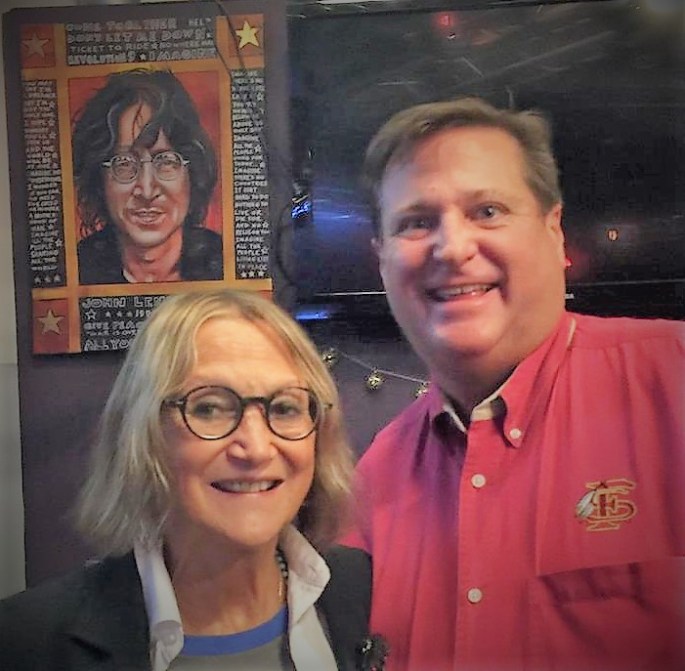
Julia Lennon and JC Bowman at Beatles Tribute

I was too young to really appreciate the British Music Invasion.  However, I became a die-hard Beatles fan in 4th grade, a tradition that I passed down to my children.  Later, I listened and enjoyed the different directions and songs of the individual members of the Beatles.  One of my favorite John Lennon tunes was Mind Games. Lennon nailed it, about how ideologues betray themselves in the clash of competing ideas.

Penny Lane has barbers with photographs, but today trends come with charts and graphs.  Pharisees today would rather stifle debate and only present one side of an issue.  These are people who would sooner ridicule someone, rather than pushing barriers or planting seeds.  In Mind Games, Lennon coined the term mind guerrillas, which was absolutely brilliant.  The mind guerrillas are alive and well. They talk a good game. Unfortunately, a few of them are in our classrooms with captive audience and captive minds.

On both the political right and the left, academic freedom is sometimes erroneously confused with complete autonomy, with thought and speech freed from all constraints. There are definitely limits, and educators have responsibilities.  Students have the freedom to form independent judgments on subjects.  In education, as in life, we must engage differences of opinion, evaluate the evidence, and then form our own individual opinions.  Students have the right to hear and assess diverse views, as long as they are age appropriate and not merely propaganda disguised as information.   American’s have debated the issue historically.  Because of this, in 1840 the Massachusetts Legislature debated the increasing government control over education.

We often see in the media egregious examples of taxpayer dollars being used in ways that seem more in line with indoctrination, rather than mere encouraging independent thought.  We suggest to teachers to be careful in their lessons, unless they are not afraid of it appearing in the local newspaper or nightly news.  In fairness, most educators never have to worry about this issue.  However, let me give you an example of one instance, paraphrased and sent to me by a well-respected classroom teacher:

A local high school was registering students to vote.  This in of itself is a positive step.  It was designed for students to get informed and vote.  However, the person promoting the event didn’t stop there.  She went on a rant about the electoral college system and she said that she thinks it is archaic.  She then proceeded to talk about medical marijuana and said that Tennessee is still Tennessee and that medical pot legalization won’t happen anytime soon. Then, she further highlighted a specific political race between a conservative and a liberal candidate.   Pointing out the virtues of the liberal candidate, and criticizing the conservative.

The teacher closed her email by saying: “I could give many more specific examples, but, again, my goal is not to get anyone in trouble, just to make sure parents aren’t entrusting their children to an institution that is going to push their beliefs in one direction only.”  She then added: “Obviously teachers are going to have diverse political opinions, even strong ones, about all types of issues. My problem is with them pushing those opinions on public school students and the one-sided nature of it.”  That is the heart of the issue, whether it is conservative or liberal.

As educators, it is often hard to keep private personal views out of our public lives—yet we should exercise restraint.  Our education system is not intended for political goals and political purposes, it is intended so that all students are equipped with the knowledge and skills to successfully embark upon their chosen path in life.  We benefit as a society when we develop children with independent critical judgment.  Martin Luther King Jr. poignantly stated: “The function of education, therefore, is to teach one to think intensively and to think critically.”

Chinese leader Mao Zedong wrote:  Politics is war without bloodshed, while war is politics with bloodshed.  When it came to education, Mao stressed that students should have a “correct political point of view.”  That collectivist thought sounds like indoctrination.  John Lennon had a message for that in Revolution, “If you go carrying pictures of Chairman Mao, you ain’t going to make it with anyone anyhow.”

Educators are entitled to their own political opinions.  However, when they are performing official duties they should remain politically neutral.  The youngest citizens of our state and nation who walk through our classroom doors each day deserve to develop their own opinions, be taught to discuss issues respectfully, and not be ridiculed for have a different political or religious belief.  There is a fine line between a teacher sharing their view, or forcing their view on students. It is not the job of the educator to force their point of view on anyone in a classroom or school.

##

JC Bowman is the Executive Director of Professional Educators of Tennessee, a non-partisan teacher association headquartered in Nashville, Tennessee. Permission to reprint in whole or in part is hereby granted, provided that the author and the association are properly cited. For more information on this subject or any education issue please contact Professional Educators of Tennessee.

A Few More Thoughts on Testing in Tennessee…

Icon

Tennessee Commissioner of Education Candice McQueen soundly responded to Metro Nashville Schools Director Shawn Joseph and Shelby County Superintendent Dorsey Hopson very bluntly in a straightforward letter yesterday.  It is doubtful that either Joseph or Hopkins actually wrote the letter, which called for a “pause” in testing and convene a statewide working group of educators to look at testing.  McQueen stated that neither she or Governor Bill Haslam received the letter that got widespread media coverage.  She also pointed out that “both state and federal law require an annual statewide assessment.”

Some may argue that states have more flexibility, which is true to an extent.  We should take a hard look at Tennessee’s ESSA plan and certainly make necessary adjustments.  But we identified our own measures of progress and agreed to take certain actions in order to receive federal monies.  Like that or not, it is how the game is played.  When Tennessee was touting Race to the Top money, the state certainly jumped through even more hoops to get those dollars.

Dr.  McQueen, who serves at the pleasure of the Governor, must follow state and federal laws.    Joseph and Hopson have their own Boards of Education they must listen to on policy issues.  Policy analysts TC Weber and Andy Spears have both weighed in on the subject, as has Sharon Roberts.  Professional Educators of Tennessee added our opinion on the subject.  All stakeholders want to get testing right.  However, the emphasis on testing misses the bigger issue:  student academic growth measured by flawed testing.  Then the results being used in educator evaluations.  This is certainly more problematic to educators than the actual tests themselves.

Once the Tennessee Department of Education gets testing corrected, then we, as a state, can refocus on discussing what should or shouldn’t be included in teacher evaluations.  It is clear:  flawed testing equals faulty evaluations.  This is no way to measure the success or failure of our students, teachers or schools.  This issue isn’t going away.  Stay tuned.

##

 JC Bowman is the Executive Director of Professional Educators of Tennessee, a non-partisan teacher association headquartered in Nashville, Tennessee. Permission to reprint in whole or in part is hereby granted, provided that the author and the association are properly cited. For more information on this subject or any education issue please contact Professional Educators of Tennessee.