What Is a Superintendent of Schools?

1 innovation.jpg

It is often said that the most important role of a board of education is to hire its superintendent. I think that is a somewhat a valid claim. Certainly if you value public education, you must have competent leadership managing the daily operations of the school district. A good superintendent leads the districts educational, financial and administrative performance; facilitates the performance of all personnel; and responds to and informs stakeholders and policymakers about the performance and leadership of the district.

Having met many, if not most, Superintendents of Schools here in Tennessee, I believe we do have some excellent leaders across our state. Probably one of the most important duties of the superintendent is to make sure district students are learning and achieving at the highest level possible. A superintendent must understand effective academic practices and be supportive of the teachers and administrators in the district. Leadership, vision, and strategic thinking are critical skills for every superintendent. A successful superintendent is should also be an effective and excellent communicator. If the only voice a superintendent listens to is his/her own, or a few members of the school board, public education will eventually lose community support.

In the last few years, I have seen some horrifying treatment of Superintendents across the state. I have seen them maligned by anonymous message boards, attacked in the media, belittled by their own school board members, often unfairly. I am reminded of Mark Twain’s quote: “Great minds talk about ideas; good minds talk about events; small minds talk about people.”

Does that mean that we simply accept decisions from superintendents, without challenging them? Of course not! We must particularly hold them accountable in regard to educational, financial and administrative performance. However, we should provide them latitude in regards to leadership, vision and strategic thinking on how to address the performance in those areas. And we must expect them to communicate effectively to all stakeholders.

The American Association of School Administrators suggests that the superintendent, like principals, must also demonstrate a keen understanding of teaching, learning and what works for students. As a change leader, a successful superintendent should emphasize the efficient use of resources, personnel, and data to break down resistance and drive systemic change; empower board and personnel to set goals, measure results, develop accountability, and support planning, evaluation, and resource allocation.

Our state has made some incredible strides in public education. It is an accomplishment that we should admire and respect. It begins with the men and women in the classroom across this state, and we must also acknowledge the hard work of those who lead our schools.

##

JC Bowman is the Executive Director of Professional Educators of Tennessee. Professional Educators of Tennessee, a non-partisan teacher association headquartered in Nashville, Tennessee. Permission to reprint in whole or in part is hereby granted, provided that the author and the association are properly cited.

The Role of a School Board

Fotolia_1877783_Subscription_XL.jpg

Education is primarily a state and local responsibility in the United States. Most Tennesseans support local control of public education by the district board of education. This includes the autonomy of the local school district to adopt curriculum, assessments and programs to meet recognized educational goals and objectives. The most important role of a board of education is to hire its superintendent.

It is clear in the Tennessee Constitution that the responsibility for control and support of public schools is delegated in the Tennessee General Assembly, while in large measure the operation is entrusted to local school boards. The school board is the community’s watchdog on public education, thus ensuring that taxpayers get the most for their tax dollars. Taxpayers must hold school board members accountable for spending and results. School boards represent the public’s voice in public education.

Local school boards reflect the needs and aspirations of the communities as well as the interests and concerns of professional and nonprofessional employees. We believe non-partisan control is what is best for our communities. This is best ensured when educational policy is made by representatives vested in the community they live, and whose undivided attention and interests are devoted strictly to education of the children in that district. What we stress in a nutshell: Public education is a federal concern, a state responsibility, and a local operation.

State and federal education policies should be designed to assist local school districts in improving student achievement for all children and not be disguised as a means to label public schools as failures. Prior to any state or federal intervention based on a school’s or district’s failure to meet performance or accountability standards, governments should ensure that local schools and districts receive the necessary resources, support and time to improve. Tennessee, to its credit, has done a lot right in public education. However, no system is perfect.

The authority of the local school board is established in code, and this authority should not be delegated to others. Local boards of education must not relinquish their governance responsibilities in any situation, especially in management and oversight. We believe all children should have equal access to an education that maximizes his or her individual potential.

School boards are subject to the requirements of existing law are the governing and policymaking bodies for schools in their district. They should refrain from agreements that compromise their responsibility for representing general public interest in education. Local boards (should) know the unique and varied needs of their communities. They must also work with local governance to further the goals of the school district. Professional Educators of Tennessee are also glad to assist school board members when they reach out for assistance.

School boards must embody the community’s beliefs and values. School board members should be as diverse as the citizens they serve. We should thank the men and women who are serving our communities as school board members. They are too often unappreciated, and it is often a thankless but needed job.

Unfortunately, there are some people who end up on school boards who do not understand their unique role, and we should look at increased training to assist them in increasing their knowledge. The Tennessee School Board Association can play a significant function in that effort.

We should also encourage high character men and women in that want to serve the community to consider seeking a position on the school board. We need passionate people committed to children and those who teach them, looking out for each community’s interest. Are you ready to serve?

##

JC Bowman is the Executive Director of Professional Educators of Tennessee, a non-partisan teacher association headquartered in Nashville, Tennessee. Follow him on Twitter @jcbowman. Permission to reprint in whole or in part is hereby granted, provided that the author and the association are properly cited.

Betray the Age

Quotefancy-2823916-3840x2160

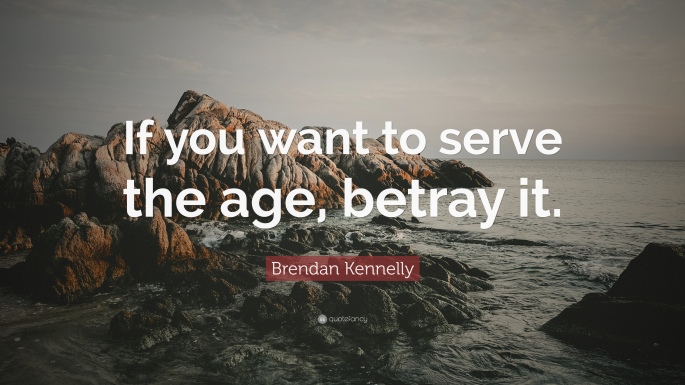
One of my musical heroes, Bono, the singer for the rock group U2, shares the story of the Irish poet, Brendan Kennelly. He relates that Kennelly has a memorable poem called The Book of Judas, and there’s a line in it that says: “If you want to serve the age, betray it.”

Then Bono asks: “What does that mean, to betray the age?”

Answering the question, Bono says: “Well to me betraying the Age means exposing its conceits, its foibles, its phony moral certitudes. It means telling the secrets of the age and facing harsher truths.”

Prevailing wisdom says that it is no measure of mental health to be well adjusted to a profoundly sick society. Every day in Tennessee, educators are challenged by a wide-ranging mixture of social, psychological, and physical problems that impede the improvement of so many students entrusted into their care.

Unfortunately for educators, policymakers worry about the results of a test given at the end of every school the year, used so that we can measure the effectiveness of those teachers educating children. We have made textbook companies and test publishers prosperous, while we engage in a rigorous debate over trivial items.

We eagerly listen to wealthy philanthropists (or organizations representing them) that lack the prerequisite background in the policy areas that they are influencing. By virtue of their wealth, they have gained an unfair advantage, as well as access to policymakers. They then promote public policies by the access of their political donations and may not even understand the problems average people face. In education, they certainly do not understand the challenges confronting public school educators.

For example, Tennessee is the 12th poorest state based on the last US Census figures. Even more startling is that the child poverty rate is 26%. So when the philanthropist experiences donor fatigue and migrates to their next passing interest, educators will still be here to do what God has gifted them to do — which is to educate and demonstrate compassion for the children of our state.

The late political theorist Hannah Arendt wrote, “No cause is left but the most ancient of all, the one, in fact, that from the beginning of our history, has determined the very existence of politics, the cause of freedom versus tyranny.” When political donations replace the contributions of men and women from controlling their own destiny, tyranny will gain a stranglehold in our society.

If we oppose state control of the means of production, it stands to reason that production in the hands of a few would also be undesirable. Politicians understand it is much easier to make laws than repeal them. Too often the extremes on both ends of the political spectrum are heard and the majority of people get silenced.

Every age has moral blind spots, with issues such as slavery, discrimination, unequal pay between sexes, and religious intolerance. Still, my Irish heritage compels me to believe in the idea that anything is possible when we embrace freedom.

The question for educators is this: where are we willing to spend our moral and intellectual capital, our money, or our sweat equity outside of the walls of our classroom or homes?

In a field as diverse as public education, we must all collaborate together to foster a more constructive dialogue among education stakeholders and policymakers. We share a common destiny. We have the power to create amazing change in this world and be champions for the vulnerable who cannot speak for themselves when they need us the most.

This is the time for bold measures. This is Tennessee and we are the generation of Educators to bring change, not only to our profession but to all of our society. Betray the Age.

##

JC Bowman is the Executive Director of Professional Educators of Tennessee, a non-partisan teacher association headquartered in Nashville, Tennessee. Follow him on Twitter @jcbowman. Permission to reprint in whole or in part is hereby granted, provided that the author and the association are properly cited.  His Blog is at http://www.jcbowman.com 

Killing Public Education

1teacher-education

Bill O’Reilly has gone on quite a killing spree. He has written books such as Killing the Rising Sun, Killing Reagan, Killing Patton, Killing Jesus, Killing Kennedy and Killing Lincoln. I think he should also write one called Killing Public Education.

Here is what is killing public education:

  1. A Culture of Disrespect is rampant in our schools. This can be created by a variety of reasons. Lack of respect for a profession, which is roughly 80% female. Too many people incorrectly believing that anybody can be a teacher. The very structure of our public education system, as well as the state of our society, often means educators are the major authority figure in many children’s lives. This necessitates that educators are on the frontlines of the culture wars. This result in an ugly fact: teachers provide the only correction or discipline some children ever receive. This leads to a negative perception of teachers and public education in general.
  2. The struggles that most educators face are daunting. Poverty is rampant in our nation and it is particularly obvious in our Southern states. One high school principal told me: “My school has very high poverty and mobility rates. We can’t continue to blame failure on teachers and principals. Families are failing and the evidence of that damage is clear. We love our students and are dedicated to them. Honestly, I don’t know what the answer is anymore. Eradicate poverty seems to be the obvious solution.” However, government has been trying to address this issue for well over 50 years. And it really hasn’t improved the situation. Family structures are being redefined and crumbling.
  3. We have become so driven by standards, testing and accountability that we have lost sight of what truly matters: children and those who educate our children. Testing has become big business; it is no longer merely a snapshot on a child’s progress. Data is the gold standard. We care more about what data tells us, than what a teacher tells us. And what do we know about the people creating the tests and interpreting the data? Data is not more important than children, or those that teach them. British Prime Minister Benjamin Disraeli said: “There are three kinds of lies: lies, damned lies, and statistics.” Perhaps we are not looking at the right statistics.

Educators know what needs to be done to improve education. Unfortunately, their voices have too often been replaced by philanthropists, business leaders and outside organizations. Often these “outside influencers” are driven by poor understanding of the issues, self-serving interests or in some cases greed.

The argument often used to counter the power of educators is that public education needs to be run more like a business and be more efficient. These arguments often fail to consider the “inside influencers” of district policy, state policy, and federal rules, laws and controls which often end up essentially micro-managing our local schools.

If we do not want to kill public education, the teaching profession must be elevated in stature. Educators must be seen as community leaders both inside and outside of the classroom. Far too often the voices of classroom teachers are not included in the decisions that impact their livelihood or their students. Few occupations are given so little say in their chosen field.

Let’s not wait until the autopsy or until Bill O’Reilly writes another book to explain that educators must be given a more active role in determining the policies that concern their students and the teaching profession. It is imperative that that we accept and nurture the teacher-leaders we already have and look to them for the guidance we need to improve education.

##

JC Bowman is the Executive Director of Professional Educators of Tennessee, a non-partisan teacher association headquartered in Nashville, Tennessee. Follow him on Twitter @jcbowman.

You Did It!!

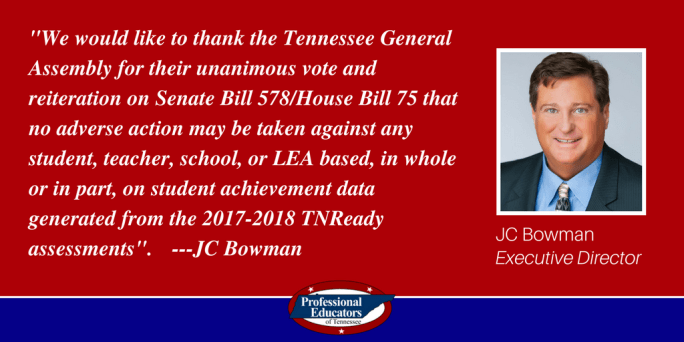
Last night I watched legislators—on both sides of the political aisle, whether you agree with them or not, bust their butts; I witnessed Educators: teachers, administrators and Superintendents—across the state, individually and completely on their own initiative work for a common goal; I saw parents using all means at their disposal to work for the same objective; and, I observed a beleaguered Department of Education also work to get this done with all of us. It was beautiful. No adverse action may be taken against any student, teacher, school, or LEA based, in whole or in part, on student achievement data generated from the 2017-2018 TNReady assessments. Perfect? No. But we will take it. So when the union comes along and claims credit for this work. Remind them: The effort belongs to all of us. We simply serve to protect our kids, educators and schools. We are public education. And together we all accomplish more. —– JC Bowman.

Unanimous Vote Senate Bill 578/House Bill 75

We are pleased that legislators unanimously provided that students, educators or schools will not be held responsible for unreliable results from the failures of the TNReady online assessment platform this year.

JC's Blurb 10

We Can’t Hide from the Tough Issues

Heftiger Disput

Problems are seemingly growing more and more complex, or are they?  In yesterday’s commentary,  Legislators – One Last Thing Before You Go!, we wanted to make sure our teachers are not going to be penalized by flawed test results and scores from this year on a teacher’s 3-year average.  It seems like it should be a simple fix, but actually is a little more complex.  That is what legislators must regularly balance in decision-making in the Tennessee General Assembly.  In public policy it isn’t always a struggle between right and wrong.  There is rarely a perfect solution.

We are very pleased that the Tennessee General Assembly wanted to hold students, educators and school districts harmless.  It really is a hold harmless, provided school districts in fact do not use test data into employment decisions like promotion, retention, termination, compensation—or even an improvement plan. It seems clear that the intent of the legislature was to ensure that the scores couldn’t harm teachers or students in any way, so we think this is an important part emphasized in SB 1623/HB1981.  However, we argued that they just missed a critical component, which is true.  Test results from this year still affect their scores and 3-year averages.

Here is the dilemma:  if we do not use this year’s TVAAS for teachers it would also likely hurt some teachers from gaining tenure.   And that too, is unacceptable and unfair.   So accordingly, this year’s data only counts as 10%, last year at 10% and the previous year at 15% to make up the 35% of the evaluation.   Teachers can use last year or this year as the full 35% if it helps the teacher.   They must have that data as part of their evaluation or the results can’t be used.  So, to be clear, a school district cannot use that flawed data, but a teacher can.  School districts cannot base employment termination and compensation decisions for teachers on data generated by these statewide assessments.  So, do legislators change the law they just passed, try to modify, or leave it be for now?  That is the discussion that they must have this week.

Legislators would be negligent if they do not further discuss the issue. They may choose to just take the fleas with the dog.  They have done excellent work on this issue to protect teachers, and they deserve the credit.  In the end the lesser of disappointing options is to leave in place what was passed.  We understand that choice.  In a perfect world we would have had perfect execution of the TNReady Test by our vendor Questar.  Then we would not be talking about flawed data, impact on 3-year averages or tenure. However, three things are almost certain on the campaign trail in 2018, especially in state races:

  • The continued feasibility of using a complicated statistical method as an evaluation tool for teachers will certainly be further debated by stakeholders and policymakers in the foreseeable future. Do we continue using The Tennessee Value-Added Assessment System (TVAAS)? Move to another more reliable statistical method?  Or do we abandon these complicated formulas altogether?
  • States are allowed to use federal funds, but no longer required, to continue teacher evaluations linked to test scores. Only a handful of states took advantage of the testing flexibility Every Student Succeeds Act (ESSA) allows.  In fact, the US Secretary of Education is explicitly prohibited from mandating any aspect of a teacher evaluation system.  So, will our state continue linkage of test scores to evaluation moving forward? Or will we end the practice?
  • Do we continue moving toward an online test, or do we yet again revert strictly to paper and pencil or some combination of the two?

Sometimes issues are complex, and the simple solution is not possible.  Simon Sinek, wrote: “There is no decision that we can make that doesn’t come with some sort of balance or sacrifice.”  This may be a case where the right solution is based on flawed data may be a right solution.  Then again, we may be all be wrong.  Let the debate continue.

##

Audrey Shores is the Chief Operating Officer of Professional Educators of Tennessee.   JC Bowman is the Executive Director of Professional Educators of Tennessee, a non-partisan teacher association headquartered in Nashville, Tennessee. Permission to reprint in whole or in part is hereby granted, provided that the author and the association are properly cited. For more information on this subject or any education issue please contact Professional Educators of Tennessee.


The Changing Face of Advocacy

hellios

According to the Greek Mythology, the god, Helios, would put the Sun in a chariot and drive it through the sky each day.  That is how the Sun would rise and set.  Today, we would scoff at such a notion and understand that such a feat would be impossible.  We would think that people who would believe such a notion probably were not very intelligent and extremely gullible.  Such is the story of modern day lobbyists and advocates.

Frank R. Baumgartner, a Professor of Political Science at the University of North Carolina at Chapel Hill says there is no consistent correlation between money spent on lobbying and outcomes.  In his book, Lobbying and Policy Change: Who Wins, Who Loses, and Why, Baumgartner effectively proves that lobbyists are far less influential than political rhetoric suggests and that they fail to change policy despite millions of dollars spent trying. As to the why?  He points to an “entrenched system” with an enormous “bias in favor of the status quo.”

I have been on the forefront of policy change for over a quarter of a century, advocating for education.  It means that I have witnessed much the last three decades in Tennessee. I have seen policymakers come and go.  I have seen lobbyists come and go.  Next year, in 2019, we will see a new US Senator, a new Governor and perhaps as many as 35 new state legislators.  Campaign contributions, as important as those may be to the candidate, mean very little in the current system.  Money no longer “buys” votes, and it should never have done so in the first place.  Politicians now often receive contributions from interests on both sides of any issue.

It is amazing with the vast array of people lobbying on an issue that anyone or any group should take credit for the passage of any legislation.  The truth is that it is always a coalition of stakeholders building a compelling case on a political issue.  In the end, only the legislator votes.  So, any person or group who claims credit for a passage of legislation needs to be reminded of that truth.

In the end, we build coalitions work together, educate legislators on issues and count votes.  The legislator is the decisionmaker.  Advocates have three numbers you have to reach – 50, 17 and one:  50 votes in the House of Representatives, 17 in the Senate, and one from the Governor.  Only the Tennessee General Assembly deserves credit or blame for the passage of legislation.  In all the years that I have worked with legislators, I truthfully have found most to be honest, hard working people who want to do the right thing for their constituents.  I have also seen some who really do not listen, and these usually do not last long in the political arena.

The key to effective advocacy is relationships, which must be developed and also sustained.  Building relationships with lawmakers and other stakeholders means getting to know them, their personal interests and histories, and even their families. Having a relationship never guarantees support, but it does help to ensure that others will listen to you.  We must build networks and coalitions, around the objective of helping those you serve.  Stakeholders know what is likely to be taken serious by policymakers, sometimes just by whom introduces it, or who carries the legislation for the lobbyists.  We must also know how to correctly draft legislation to assist lawmakers who are overwhelmed during session.  We frequently see people try to put things in the wrong part of the code or use the wrong terminology. Advocates must identify people who support changing a policy and are willing to testify.  Those who advocate or lobby have to be taken seriously at the Capitol.  Then there is media coverage, which is a whole separate issue.  The media will cover an issue if they think voters or their audience are interested in the subject.

In advocacy, we have to be honest and transparent.  We have to tell the truth.  People can spot a snake-oil salesman a mile away.  A Cheshire cat grin and a fake tan will only take you so far.  Legislators do not like being lectured to when you testify.  The biggest mistake I see is when a know-it-all goes before a committee arrogantly and moralizes and lectures legislators.  People talk.  Just answer the question when asked, and don’t pontificate to hear your own voice by expounding on unrelated issues.  Conceit, excessive pride, combined with arrogance is called hubris.

When we engage in grassroots and direct advocacy with policymakers and key influencers around the state on behalf of public education policies, it reminds us that we live for a far greater purpose than just ourselves. Our impact is immeasurable and transforming.  It not only matters to the profession and our educators, it also matters to children and families across Tennessee.

Our experience here in Tennessee ensures our members’ concerns are heard at the Tennessee General Assembly and by other stakeholder groups. It also means we work with other groups on goals we want to achieve: some long-term, some short-term.  By doing this, we witness and help facilitate minor and major shifts in education policies and observe and work with changing political leaders.  And we must remember, these new education policies can have a positive or negative impact on educators or children.  We work the entire year focused on the priorities of our organization and our members.  However, we do not do it alone.  We accomplish our goals by working with others and through elected officials.

Leaders also need mountains to climb.  We and they also realize that they cannot solve every problem on our own. Leadership is about giving.  Great leaders understand that leading others means serving others.  The one question leaders must ask themselves: are you interested in finding solutions for today’s challenges? Then learn to work with others to benefit those you serve, without worrying about who gets credit.  It is a hard lesson to learn for some.  The sun will still come up, even if you don’t get the recognition.

##

JC Bowman is the Executive Director of Professional Educators of Tennessee, a non-partisan teacher association headquartered in Nashville, Tennessee. Permission to reprint in whole or in part is hereby granted, provided that the author and the association are properly cited. For more information on this subject or any education issue please contact Professional Educators of Tennessee.

Special Education Teachers Are Also Special

overworked teacher

It is becoming tough to keep special education teachers in the field beyond two or three years.  We already have a shortage and it is likely to get worse in the future.  Teaching is demanding enough, but special education teachers must cope with even more challenges.  Professional learning is rarely aligned to special education teachers’ needs. Special education teachers face more parental interaction, longer hours, potential lawsuits, additional paperwork, while their students need more attention.  The slogan “work more, same pay” is not exactly a great selling point in teacher recruitment.

The federal Individuals with Disabilities Education Act, or IDEA, requires that every student have what’s known as an IEP — Individualized Education Program.  The IEP involves hours and hours of filling out forms and writing reports documenting each student’s progress.  Recently the Tennessee State Board of Education, in the name of greater transparency, has proposed a rule that may actually create more problems for Special Education Teachers.

The Proposed Rule:  The LEA must notify the parents of a child with a disability at least ten (10) days before an IEP meeting to ensure that a parent will have an opportunity to attend. A meeting conducted pursuant to 34 C.F.R. §300.530(e) may be conducted on at least twenty-four (24) hours’ notice to the parents. If the LEA prepares a draft IEP prior to the IEP meeting, a copy shall be provided to the parent(s) of the child at least twenty-four (24) hours prior to the scheduled meeting time. The copy of the draft IEP shall become the property of the parent(s). If the LEA prepares a draft IEP prior to the IEP team meeting, the LEA shall make it clear to the parents at the outset of the meeting that the services proposed by the LEA are preliminary recommendations for review and discussion with the parents. It is not permissible for the LEA to have the final IEP completed before an IEP Team meeting begins.

Many, but not all, districts provide parents with a draft prior to the IEP meeting, if requested, and with a reasonable timeline.  However, it would not be appropriate or reasonable to mandate that districts provide a draft prior to all IEP meetings.  Here are a few of the concerns, suggestions and questions that have been put forth by our members:

  • May discourage LEAs from creating drafts, which would lead to longer, less structured IEP meetings and may increase the likelihood of procedural errors.
  • May result in LEAs having to hold separate IEP meetings, which could delay initial services up to 30 days after initial eligibility, in order to give time to have a draft ready.
  • Currently, there is no means of documenting LEAs’ compliance as drafts are removed from EasyIEP system after 30 days or when final IEP is created
  • Places undue paperwork burden on already paperwork-heavy sped teachers.
  • May send information that is confusing to parents without having immediate access to professionals who can help interpret or give meaning to info in IEP.
  • May result in fewer parents attending IEP meetings as perception would be that IEP is already completed and their attendance is not necessary.
  • May lead to meetings starting with an adversarial tone.
  • Not all IEP team members are staffed at the same school, making it impossible for them to convene with the other IEP team members to collaborate on the draft 24 hours prior to the meeting.

Looking at the Individuals with Disabilities Education Act and new regulations, an LEA should provide the parents with a copy of its draft proposals, if the LEA has developed them, prior to the IEP team meeting.  Parents deserve an opportunity to review any recommendations prior to the IEP team meeting, in order that they may be better able to engage in a full discussion of the proposals for their child.  It is already not permissible for an LEA to have a final IEP completed before an IEP meeting.  Parents should be able to request a copy of any draft documents prior to an IEP team meeting. However, it is critical to be reminded that not all IEP team members are staffed at the same school, and it may be impossible for them to convene with the other IEP team members to collaborate on the draft 24 hours prior to the meeting.  This creates twice the work for teachers.

Which brings us back full circle.  We subscribe to the philosophy of “All Means All” in public education, which means we educate each and every one of our students to the highest level possible.  If we continue to overwhelm special education teachers when we already have a special education teacher shortage by adding to their workload, recruitment and retention challenges will only escalate.  Then students with disabilities will never attain their full academic potential especially if teachers with no special education background are placed in their classroom.  The proposed IEP policy, as currently being suggested needs work.  This may well be a legislative item in 2019.

##

JC Bowman is the Executive Director of Professional Educators of Tennessee, a non-partisan teacher association headquartered in Nashville, Tennessee. Permission to reprint in whole or in part is hereby granted, provided that the author and the association are properly cited. For more information on this subject or any education issue please contact Professional Educators of Tennessee.