Chaos is a Ladder

Alinsky-Littlefinger_840x480

I am unapologetically a fan of the HBO series Game of Thrones.  In the episode, “The Climb,” the overly ambitious character, Petyr Baelish, aka Littlefinger, played masterfully by Aiden Gillen, delivers a speech that is eerily reminiscent of Saul Alinsky:

“Chaos isn’t a pit. Chaos is a ladder. Many who try to climb it fail and never get to try again. The fall breaks them. And some are given a chance to climb; they cling to the realm or the gods or love. Only the ladder is real. The climb is all there is.”

Essentially, Littlefinger is supporting a moral code that says everyone ought to be out for themselves. The only purpose in life is to gain power. Sound familiar?  Power can only be accumulated through chaos, by using upheaval to rearrange things so that you gain power.  The speech reads like a paragraph out of Rules for Radicals, with the word chaos replacing the word conflict.  Issues such as patriotism, love, religious faith – are all things to be denigrated.

For Littlefinger, a character loathed by most fans, the tearing of the realm can create opportunities. For people who subscribe to his, or Alinsky’s theories on accumulating power for the sake of accumulating power, what is there left to rule over when you have destroyed the world?  In 1972 as Alinsky was questioned by Playboy, the interviewer asked him: “Do you believe in any kind of afterlife?” Alinsky said if there was an afterlife he would “unreservedly choose to go to hell.” And while further explaining his answer:  “Once I get into hell, I’ll start organizing…”

Emma Goldman, an anarchist in the first half of the twentieth century declared, “Religion, the dominion of the human mind; Property, the dominion of human needs; and Government, the dominion of human conduct, represent the stronghold of man’s enslavement and all the horrors it entails.” That radical response, which is embraced by Marxists, should be alarming to those in our country.

The levels of hypocrisy of most, who seek conflict, rather than attainable solutions to issues facing people, are rarely confronted. People should not be afraid to talk about their beliefs, stick up for those in the faith community who are under attack, and call out bigotry whenever or wherever we find it.  When you want chaos or conflict, your goal is to continue the creation of problems, not find solutions to real problems.   And if problems do not exist, you make them up. That is why some organizations and institutions are increasingly losing members, support and influence.

For example, in our organization and on a personal level we try to map-out a path toward a viable and sustainable solution on issues facing our members. Just recently, we were made aware of school district that had too many students in their class for a teacher.  Our solution was not to go to the media and have the school district on the defense.  We didn’t get on the school board agenda, and send letters to our members to embarrass the Superintendent.  We simply called and talked to the Central Office.  The problem was resolved in 5 minutes.  The Director of Schools was simply unaware of the issue.  That is leadership, and it doesn’t have to be built on pointless or unnecessary conflict.

Resolving issues is about people working together to resolve legitimate concerns. There are no hidden agendas when you build a culture motivated upon collaboration and problem solving.  As an organization, our beliefs are practical and non-partisan, consisting of rational people across a broad political spectrum who will focus on solutions for our members.  A solid strategy is critical in order to solve any problem.  If your problem-solving creates chaos, that is a sign of a serious leadership problem.  This never-ending cycle is not conducive to the adversity most people face.  Solving problems consist of the transparent exchange of ideas, where the concerns and points of view of all people are freely expressed, not just those of the militant minority.

To relate this to my field of public education, we have to engage parents and taxpayers more on the great challenges we face.   We cannot engage in frivolous lawsuits against our own school districts and expect Boards of Education to be responsive to legitimate concerns.  Public education fails, when Alinsky tactics win.  It isn’t hard to figure that out.  We must work together.

In a Game of Thrones episode from this past season, “The Spoils of War,” Bran Stark perhaps mockingly uses Littlefinger’s own words against him: “Chaos is a ladder.”  This statement reveals that Bran understood the very heart of a master manipulator Petyr Baelish.  He knows that Littlefinger is a self-centered, promoter of himself, more interested in power-plays and schemes, and being deceptive.

Petyr Baelish, will never hear the announcement, “Littlefinger, First of His Name, King of the Andals and the First Men, Lord of the Seven Kingdoms, and Protector of the Realm.” He may be organizing hell with Alinsky, still in the middle of chaos—and there is no ladder there.

##

JC Bowman is the Executive Director of Professional Educators of Tennessee, a non-partisan teacher association headquartered in Nashville, Tennessee. Permission to reprint in whole or in part is hereby granted, provided that the author and the association are properly cited. 


Beyond Alinsky

Alinsky-dedication

There is no doubt that the “community organizing” methods and philosophy developed by Saul Alinsky have had a penetrating effect on our politics. However, has it made government more responsive or improved results for citizens?  That is highly doubtful.

What happens when Saul Alinsky and his tactics do not go far enough for you?

We are probably about to find out. There are seemingly no longer limits to acceptable behavior in society, no moral conscience for some people and Alinsky’s radical “methods” are now the new normal. Combined with the usual Orwellian double-speak from those trained in Alinsky tactics. They can attract the gullible.

Alinsky famously referenced his admiration for Lucifer in his book Rules for Radicals. I really do not care to speculate what the motivation was; it is in front of the book.  Alinsky adhered to a Marxist ideology.  People should read Rules for Radicals for themselves.  Some of the rules that are often cited, and are subsequently employed regularly are:

  • “Make the enemy live up to its own book of rules.”
  • “Ridicule is man’s most potent weapon.”
  • “If you push a negative hard enough, it will push through and become a positive.”
  • “Pick the target, freeze it, person­alize it, and polarize it.” Cut off the support network and isolate the target from sympathy. Go after people and not instit­utions; people hurt faster than instit­utions.

The objective of most community organizers is to inject politics into every issue, every debate. It is dangerous to induce immoral and scrupulous tactics solely for political gain for the “militant minority.”  One overarching goal is never-ending conflict.  They simply move from issue to issue.

The reaction community organizers seek: is to identify activists, who can build a larger, more robust militant minority within organizations they control.  This warped strategy leaves the majority of people in organizations impacted by community organizers pushing this radical agenda underserved.   This approach is why so many labor unions are dying, as they only exist to serve the excessively bureaucratic union leadership.  This leadership often encompasses a socialist agenda at odds with a majority of the members.

The question for all of us, is how far is too far? In the world of Alinsky, “organizing” is simply the revolution.  Who leads the revolution?  The community organizers who control the radicals/militant minority will be the leaders.  And for many, Alinsky is just a stepping stone for the next wave of issues that will emerge.  And the organizer knows that there can be no action until those “issues are polarized.”  There is no solution possible, when conflict never ends.

##

JC Bowman is the Executive Director of Professional Educators of Tennessee, a non-partisan teacher association headquartered in Nashville, Tennessee. Permission to reprint in whole or in part is hereby granted, provided that the author and the association are properly cited.
More Than Just A Test Score

test score girl

“Public Education” is on the lips of every politician, during every election cycle. Yet, the debate continues. It is doing well, it is doing poorly, it needs reform, whatever the narrative needs to be that day or what the audience wants to hear.

Well, there are three sides to every story: “Yours, mine, and the cold, hard truth,” like the old Don Henley song reminds us. Out of the roughly 55.5 million K-12 students in America, 49.5 million of them are in our public schools, which is a little over 89%. If you visit a public education classroom today, you would be amazed at what our educators do on a daily basis.

We must remind ourselves we are not producing components for an industrial and societal machine. We are educating children. We can all agree that an engaging and challenging education is the proven path to prosperity and a life-long love of learning. Teachers consistently tell us that “testing” and “preparing students for a test” are among their top concerns in our internal surveys.

It has long been acknowledged that a strong public educational system is essential not only to the successful functioning of a democracy, but also to its future. That system must provide all children with an equitable and exceptional education that prepares them for college, career and life.

Educators, themselves, must exercise a higher duty of care than most professionals. Teachers face exposure to liability much greater than does the average citizen. Nearly every day, teachers must deal with diverse laws related to issues such as child abuse, student discipline, negligence, defamation, student records and copyright infringement. And many politicians are more concerned with a test score that their children produce than the immeasurable impact that teachers may make on a child’s life.

Often educators must contend with the fact that students do not have a consistent source of high-quality, nutritious food, if they have food at all at home. Issues like hunger and poverty, like it or not, are not imagined and they are prevalent in classrooms and schools across the nation. According to the United States Department of Agriculture (USDA), 15.3 million children under 18 in the United States live in households where they are unable to consistently access enough nutritious food necessary for a healthy life. These 8 states have statistically higher food insecurity rates than the US national average (14.6%): Arkansas (21.2%), Mississippi (21.1%), Texas (18.0%), Tennessee (17.4%), North Carolina (17.3%), Missouri (16.9%), Georgia (16.6%), and Ohio (16.0%). More than 1 in 5 children is at risk of hunger. Among African-Americans and Latinos, it’s 1 in 3 according to the USDA.

It is hard to focus on education when you are hungry. Poverty and hunger also lead to other health issues, which also go untreated. What other profession besides public education teacher is evaluated on their students’ test scores, when students lack the basic necessities of life?

Steve Turner in his brilliant satirical poem “Creed” referenced the state of our culture, when he wrote prevailing illogical thought processes: “This is the fault of society. Society is the fault of conditions. Conditions are the fault of society.” Seemingly educators bear the brunt of the outcomes of children, and society is a given a pass. The problems we confront are larger than the children walking through the school house door.

The solutions are more than a score on a test. So, when the next politician speaks about education when seeking your vote, ask them what their plans are to alleviate poverty and hunger in your community. That is much more important than test scores to a whole lot of families.

#####

JC Bowman is the Executive Director of Professional Educators of Tennessee, a non-partisan teacher association headquartered in Nashville, Tennessee. Permission to reprint in whole or in part is hereby granted, provided that the author and the association are properly cited.  Check out his Blog at http://www.jcbowman.com.  Follow him on Twitter @jcbowman

What Is a Superintendent of Schools?

1 innovation.jpg

It is often said that the most important role of a board of education is to hire its superintendent. I think that is a somewhat a valid claim. Certainly if you value public education, you must have competent leadership managing the daily operations of the school district. A good superintendent leads the districts educational, financial and administrative performance; facilitates the performance of all personnel; and responds to and informs stakeholders and policymakers about the performance and leadership of the district.

Having met many, if not most, Superintendents of Schools here in Tennessee, I believe we do have some excellent leaders across our state. Probably one of the most important duties of the superintendent is to make sure district students are learning and achieving at the highest level possible. A superintendent must understand effective academic practices and be supportive of the teachers and administrators in the district. Leadership, vision, and strategic thinking are critical skills for every superintendent. A successful superintendent is should also be an effective and excellent communicator. If the only voice a superintendent listens to is his/her own, or a few members of the school board, public education will eventually lose community support.

In the last few years, I have seen some horrifying treatment of Superintendents across the state. I have seen them maligned by anonymous message boards, attacked in the media, belittled by their own school board members, often unfairly. I am reminded of Mark Twain’s quote: “Great minds talk about ideas; good minds talk about events; small minds talk about people.”

Does that mean that we simply accept decisions from superintendents, without challenging them? Of course not! We must particularly hold them accountable in regard to educational, financial and administrative performance. However, we should provide them latitude in regards to leadership, vision and strategic thinking on how to address the performance in those areas. And we must expect them to communicate effectively to all stakeholders.

The American Association of School Administrators suggests that the superintendent, like principals, must also demonstrate a keen understanding of teaching, learning and what works for students. As a change leader, a successful superintendent should emphasize the efficient use of resources, personnel, and data to break down resistance and drive systemic change; empower board and personnel to set goals, measure results, develop accountability, and support planning, evaluation, and resource allocation.

Our state has made some incredible strides in public education. It is an accomplishment that we should admire and respect. It begins with the men and women in the classroom across this state, and we must also acknowledge the hard work of those who lead our schools.

##

JC Bowman is the Executive Director of Professional Educators of Tennessee. Professional Educators of Tennessee, a non-partisan teacher association headquartered in Nashville, Tennessee. Permission to reprint in whole or in part is hereby granted, provided that the author and the association are properly cited.

The Role of a School Board

Fotolia_1877783_Subscription_XL.jpg

Education is primarily a state and local responsibility in the United States. Most Tennesseans support local control of public education by the district board of education. This includes the autonomy of the local school district to adopt curriculum, assessments and programs to meet recognized educational goals and objectives. The most important role of a board of education is to hire its superintendent.

It is clear in the Tennessee Constitution that the responsibility for control and support of public schools is delegated in the Tennessee General Assembly, while in large measure the operation is entrusted to local school boards. The school board is the community’s watchdog on public education, thus ensuring that taxpayers get the most for their tax dollars. Taxpayers must hold school board members accountable for spending and results. School boards represent the public’s voice in public education.

Local school boards reflect the needs and aspirations of the communities as well as the interests and concerns of professional and nonprofessional employees. We believe non-partisan control is what is best for our communities. This is best ensured when educational policy is made by representatives vested in the community they live, and whose undivided attention and interests are devoted strictly to education of the children in that district. What we stress in a nutshell: Public education is a federal concern, a state responsibility, and a local operation.

State and federal education policies should be designed to assist local school districts in improving student achievement for all children and not be disguised as a means to label public schools as failures. Prior to any state or federal intervention based on a school’s or district’s failure to meet performance or accountability standards, governments should ensure that local schools and districts receive the necessary resources, support and time to improve. Tennessee, to its credit, has done a lot right in public education. However, no system is perfect.

The authority of the local school board is established in code, and this authority should not be delegated to others. Local boards of education must not relinquish their governance responsibilities in any situation, especially in management and oversight. We believe all children should have equal access to an education that maximizes his or her individual potential.

School boards are subject to the requirements of existing law are the governing and policymaking bodies for schools in their district. They should refrain from agreements that compromise their responsibility for representing general public interest in education. Local boards (should) know the unique and varied needs of their communities. They must also work with local governance to further the goals of the school district. Professional Educators of Tennessee are also glad to assist school board members when they reach out for assistance.

School boards must embody the community’s beliefs and values. School board members should be as diverse as the citizens they serve. We should thank the men and women who are serving our communities as school board members. They are too often unappreciated, and it is often a thankless but needed job.

Unfortunately, there are some people who end up on school boards who do not understand their unique role, and we should look at increased training to assist them in increasing their knowledge. The Tennessee School Board Association can play a significant function in that effort.

We should also encourage high character men and women in that want to serve the community to consider seeking a position on the school board. We need passionate people committed to children and those who teach them, looking out for each community’s interest. Are you ready to serve?

##

JC Bowman is the Executive Director of Professional Educators of Tennessee, a non-partisan teacher association headquartered in Nashville, Tennessee. Follow him on Twitter @jcbowman. Permission to reprint in whole or in part is hereby granted, provided that the author and the association are properly cited.

Betray the Age

Quotefancy-2823916-3840x2160

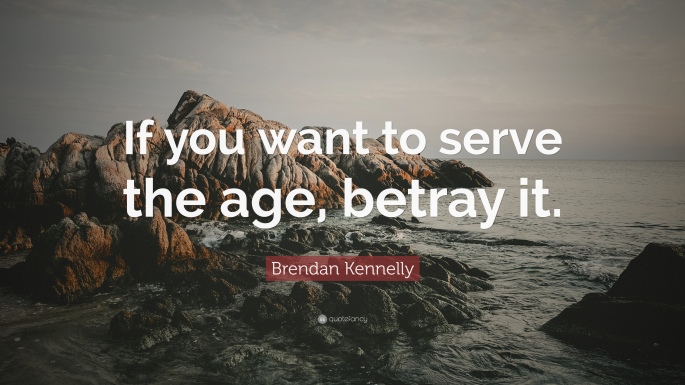
One of my musical heroes, Bono, the singer for the rock group U2, shares the story of the Irish poet, Brendan Kennelly. He relates that Kennelly has a memorable poem called The Book of Judas, and there’s a line in it that says: “If you want to serve the age, betray it.”

Then Bono asks: “What does that mean, to betray the age?”

Answering the question, Bono says: “Well to me betraying the Age means exposing its conceits, its foibles, its phony moral certitudes. It means telling the secrets of the age and facing harsher truths.”

Prevailing wisdom says that it is no measure of mental health to be well adjusted to a profoundly sick society. Every day in Tennessee, educators are challenged by a wide-ranging mixture of social, psychological, and physical problems that impede the improvement of so many students entrusted into their care.

Unfortunately for educators, policymakers worry about the results of a test given at the end of every school the year, used so that we can measure the effectiveness of those teachers educating children. We have made textbook companies and test publishers prosperous, while we engage in a rigorous debate over trivial items.

We eagerly listen to wealthy philanthropists (or organizations representing them) that lack the prerequisite background in the policy areas that they are influencing. By virtue of their wealth, they have gained an unfair advantage, as well as access to policymakers. They then promote public policies by the access of their political donations and may not even understand the problems average people face. In education, they certainly do not understand the challenges confronting public school educators.

For example, Tennessee is the 12th poorest state based on the last US Census figures. Even more startling is that the child poverty rate is 26%. So when the philanthropist experiences donor fatigue and migrates to their next passing interest, educators will still be here to do what God has gifted them to do — which is to educate and demonstrate compassion for the children of our state.

The late political theorist Hannah Arendt wrote, “No cause is left but the most ancient of all, the one, in fact, that from the beginning of our history, has determined the very existence of politics, the cause of freedom versus tyranny.” When political donations replace the contributions of men and women from controlling their own destiny, tyranny will gain a stranglehold in our society.

If we oppose state control of the means of production, it stands to reason that production in the hands of a few would also be undesirable. Politicians understand it is much easier to make laws than repeal them. Too often the extremes on both ends of the political spectrum are heard and the majority of people get silenced.

Every age has moral blind spots, with issues such as slavery, discrimination, unequal pay between sexes, and religious intolerance. Still, my Irish heritage compels me to believe in the idea that anything is possible when we embrace freedom.

The question for educators is this: where are we willing to spend our moral and intellectual capital, our money, or our sweat equity outside of the walls of our classroom or homes?

In a field as diverse as public education, we must all collaborate together to foster a more constructive dialogue among education stakeholders and policymakers. We share a common destiny. We have the power to create amazing change in this world and be champions for the vulnerable who cannot speak for themselves when they need us the most.

This is the time for bold measures. This is Tennessee and we are the generation of Educators to bring change, not only to our profession but to all of our society. Betray the Age.

##

JC Bowman is the Executive Director of Professional Educators of Tennessee, a non-partisan teacher association headquartered in Nashville, Tennessee. Follow him on Twitter @jcbowman. Permission to reprint in whole or in part is hereby granted, provided that the author and the association are properly cited.  His Blog is at http://www.jcbowman.com 

Killing Public Education

1teacher-education

Bill O’Reilly has gone on quite a killing spree. He has written books such as Killing the Rising Sun, Killing Reagan, Killing Patton, Killing Jesus, Killing Kennedy and Killing Lincoln. I think he should also write one called Killing Public Education.

Here is what is killing public education:

  1. A Culture of Disrespect is rampant in our schools. This can be created by a variety of reasons. Lack of respect for a profession, which is roughly 80% female. Too many people incorrectly believing that anybody can be a teacher. The very structure of our public education system, as well as the state of our society, often means educators are the major authority figure in many children’s lives. This necessitates that educators are on the frontlines of the culture wars. This result in an ugly fact: teachers provide the only correction or discipline some children ever receive. This leads to a negative perception of teachers and public education in general.
  2. The struggles that most educators face are daunting. Poverty is rampant in our nation and it is particularly obvious in our Southern states. One high school principal told me: “My school has very high poverty and mobility rates. We can’t continue to blame failure on teachers and principals. Families are failing and the evidence of that damage is clear. We love our students and are dedicated to them. Honestly, I don’t know what the answer is anymore. Eradicate poverty seems to be the obvious solution.” However, government has been trying to address this issue for well over 50 years. And it really hasn’t improved the situation. Family structures are being redefined and crumbling.
  3. We have become so driven by standards, testing and accountability that we have lost sight of what truly matters: children and those who educate our children. Testing has become big business; it is no longer merely a snapshot on a child’s progress. Data is the gold standard. We care more about what data tells us, than what a teacher tells us. And what do we know about the people creating the tests and interpreting the data? Data is not more important than children, or those that teach them. British Prime Minister Benjamin Disraeli said: “There are three kinds of lies: lies, damned lies, and statistics.” Perhaps we are not looking at the right statistics.

Educators know what needs to be done to improve education. Unfortunately, their voices have too often been replaced by philanthropists, business leaders and outside organizations. Often these “outside influencers” are driven by poor understanding of the issues, self-serving interests or in some cases greed.

The argument often used to counter the power of educators is that public education needs to be run more like a business and be more efficient. These arguments often fail to consider the “inside influencers” of district policy, state policy, and federal rules, laws and controls which often end up essentially micro-managing our local schools.

If we do not want to kill public education, the teaching profession must be elevated in stature. Educators must be seen as community leaders both inside and outside of the classroom. Far too often the voices of classroom teachers are not included in the decisions that impact their livelihood or their students. Few occupations are given so little say in their chosen field.

Let’s not wait until the autopsy or until Bill O’Reilly writes another book to explain that educators must be given a more active role in determining the policies that concern their students and the teaching profession. It is imperative that that we accept and nurture the teacher-leaders we already have and look to them for the guidance we need to improve education.

##

JC Bowman is the Executive Director of Professional Educators of Tennessee, a non-partisan teacher association headquartered in Nashville, Tennessee. Follow him on Twitter @jcbowman.