Tennessee School Safety Survey Results

school-safety_LG

One of the highest priorities we can have in American society is the safety and protection of children – and the men and women who teach them. From February 27 to March 9, 2018 Professional Educators of Tennessee surveyed 1403 educators across Tennessee. Ninety-seven percent listed their role as being a current educator, while 3% reported being retired educators.

When asked if they felt safe at school, 47% stated they felt safe, while 41% stated they felt somewhat safe, 10% felt somewhat unsafe and 2% felt unsafe.  When asked if an armed School Resource Office improved safety, 98% felt that they either improved or somewhat improved the safety of a school climate. While 62% responded that they have an active shooter protocol, only 55% reported that their School Resource Officer carried a side-arm. Conversely, while 1% of respondents stated their school already had metal detectors, 53% felt they were not needed at this time.

When asked about safety regulations already in place at school, 87% percent stated that all visitors are required to have a visitor’s pass but only 34% of schools required students and staff to wear a photo ID at all times. Seventy-five percent of all educators reported an increase on security procedures and awareness and 89% have practiced “lockdown” drills.

We also asked if educators thought that there were enough school counselors available to actually counsel students needing mental health services.  Sixty-three percent of the respondents said there are NOT enough guidance counselors at their school. Thirty-seven percent believed there are enough guidance counselors.

Regarding the hotly debated issue of allowing teachers to be armed in the classroom, an interesting finding of our survey was that 53% percent of educators stated that they personally would be unlikely to carry a firearm in the classroom, but 63% of those surveyed felt that properly trained personnel should be allowed to carry a weapon to school. Although 59% of educators reported owning a firearm, only 37% stated they would be likely or somewhat likely to carry a firearm to school.

There is a wealth of information in the nearly 850 comments that educators thoughtfully provided. We appreciate the educators who took the time to provide diverse thoughts and responses. Open-ended responses showed strong support for increased focus on student mental health, and lower school-counselor ratios were mentioned frequently. Comments also frequently mentioned support for increased SRO presence and improved school safety infrastructure (eg. bulletproof glass, door locks, intercoms, panic buttons, use of retired military and law enforcement, and cameras). There was both strong opposition to and support for allowing educators to carry firearms in schools. The entire comments section is available for download here. Comments are unedited except for the removal of  identifying district or school information.

#####

JC Bowman is the Executive Director of Professional Educators of Tennessee, a non-partisan teacher association headquartered in Nashville, Tennessee. Permission to reprint in whole or in part is hereby granted, provided that the author and the association are properly cited. For more information on this subject or any education issue please contact Professional Educators of Tennessee. To schedule an interview please contact Audrey Shores, Director of Communications, at 1-800-471-4867 ext.102.

JC's Twitter Post 2

Rethinking Driver’s Education

textingteendriving

Ladies and gentlemen, start your engines! 

With that little phrase, we are off to the races to get to our morning destination—work, school or other location.  I have been driving since I was 13 years old, and legally since I was 16.  I have never seen worse drivers in my lifetime, all across the state and nation.  Every time I get behind the wheel I say a silent prayer, “Dear Lord, please don’t let me be run-over by the idiots today and keep me and others safe out there.”

I remember when driving a vehicle was a privilege, first granted to me by my parents and then recognized by those who issued a license.  In fact, driving a car is not a right promised to every person, but rather a privilege granted to people who complete certain requirements. In the legal arena, even the US Supreme Court says that citizens do not have a fundamental “right to drive.” In Dixon v. Love, 431 U.S. 105, 112-16, 97 S.Ct. 1723, 52 L.Ed.2d 172 (1977), the Supreme Court held that a state could summarily suspend or revoke the license of a motorist who had been repeatedly convicted of traffic offenses with due process satisfied by a full administrative hearing available only after the suspension or revocation had taken place. The Court conspicuously did not afford the possession of a driver’s license the weight of a fundamental right.  (See also Mackey v. Montrym, 443 U.S. 1, 10, 99 S.Ct. 2612, 61 L.Ed.2d 321 (1979); Bell v. Burson, 402 U.S. 535, 539, 542-43, 91 S.Ct. 1586, 29 L.Ed.2d 90 (1971).)

Tennessee does mandate that in order to get an Intermediate Driver’s License, a minor must have certified 50 hours of supervised behind-the-wheel experience, including 10 hours at night.  The Tennessee Department of Safety only requires students to complete a driver’s education course if they have been convicted of multiple moving violations while they are operating on their intermediate restricted license.  It is time to re-think that policy.  It is currently not a requirement in order for a minor child to obtain a permit or license to successfully complete a driver’s education course.  Nobody disputes that it is an important resource that can help students become responsible and safe drivers.  Should we restrict student access on our school campuses until they can prove to be responsible and safe drivers?   Should driver’s education course be required?  How can we prove or truly verify the supervised behind the behind-the-wheel or night experience?  

From a school safety perspective, school district policy should require a student pass a driver’s education course before being allowed to drive to/from school or park their vehicle on school grounds. This class could also be offered during the summer or through any of the legitimate driving schools across the state. The objective should not be to save parents a few dollars on auto insurance, it must be to improve driving, reduce accidents and injuries and ultimately save lives.  We all benefit by learning defensive driving techniques and other safe driving skills that will last a lifetime.

distracted

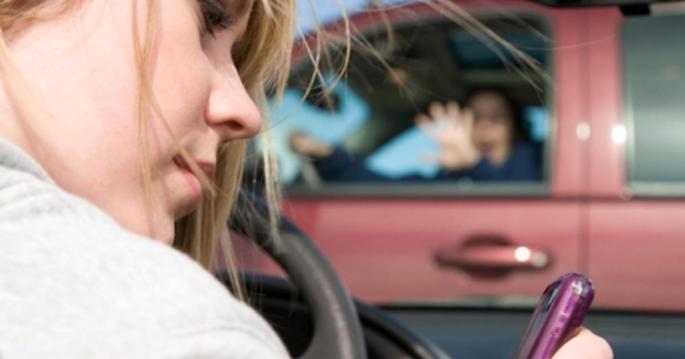
The  rules of the road are also shifting. We all face obstacles in an increasingly challenging driving environment, especially with more inexperienced drivers on the roads.  Texting in driving, is one of the most distracting items a driver can do.  Phone use – particularly calling and texting – while driving is one of the most common distractions. New technologies bring even greater challenges with distracted drivers.  New technology in vehicles is not always to our benefit, “infotainment” dashboards GPS maps and other hands-free technology may actually impede smart driving and safety.  Multitasking technology is about convenience, not safety.  Good driving habits require training and repetition.

A driver’s education course is a beneficial choice for drivers of any age and experience levels.  However, it should be required for all minors navigating our roads.  It is time to re-think our policies before the next generation starts their engines.  Lives most certainly will depend on it.

##

JC Bowman is the Executive Director of Professional Educators of Tennessee, a non-partisan teacher association headquartered in Nashville, Tennessee. Permission to reprint in whole or in part is hereby granted, provided that the author and the association are properly cited. For more information on this subject or any education issue please contact Professional Educators of Tennessee.


Just Follow the Law

Uncertain judge

I know that taxpayers see the best and worst of educators. The truth is that the vast majority of educators are incredibly dedicated public servants who deserve our praise. In surveys we conduct, it reveals that working conditions are a bigger issue to teachers than salary.

Let me share one example: We have discovered that several school districts are now using the term “Leaves of Absences” while investigating any allegations against teachers. During the “tell your side” conference, the teacher is informed of the supposed allegations to which he/she is supposed to respond. Soon thereafter, a “Written Reprimand” is issued and at times, the teacher is found responsible of violations of school policy and penalized certain days of pay. This occurs without sufficient notice of the charges or due process rights afforded within an impartial hearing. We believe this is improper and may in fact be actionable. We are very concerned about these methods which in essence dilute, and at times, abuse the due process rights of a tenured educator. The right to be heard before an impartial hearing officer, along with the appeal rights to the Board and Chancery Court are obviated. We believe this to be contrary to the legislative intent of and due process rights provided by Tennessee Code Annotated §49-5-511 and Tennessee Code Annotated §49-5-512.

Let me put it into something more relatable for the average reader. Imagine you walk into your job today and are questioned by a supervisor. You are told you are being sent home because a subordinate told you something. Keep in mind you followed company policy and reported the conversation which involved illegal activities to authorities, as required by company policy. Now the “Leave of Absence” is under media scrutiny, you cannot defend yourself. To make matters worse, the supervisor can take as long as he wants to investigate the issue. The longer you stay at home, the more damaging to your career. Rumors begin to circulate that you must have done something wrong, which you clearly did not. The supervisor purposely skirts company policy, by using the term, “Leave of Absence.” Ask yourself this question, would you want to work for that company? More importantly would anybody want to work for that company?

While this sounds complicated. It is really simple: Follow the Law. People should not play semantics with words. If a teacher or administrator has done something that warrants a reprimand or suspension, then address that issue and allow due process to take place. When districts try to avoid following the law, the recourse will eventually and most certainly end up in court. When that happens students lose, teachers and administrators lose, and most importantly taxpayers lose.

My advice to school districts. You may not like the law. You may not agree with the law. But as long as it is the law…. follow the law.

##

JC Bowman is the Executive Director of Professional Educators of Tennessee, a non-partisan teacher association headquartered in Nashville, Tennessee. Permission to reprint in whole or in part is hereby granted, provided that the author and the association are properly cited. For more information on this subject or any education issue please contact Professional Educators of Tennessee.

Bullying is a Global Problem

frustrated student

Bullying is a matter that adults and students alike must take seriously.  “Bullying is a form of aggressive behavior in which someone intentionally and repeatedly causes another person injury or discomfort. Bullying can take the form of physical contact, words or more subtle actions,” according to the American Psychological Association.  They add, “The bullied individual typically has trouble defending him or herself and does nothing to “cause” the bullying.”   In addition, bullying includes actions such as making threats, spreading rumors, attacking someone physically or verbally, and excluding someone from a group on purpose according to the US Government website StopBullying.gov.

School violence and bullying is a global problem.  The countries we are most familiar with, South Korea and the United States, recognizes the growing issue.  Almost one of every three students (32%) in South Korean elementary, middle and high schools are victims of bullying according to a Korea Institute for Health and Social Affairs study.  In the United States it is almost one out of every four students (22%) report being bullied during the school year according to the National Center for Educational Statistics.  Some victims of school violence and bullying never reveal their secret.

When a 15-year-old high school student killed himself in the Gyeongsan, North Gyeongsang Province in South Korea, it sparked a national discussion of bullying. South Korea had started using surveillance cameras to limit bullying opportunities.  The student left a note that listed the names of five schoolmates who had repeatedly bullied him for two years.  His note said he was beaten by them in locations that were not covered by surveillance cameras.  In Knoxville, Tennessee in December 2017, a video of student Keaton Jones went viral drawing massive celebrity support against bullying.  Jones, alleges that he is often bullied at school. “They make fun of my nose. They call me ugly. They say I have no friends,” Keaton emotionally describes to his mother.  He even said sometimes things get physical at lunch.  “They poured milk on me and put ham down my clothes,” he recounted, fighting back tears. “Throw bread at me.” Then Keaton asked a question we all wonder: “Why do they bully? What’s the point of it?”

What can policymakers and stakeholders do to address bullying?  We argue for a three-point strategy.  1) We must promote awareness of bullying.  We have to confront the harmful impact of school violence and bullying.  2) We must establish systems to report school violence and bullying.  We must also provide support and services to those who are impacted by bullying and school violence.  Finally, 3) We must require professional development that educates teachers and students in order to identify, prevent and respond to school violence and bullying.

Let’s send a global message that bullying and school violence is unacceptable.  It will take a united effort, at the local level, to the state level and even the national level.  We should share ideas of what works in each school.  We need a clearinghouse to share ideas on how to stop the problem.   When you see people make threats, spread rumors, attack someone physically or verbally, and excluding others be that person who stands up for others.  Together, we can stop bullying in its tracks.

##

Solee Lee, is an International Exchange Student from Daejon, South Korea.  She is an intern at Professional Educators of Tennessee.  JC Bowman is the Executive Director of Professional Educators of Tennessee, a non-partisan teacher association headquartered in Nashville, Tennessee. Permission to reprint in whole or in part is hereby granted, provided that the author and the association are properly cited. For more information on this subject or any education issue please contact Professional Educators of Tennessee.

Still Battles Left to Fight

braveheart-poster

In the year of our lord, thirteen fourteen, patriots of Scotland, starving and outnumbered, charged the fields of Bannockburn. They fought like warrior poets. They fought like Scotsmen and won their freedom.

The most memorable character, in my opinion, outside of William Wallace in the movie Braveheart, was the character, Stephen. One of the great lines from Stephen was when he was describing the battle about to be fought: “The Almighty says this must be a fashionable fight. It’s drawn the finest people.”

Stephen, my hero from the aforementioned movie Braveheart, (and maybe I like it is because of my Irish heritage) added: “In order to find his equal, an Irishman is forced to talk to God… The Almighty says don’t change the subject; just answer the @#*& question.  Of course, Wallace himself says, “As you’re lying on your death bed, would trade all your days, from this day till that, for just one chance, one chance at FREEDOM!!”

However, freedom without values is anarchy.  So yes, individual character does in fact matter.  There remains a real tension between spheres of commonality and social virtues and spheres of individuality and personal virtues. However, there are areas which deservedly lie in the public realm and those which ought to be left to individual choice.

Oliver Williams and John Houck in their book “Virtues in a Democracy” wrote:  “And, while there are frequently differences in interpreting the exact meanings and implications of prevailing virtues…virtues do provide sound and shared foundations for consensus formation, community endeavors, public policies and moral standing.”

In our elections, it is important that we are wise and elect those who best demonstrate virtue and reflect our shared values.  There are four cardinal virtues – justice, wisdom (prudence), courage (fortitude), and moderation (self-control, temperance). These are inherent foundational laws. If these moral values and commitments are as compelling as virtues are, they remain the foundations of moral discourse in society. They are indispensable guides to our actions. Statements which push new moral claims not absorbed into the set of shared virtues — have little or no standing, despite the age in which we now find ourselves living.

In 1788, James Madison asked the question: “Is there no virtue among us? If there be not, we are in a wretched situation. No theoretical checks–no form of government can render us secure. To suppose that any form of government will secure liberty or happiness without any virtue in the people, is a chimerical idea.”  Madison understood the battles that were ahead for a nation.

Our society works best when we recognize the need for shared values. Shared values are much deeper than principles rooted in popular opinion. Those who live for the moment are building their house on sinking sand. Those who only live in the present are incapable of seeing things in perspective. They do not fully grasp the relationship between means and ends, principles and practice. They are often self-centered individuals believing that only they can be the judges of their conduct, choosing what is best and right for them at the expense of society.  This not only hurts families and communities, it also destroys the fabric of our society. That’s why Madison added “we do not depend on their virtue, or put confidence in our rulers, but in the people who are to choose them.”

We fought some great battles in 2017.  Some of these battles were fought politically, socially and culturally.  We will undoubtedly see even more battles in 2018.  However, we also had some celebrations to go with our victories and some good times to go with the bad.  We are eagerly preparing for the legislative session to kick off in the Tennessee General Assembly.  Then, the election season gets underway.  In 2018, we will have a very quick legislative session in Tennessee.  In education, we have found policy enacted quickly often fails to be implemented correctly.  So there are many battles still left to fight here in Tennessee.    We should choose the best people to fight for us.

##

JC Bowman is the Executive Director of Professional Educators of Tennessee.  Professional Educators of Tennessee is a non-partisan teacher association headquartered in Nashville, Tennessee.  Permission to reprint in whole or in part is hereby granted, provided that the author and the association are properly cited. Follow him on Twitter at @jcbowman

Reflecting on Our Bill of Rights

declaration of independence

In 1941, President Franklin Roosevelt designated December 15 as Bill of Rights DayThis is the day we recognize and commemorate the first 10 amendments to the Constitution, which spell out our rights as citizens here in the United States of America.  That date was chosen because the Bill of Rights was originally ratified on December 15, 1791.  Our rights and freedoms as Americans are rooted in the Bill of Rights.  Unfortunately, many Americans do not fully appreciate or understand our Bill of Rights.

Future President, James Madison of Virginia, was the primary author of the first 10 amendments to the Constitution, which are recognized today as our Bill of Rights.  The Virginia Declaration of Rights, written by George Mason, strongly influenced their writing. Other documents such as the Magna Carta, the Petition of Right, the English Bill of Rights, and the Massachusetts Body of Liberties are considered foundations to our Bill of Rights.  The Bill of Rights was written to provide mutual constitutional protection of individual liberties of our citizens, and to limit the power of the federal government.

Regardless of personal political persuasion or affiliation, American citizens can unite around the Bill of Rights because it communicates our basic shared values.   President George W. Bush stated, “The true [American] revolution was not to defy one earthly power, but to declare principles that stand above every earthly power—the equality of each person before God, and the responsibility of government to secure the rights of all.”  President Franklin D. Roosevelt referred to the Constitution as “the great American charter of personal liberty and human dignity.”

Limiting the power of government and safeguarding the rights of our citizens is something we must all make a conscientious effort to protect.   We should be especially appreciative for the protection afforded in our Bill of Rights against a national government gaining ground against our most fundamental rights—freedom of speech, protest, and conscience guarantees our equal protection under the law.  A free society does not just occur. It has to be consciously devised and intentionally preserved. Eternal vigilance is the price of freedom.

We invite all citizens and educators to celebrate Bill of Rights Day on December 15 and commemorate the ratification of the first ten amendments to the U.S. Constitution.  It is critical to share the knowledge of the relevance and practicality gained through an understanding of the U.S. Constitution to the next generation.[i]

The Bill of Rights

Amendment I

Congress shall make no law respecting an establishment of religion, or prohibiting the free exercise thereof; or abridging the freedom of speech, or of the press; or the right of the people peaceably to assemble, and to petition the government for a redress of grievances.

Amendment II

A well-regulated militia, being necessary to the security of a free state, the right of the people to keep and bear arms, shall not be infringed.

Amendment III

No soldier shall, in time of peace be quartered in any house, without the consent of the owner, nor in time of war, but in a manner to be prescribed by law.

Amendment IV

The right of the people to be secure in their persons, houses, papers, and effects, against unreasonable searches and seizures, shall not be violated, and no warrants shall issue, but upon probable cause, supported by oath or affirmation, and particularly describing the place to be searched, and the persons or things to be seized.

Amendment V

No person shall be held to answer for a capital, or otherwise infamous crime, unless on a presentment or indictment of a grand jury, except in cases arising in the land or naval forces, or in the militia, when in actual service in time of war or public danger; nor shall any person be subject for the same offense to be twice put in jeopardy of life or limb; nor shall be compelled in any criminal case to be a witness against himself, nor be deprived of life, liberty, or property, without due process of law; nor shall private property be taken for public use, without just compensation.

Amendment VI

In all criminal prosecutions, the accused shall enjoy the right to a speedy and public trial, by an impartial jury of the state and district wherein the crime shall have been committed, which district shall have been previously ascertained by law, and to be informed of the nature and cause of the accusation; to be confronted with the witnesses against him; to have compulsory process for obtaining witnesses in his favor, and to have the assistance of counsel for his defense.

Amendment VII

In suits at common law, where the value in controversy shall exceed twenty dollars, the right of trial by jury shall be preserved, and no fact tried by a jury, shall be otherwise reexamined in any court of the United States, than according to the rules of the common law.

Amendment VIII

Excessive bail shall not be required, nor excessive fines imposed, nor cruel and unusual punishments inflicted.

Amendment IX

The enumeration in the Constitution, of certain rights, shall not be construed to deny or disparage others retained by the people.

Amendment X

The powers not delegated to the United States by the Constitution, nor prohibited by it to the states, are reserved to the states respectively, or to the people.

##

JC Bowman in NYCJC Bowman is the Executive Director of Professional Educators of Tennessee.  Professional Educators of Tennessee, a non-partisan teacher association headquartered in Nashville, Tennessee.  Permission to reprint in whole or in part is hereby granted, provided that the author and the association are properly cited.

 

[i] NOTE:  We are glad to assist our educator members across the state in promoting awareness of the United States Constitution, through various partners and projects.  In addition, if you email our partners at the 917 Society (917society@gmail.com) they will provide copies of the US Constitutions free of charge to all 8th grade classrooms.

Opposing Vouchers in Tennessee

Fotolia_38134510_Subscription_XXL.jpg

Vouchers are likely to return both at the Tennessee General Assembly in 2018 and in the upcoming gubernatorial election. The issue has been debated and discussed for many years across our state. Public school teachers, administrators, superintendents and school boards, especially the members of our organization, are almost universal in opposition. Almost 90% of the children in our state currently attend a public school.   Our organization, Professional Educators of Tennessee, continues to oppose vouchers here in Tennessee.

Politicians across Tennessee, who ran for election or re-election in 2016, ran on one message: Tennessee is on the right track in public education. Nothing has changed. In fact, the National Assessment of Educational Progress (NAEP) is the largest nationally representative and continuing assessment of what America’s students know and can do in various subject areas. Tennessee is number one in improvement in both English and math for both 4th and 8th grade on the 2012 NAEP test scores and is number one in improvement in science on 2016 test scores. We are on the right track according to state politicians, and referenced in testimony by Economist Art Laffer in the Tennessee General Assembly in 2017.

Here is some additional food for thought:

  • Private schools will eventually be subjected to new regulations. There will, and there should be, strings attached if any school takes taxpayer money. Just look at these quotes: “A public school would become any school that receives students who brought with them public monies” –Lamar Alexander, former Secretary of Education under George Bush.  His words should serve as a warning to all private and parochial schools.
  • There are very limited seats available in accredited private schools. In Florida as vouchers were expanding in 2003, it was discovered that a state of 24 million had less than 5,000 seats in private schools available. Florida was a rapidly growing state and is approximately four times the size of Tennessee. A best estimate is there are only 1200 to 1500 seats available in Tennessee at accredited private schools that may be willing to take a voucher student. We would challenge voucher proponent to produce the statistics of seats available at an accredited private school that would accept a student for a $7,000 voucher.
  • Public Schools are more than a safety net. Many schools serving poor children throughout the United States are overwhelmed by the social needs of the children they serve. According to the United States Department of Agriculture (USDA), 15.3 million children under 18 in the United States live in households where they are unable to consistently access enough nutritious food necessary for a healthy life. These 8 states have statistically higher food insecurity rates than the US national average (14.6%): Arkansas (21.2%), Mississippi (21.1%), Texas (18.0%), Tennessee (17.4%), North Carolina (17.3%), Missouri (16.9%), Georgia (16.6%), and Ohio (16.0%). More than 1 in 5 children is at risk of hunger. Among African-Americans and Latinos, it’s 1 in 3 according to the USDA. Our public schools are dealing with this issue, largely without additional resources or even acknowledgment by state and federal officials. Taking money from public schools, either rural or urban districts, will impact that school and community.

It is important that we remind ourselves of the purpose of public education under the Tennessee Constitution: “The state of Tennessee recognizes the inherent value of education and encourages its support. The General Assembly shall provide for the maintenance, support and eligibility standards of a system of free public schools.” Tennessee has a responsibility to ensure the right of all children to a quality education.

Most educators do not support the status quo in public education and strive to raise the bar every day. They understand an engaging and challenging education is the proven path to prosperity and a life-long love of learning. It has long been acknowledged that a strong educational system is essential not only to the successful functioning of a democracy, but also to its future. Therefore, we remain focused on our public schools in Tennessee, the teachers we serve and the students they serve.

##

JC Bowman is the Executive Director of Professional Educators of Tennessee, a non-partisan teacher association headquartered in Nashville, Tennessee.  Permission to reprint in whole or in part is hereby granted, provided that the author and the association are properly cited.