It’s NOT About the Money

Admin vs. Teachers

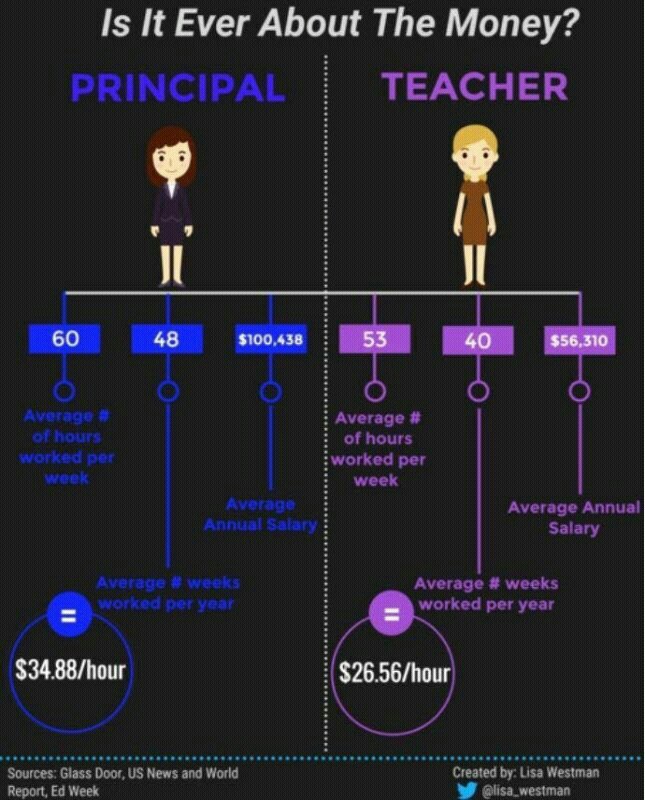
Teachers and Administrators do not go into public education for the money. That point been driven home the last few decades. This is a great chart to demonstrate that money alone will not serve as an inducement to recruit teachers, or keep them in the field.

Still Battles Left to Fight

braveheart-poster

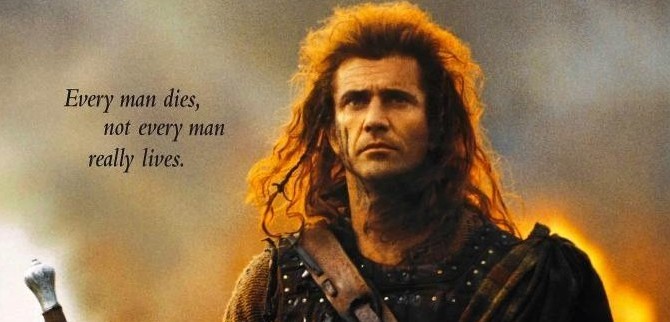
In the year of our lord, thirteen fourteen, patriots of Scotland, starving and outnumbered, charged the fields of Bannockburn. They fought like warrior poets. They fought like Scotsmen and won their freedom.

The most memorable character, in my opinion, outside of William Wallace in the movie Braveheart, was the character, Stephen. One of the great lines from Stephen was when he was describing the battle about to be fought: “The Almighty says this must be a fashionable fight. It’s drawn the finest people.”

Stephen, my hero from the aforementioned movie Braveheart, (and maybe I like it is because of my Irish heritage) added: “In order to find his equal, an Irishman is forced to talk to God… The Almighty says don’t change the subject; just answer the @#*& question.  Of course, Wallace himself says, “As you’re lying on your death bed, would trade all your days, from this day till that, for just one chance, one chance at FREEDOM!!”

However, freedom without values is anarchy.  So yes, individual character does in fact matter.  There remains a real tension between spheres of commonality and social virtues and spheres of individuality and personal virtues. However, there are areas which deservedly lie in the public realm and those which ought to be left to individual choice.

Oliver Williams and John Houck in their book “Virtues in a Democracy” wrote:  “And, while there are frequently differences in interpreting the exact meanings and implications of prevailing virtues…virtues do provide sound and shared foundations for consensus formation, community endeavors, public policies and moral standing.”

In our elections, it is important that we are wise and elect those who best demonstrate virtue and reflect our shared values.  There are four cardinal virtues – justice, wisdom (prudence), courage (fortitude), and moderation (self-control, temperance). These are inherent foundational laws. If these moral values and commitments are as compelling as virtues are, they remain the foundations of moral discourse in society. They are indispensable guides to our actions. Statements which push new moral claims not absorbed into the set of shared virtues — have little or no standing, despite the age in which we now find ourselves living.

In 1788, James Madison asked the question: “Is there no virtue among us? If there be not, we are in a wretched situation. No theoretical checks–no form of government can render us secure. To suppose that any form of government will secure liberty or happiness without any virtue in the people, is a chimerical idea.”  Madison understood the battles that were ahead for a nation.

Our society works best when we recognize the need for shared values. Shared values are much deeper than principles rooted in popular opinion. Those who live for the moment are building their house on sinking sand. Those who only live in the present are incapable of seeing things in perspective. They do not fully grasp the relationship between means and ends, principles and practice. They are often self-centered individuals believing that only they can be the judges of their conduct, choosing what is best and right for them at the expense of society.  This not only hurts families and communities, it also destroys the fabric of our society. That’s why Madison added “we do not depend on their virtue, or put confidence in our rulers, but in the people who are to choose them.”

We fought some great battles in 2017.  Some of these battles were fought politically, socially and culturally.  We will undoubtedly see even more battles in 2018.  However, we also had some celebrations to go with our victories and some good times to go with the bad.  We are eagerly preparing for the legislative session to kick off in the Tennessee General Assembly.  Then, the election season gets underway.  In 2018, we will have a very quick legislative session in Tennessee.  In education, we have found policy enacted quickly often fails to be implemented correctly.  So there are many battles still left to fight here in Tennessee.    We should choose the best people to fight for us.

##

JC Bowman is the Executive Director of Professional Educators of Tennessee.  Professional Educators of Tennessee is a non-partisan teacher association headquartered in Nashville, Tennessee.  Permission to reprint in whole or in part is hereby granted, provided that the author and the association are properly cited. Follow him on Twitter at @jcbowman

Reflecting on Our Bill of Rights

declaration of independence

In 1941, President Franklin Roosevelt designated December 15 as Bill of Rights DayThis is the day we recognize and commemorate the first 10 amendments to the Constitution, which spell out our rights as citizens here in the United States of America.  That date was chosen because the Bill of Rights was originally ratified on December 15, 1791.  Our rights and freedoms as Americans are rooted in the Bill of Rights.  Unfortunately, many Americans do not fully appreciate or understand our Bill of Rights.

Future President, James Madison of Virginia, was the primary author of the first 10 amendments to the Constitution, which are recognized today as our Bill of Rights.  The Virginia Declaration of Rights, written by George Mason, strongly influenced their writing. Other documents such as the Magna Carta, the Petition of Right, the English Bill of Rights, and the Massachusetts Body of Liberties are considered foundations to our Bill of Rights.  The Bill of Rights was written to provide mutual constitutional protection of individual liberties of our citizens, and to limit the power of the federal government.

Regardless of personal political persuasion or affiliation, American citizens can unite around the Bill of Rights because it communicates our basic shared values.   President George W. Bush stated, “The true [American] revolution was not to defy one earthly power, but to declare principles that stand above every earthly power—the equality of each person before God, and the responsibility of government to secure the rights of all.”  President Franklin D. Roosevelt referred to the Constitution as “the great American charter of personal liberty and human dignity.”

Limiting the power of government and safeguarding the rights of our citizens is something we must all make a conscientious effort to protect.   We should be especially appreciative for the protection afforded in our Bill of Rights against a national government gaining ground against our most fundamental rights—freedom of speech, protest, and conscience guarantees our equal protection under the law.  A free society does not just occur. It has to be consciously devised and intentionally preserved. Eternal vigilance is the price of freedom.

We invite all citizens and educators to celebrate Bill of Rights Day on December 15 and commemorate the ratification of the first ten amendments to the U.S. Constitution.  It is critical to share the knowledge of the relevance and practicality gained through an understanding of the U.S. Constitution to the next generation.[i]

The Bill of Rights

Amendment I

Congress shall make no law respecting an establishment of religion, or prohibiting the free exercise thereof; or abridging the freedom of speech, or of the press; or the right of the people peaceably to assemble, and to petition the government for a redress of grievances.

Amendment II

A well-regulated militia, being necessary to the security of a free state, the right of the people to keep and bear arms, shall not be infringed.

Amendment III

No soldier shall, in time of peace be quartered in any house, without the consent of the owner, nor in time of war, but in a manner to be prescribed by law.

Amendment IV

The right of the people to be secure in their persons, houses, papers, and effects, against unreasonable searches and seizures, shall not be violated, and no warrants shall issue, but upon probable cause, supported by oath or affirmation, and particularly describing the place to be searched, and the persons or things to be seized.

Amendment V

No person shall be held to answer for a capital, or otherwise infamous crime, unless on a presentment or indictment of a grand jury, except in cases arising in the land or naval forces, or in the militia, when in actual service in time of war or public danger; nor shall any person be subject for the same offense to be twice put in jeopardy of life or limb; nor shall be compelled in any criminal case to be a witness against himself, nor be deprived of life, liberty, or property, without due process of law; nor shall private property be taken for public use, without just compensation.

Amendment VI

In all criminal prosecutions, the accused shall enjoy the right to a speedy and public trial, by an impartial jury of the state and district wherein the crime shall have been committed, which district shall have been previously ascertained by law, and to be informed of the nature and cause of the accusation; to be confronted with the witnesses against him; to have compulsory process for obtaining witnesses in his favor, and to have the assistance of counsel for his defense.

Amendment VII

In suits at common law, where the value in controversy shall exceed twenty dollars, the right of trial by jury shall be preserved, and no fact tried by a jury, shall be otherwise reexamined in any court of the United States, than according to the rules of the common law.

Amendment VIII

Excessive bail shall not be required, nor excessive fines imposed, nor cruel and unusual punishments inflicted.

Amendment IX

The enumeration in the Constitution, of certain rights, shall not be construed to deny or disparage others retained by the people.

Amendment X

The powers not delegated to the United States by the Constitution, nor prohibited by it to the states, are reserved to the states respectively, or to the people.

##

JC Bowman in NYCJC Bowman is the Executive Director of Professional Educators of Tennessee.  Professional Educators of Tennessee, a non-partisan teacher association headquartered in Nashville, Tennessee.  Permission to reprint in whole or in part is hereby granted, provided that the author and the association are properly cited.

 

[i] NOTE:  We are glad to assist our educator members across the state in promoting awareness of the United States Constitution, through various partners and projects.  In addition, if you email our partners at the 917 Society (917society@gmail.com) they will provide copies of the US Constitutions free of charge to all 8th grade classrooms.

What is a Superintendent of Schools?

difficult decision

It is often said that the most important role of a board of education is to hire its superintendent.  I think that is a somewhat a valid claim.   Certainly if you value public education, you must have competent leadership managing the daily operations of the school district.  A good superintendent leads the districts educational, financial and administrative performance; facilitates the performance of all personnel; and responds to and informs stakeholders and policymakers about the performance and leadership of the district.

Having met many, if not most, Superintendents of Schools here in Tennessee, I believe we do have some excellent leaders across our state.  Probably one of the most important duties of the superintendent is to make sure district students are learning and achieving at the highest level possible.  A superintendent must understand effective academic practices and be supportive of the teachers and administrators in the district.  Leadership, vision, and strategic thinking are critical skills for every superintendent.  A successful superintendent is should also be an effective and excellent communicator.  If the only voice a superintendent listens to is his/her own, or a few members of the school board, public education will eventually lose community support.

In the last few years, I have seen some horrifying treatment of Superintendents across the state.  I have seen them maligned by anonymous message boards, attacked in the media, belittled by their own school board members, often unfairly.  I am reminded of Mark Twain’s quote:  “Great minds talk about ideas; good minds talk about events; small minds talk about people.”

Does that mean that we simply accept decisions from superintendents, without challenging them? Of course not!  We must particularly hold them accountable in regard to educational, financial and administrative performance.  However, we should provide them latitude in regards to leadership, vision and strategic thinking on how to address the performance in those areas. And we must expect them to communicate effectively to all stakeholders.

The American Association of School Administrators suggests that the superintendent, like principals, must also demonstrate a keen understanding of teaching, learning and what works for students. As a change leader, a successful superintendent should emphasize the efficient use of resources, personnel, and data to break down resistance and drive systemic change; empower board and personnel to set goals, measure results, develop accountability, and support planning, evaluation, and resource allocation.

Our state has made some incredible strides in public education.  It is an accomplishment that we should admire and respect.  It begins with the men and women in the classroom across this state, and we must also acknowledge the hard work of those who lead our schools.

##

JC Bowman is the Executive Director of Professional Educators of Tennessee.  Professional Educators of Tennessee, a non-partisan teacher association headquartered in Nashville, Tennessee.  Permission to reprint in whole or in part is hereby granted, provided that the author and the association are properly cited.


We Give Thanks this Thanksgiving

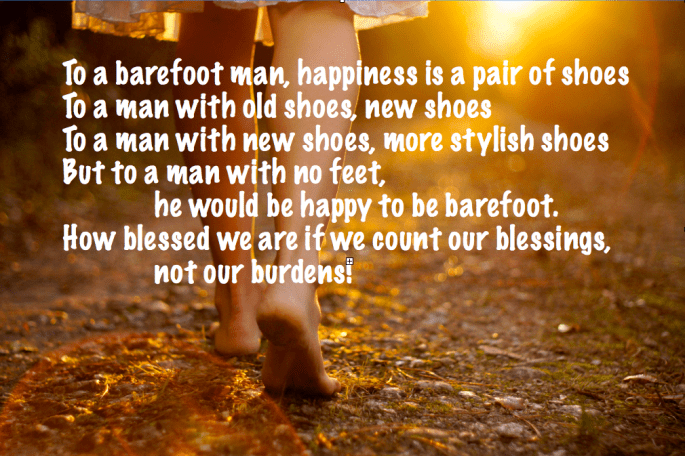
1 thanks photo-verse-jpg-barefoot-manI used to keep a framed picture in my classroom: “Your Life is God’s gift to you. What you do with your Life is your gift to God.” I wish every child could hear that repeated every day. And what teachers do with their gift benefits so many children on a daily basis. Teachers are often on the front line of the poverty battle. It is important that children know from where their gifts originate. This Thanksgiving is a good opportunity to be thankful for the gift of life we have and the gift of others in our lives.


I grew up with the knowledge I wasn’t any better than anyone else, but nobody else was better than me. Because my parents understood that we were all created in the image of God. I believe that we should never be intimidated by those in power. Power is perception, and people who have it over you do so because you give it to them in most instances. Bono, of the rock group U2 in a Rolling Stone interview said: “I don’t fear politicians or presidents. They should be afraid. They’ll be accountable for what happened on their watch.” Too often unelected bureaucrats exert influence over our lives and careers. We need to look closely at the issue of the legitimacy of power.

I have worked with many faith and community organizations and it seems to me that many of the problems they seek to address have one root cause: poverty. I take the problems of global poverty much more serious, and have noticed a rise in poverty in both urban and rural America.

It is the best American tradition of helping others help themselves. Now is an opportune time for compassion and justice to help the poorest people of our nation and the world. I see a passion for compassion diminishing in America. Government simply cannot meet the needs of all citizens. Faith and community organizations need help. They need your time and efforts. They need your money and support. We should embrace government partnership with faith-based organizations and other non-profit community organizations to do the work of fighting poverty and other issues.

To his credit, President George W. Bush recognized the poverty problem when he said: “The growing divide between wealth and poverty, between opportunity and misery, is both a challenge to our compassion and a source of instability. We must confront it.” “We cannot,” said the president, “leave behind half of humanity as we seek a better future for ourselves. We cannot accept permanent poverty in a world of progress. There are no second-class citizens in the human race.”

Bono added, “It’s an amazing thing to think that ours is the first generation in history that really can end extreme poverty, the kind that means a child dies for lack of food in its belly. This should be seen as the most incredible, historic opportunity but instead it’s become a millstone around our necks. We let our own pathetic excuses about how it’s ‘difficult’ justify our own inaction. Let’s be honest. We have the science, the technology, and the wealth. What we don’t have is the will, and that’s not a reason that history will accept.”

Poor and starving people are not particularly appealing news stories, but fighting poverty is and should be a moral imperative for citizens in our cities, state and nation. Educators are often on the frontlines‎.

Faith reminds us that theological apathy is not an acceptable excuse. Yes, “the poor will always be with us.” However, Jesus, in his first sermon said, “The spirit of the Lord is upon me, because he has anointed me to preach good news to the poor.”

As we sit in our comfortable pews on Sunday morning singing about what it is like up there, we should remember that the poverty of spirit as equally lamentable to poverty of physical wealth. This Thanksgiving we should be thankful for both the small and large blessing in our lives. If you are a parent and your child is about to enter the world, it would be a great comfort to know that your country will use all of its resources to meet the most basic needs of all citizens, so they can succeed in our country.

To paraphase an oft cited poem, if you want to touch the face of God or His heart, it is not necessary to escape the surly bonds of Earth. Take an interest in the things that interest God. Do not be so eager to grow old or love your children as long as they will let you. Eliminate some of those nonessential things that clutter our lives. Recognize what is really essential: faith, family and friends. Embrace others. Treat everybody with dignity and respect. Lose control, let God love through you. Don’t fear the politicians. Hold them accountable. God will indeed hold us all accountable.

Think of those less fortunate this year before your Thanksgiving prayers, those in poverty whose plates are often empty. We are incapable of breaking the cycle of poverty without all of us working together. The number of hungry people in the world reached nearly 800 million, a harsh reminder that the world has yet to get serious about the challenge of ending hunger. We can make a difference, can’t we? ‎

##

JC Bowman is the Executive Director of Professional Educators of Tennessee, a non-partisan teacher association headquartered in Nashville, Tennessee. Permission to reprint in whole or in part is hereby granted, provided that the author and the association are properly cited. For more information on this subject or any education issue please contact Professional Educators of Tennessee. To schedule an interview please contact Audrey Shores, Director of Communications, at 1-800-471-4867 ext.102.

Opposing Vouchers in Tennessee

Fotolia_38134510_Subscription_XXL.jpg

Vouchers are likely to return both at the Tennessee General Assembly in 2018 and in the upcoming gubernatorial election. The issue has been debated and discussed for many years across our state. Public school teachers, administrators, superintendents and school boards, especially the members of our organization, are almost universal in opposition. Almost 90% of the children in our state currently attend a public school.   Our organization, Professional Educators of Tennessee, continues to oppose vouchers here in Tennessee.

Politicians across Tennessee, who ran for election or re-election in 2016, ran on one message: Tennessee is on the right track in public education. Nothing has changed. In fact, the National Assessment of Educational Progress (NAEP) is the largest nationally representative and continuing assessment of what America’s students know and can do in various subject areas. Tennessee is number one in improvement in both English and math for both 4th and 8th grade on the 2012 NAEP test scores and is number one in improvement in science on 2016 test scores. We are on the right track according to state politicians, and referenced in testimony by Economist Art Laffer in the Tennessee General Assembly in 2017.

Here is some additional food for thought:

  • Private schools will eventually be subjected to new regulations. There will, and there should be, strings attached if any school takes taxpayer money. Just look at these quotes: “A public school would become any school that receives students who brought with them public monies” –Lamar Alexander, former Secretary of Education under George Bush.  His words should serve as a warning to all private and parochial schools.
  • There are very limited seats available in accredited private schools. In Florida as vouchers were expanding in 2003, it was discovered that a state of 24 million had less than 5,000 seats in private schools available. Florida was a rapidly growing state and is approximately four times the size of Tennessee. A best estimate is there are only 1200 to 1500 seats available in Tennessee at accredited private schools that may be willing to take a voucher student. We would challenge voucher proponent to produce the statistics of seats available at an accredited private school that would accept a student for a $7,000 voucher.
  • Public Schools are more than a safety net. Many schools serving poor children throughout the United States are overwhelmed by the social needs of the children they serve. According to the United States Department of Agriculture (USDA), 15.3 million children under 18 in the United States live in households where they are unable to consistently access enough nutritious food necessary for a healthy life. These 8 states have statistically higher food insecurity rates than the US national average (14.6%): Arkansas (21.2%), Mississippi (21.1%), Texas (18.0%), Tennessee (17.4%), North Carolina (17.3%), Missouri (16.9%), Georgia (16.6%), and Ohio (16.0%). More than 1 in 5 children is at risk of hunger. Among African-Americans and Latinos, it’s 1 in 3 according to the USDA. Our public schools are dealing with this issue, largely without additional resources or even acknowledgment by state and federal officials. Taking money from public schools, either rural or urban districts, will impact that school and community.

It is important that we remind ourselves of the purpose of public education under the Tennessee Constitution: “The state of Tennessee recognizes the inherent value of education and encourages its support. The General Assembly shall provide for the maintenance, support and eligibility standards of a system of free public schools.” Tennessee has a responsibility to ensure the right of all children to a quality education.

Most educators do not support the status quo in public education and strive to raise the bar every day. They understand an engaging and challenging education is the proven path to prosperity and a life-long love of learning. It has long been acknowledged that a strong educational system is essential not only to the successful functioning of a democracy, but also to its future. Therefore, we remain focused on our public schools in Tennessee, the teachers we serve and the students they serve.

##

JC Bowman is the Executive Director of Professional Educators of Tennessee, a non-partisan teacher association headquartered in Nashville, Tennessee.  Permission to reprint in whole or in part is hereby granted, provided that the author and the association are properly cited.

A Teacher Invests in Lives

Jay ShinThis is a picture that is four years in the making, but to understand the story is really a bond between a student and a trusted teacher. Jay Shin is a senior at Walker Valley High School in the Bradley County School System in Tennessee.  Joel Swartzel is Special Education teacher in the system.

Jay is a bright, articulate student who has a real joy for life. He has an infectious smile and comes to school every day with a carpe diem attitude. He is not the type of kid who let’s things “get him down.” He faces every day with a smile and has that rare type of courage that draws other people to him. He doesn’t allow what you see to define him and when you experience that kind of optimism in the face of cerebral palsy, you know you have a special young man on your hands. This is a glimpse into the Jay Shin part of the story.

Four years ago, a former student teacher at Walker Valley was able to land his dream job. Joel Swartzel is a Special Education teacher, and when Jay’s teaching assistant was absent, Mr. Swartzel stepped in with the daily coordination of Jay’s logistics, getting him to class and assisting him with his needs throughout the day. A friendship began to form between the two, and Jay told Mr. Swartzel he always wanted to wear a costume for the Homecoming week festivities, which includes character day at the school.

Each year, some impediment kept Jay or Mr. Swartzel from being able to dress up for the Homecoming activities. Mr. Swartzel would either have to be off campus on character day for training or Jay didn’t want to be in a suit all day long. He wanted to be Professor X from the X-Men movie. He thought he needed someone to be an X-Man to be with him. Professor X, played by the well-known actor Patrick Stuart is bald, and also is in a wheelchair.

This year, Jay’s senior year, Mr. Swartzel told Jay that if he would wear the suit, he would make sure there was an X-Man to be with him. Little did Jay know, Mr. Swartzel went to the costume store and bought the X man character “Wolverine” costume and a bald skin cap for Jay. On the day of Homecoming Character Day, Jay came to school in a suit and on his way in from the bus, there stood “Wolverine” to take him to class. As you can see, the costume is impressive but you cannot clearly see the face. The only clue is the teacher badge that he wears proudly. From the smile on Jay’s face, you can see that he will never forget this day. I can guarantee the smile on that teacher’s face is just as wide.

The heart of this story is the investment of a teacher into the life of a student. In Tennessee, every day, more than 67,000 teachers walk into our public schools, ready to tackle the responsibilities of investing in the lives of almost a million students. Their time and giving hearts in things big and small are game changers for many young people. And if the truth is told, our students usually inspire us as much as we inspire them.

Joel Swartzel said “Originally I was supposed to be Beast, but I could not find the costume in time. With this being Jay’s last year I was going to do whatever it took to make this happen. Jay is one of those kids that everyone should try to be in life. He is a joy to be around and makes everyone around him smile. When Mr. Swartzel had to opportunity to do for Jay what he does for everyone else, zero chance he was passing that up.” Thank you to Jay Shin for inspiring your teacher.

As educators, we understand this on so many levels. Even though the “rigors of the profession” are great, the moments like this help us remember why we do what we do. We make a difference every day! Thank you Joel Swartzel for reminding us of that!

##
JC Bowman is the Executive Director of Professional Educators of Tennessee, a non-partisan teacher association headquartered in Nashville, Tennessee. Permission to reprint in whole or in part is hereby granted, provided that the author and the association are properly cited. Follow him on social media via Twitter at @jcbowman.

Statement from Professional Educators of Tennessee Executive Director JC Bowman

As Shelbyville and Bedford County, as well as Murfreesboro and Rutherford County brace for white supremacist rallies, we anticipate needless conflicts.  We see the “us versus them” attitude that prevents us from collectively working to improve our communities, our state and our nation.  Racism, bigotry and vitriol hate have no place in a modern culture.   All children are created in the image of God.

For centuries, our country has attracted people in search of a share of “the American dream” from all corners of the world. E Pluribus Unum (From Many, One) remains the national motto, yet it appears that there is no longer a consensus about what that should mean. If you step into our public schools today, the many different cultures are on full display.

We reject the creed of bigotry, which is rooted in hate, that any race is superior to another.  We hope protesters, who are likely not even from the state of Tennessee, will choose to stay home and leave our residents and communities free from incurring unnecessary taxpayer expense of an event that the majority of our citizens reject.  More importantly, we hope that racist attitudes and behavior are rejected here in Tennessee, and across the nation.