The Role of a School Board

Fotolia_1877783_Subscription_XL.jpg

Education is primarily a state and local responsibility in the United States. Most Tennesseans support local control of public education by the district board of education. This includes the autonomy of the local school district to adopt curriculum, assessments and programs to meet recognized educational goals and objectives. The most important role of a board of education is to hire its superintendent.

It is clear in the Tennessee Constitution that the responsibility for control and support of public schools is delegated in the Tennessee General Assembly, while in large measure the operation is entrusted to local school boards. The school board is the community’s watchdog on public education, thus ensuring that taxpayers get the most for their tax dollars. Taxpayers must hold school board members accountable for spending and results. School boards represent the public’s voice in public education.

Local school boards reflect the needs and aspirations of the communities as well as the interests and concerns of professional and nonprofessional employees. We believe non-partisan control is what is best for our communities. This is best ensured when educational policy is made by representatives vested in the community they live, and whose undivided attention and interests are devoted strictly to education of the children in that district. What we stress in a nutshell: Public education is a federal concern, a state responsibility, and a local operation.

State and federal education policies should be designed to assist local school districts in improving student achievement for all children and not be disguised as a means to label public schools as failures. Prior to any state or federal intervention based on a school’s or district’s failure to meet performance or accountability standards, governments should ensure that local schools and districts receive the necessary resources, support and time to improve. Tennessee, to its credit, has done a lot right in public education. However, no system is perfect.

The authority of the local school board is established in code, and this authority should not be delegated to others. Local boards of education must not relinquish their governance responsibilities in any situation, especially in management and oversight. We believe all children should have equal access to an education that maximizes his or her individual potential.

School boards are subject to the requirements of existing law are the governing and policymaking bodies for schools in their district. They should refrain from agreements that compromise their responsibility for representing general public interest in education. Local boards (should) know the unique and varied needs of their communities. They must also work with local governance to further the goals of the school district. Professional Educators of Tennessee are also glad to assist school board members when they reach out for assistance.

School boards must embody the community’s beliefs and values. School board members should be as diverse as the citizens they serve. We should thank the men and women who are serving our communities as school board members. They are too often unappreciated, and it is often a thankless but needed job.

Unfortunately, there are some people who end up on school boards who do not understand their unique role, and we should look at increased training to assist them in increasing their knowledge. The Tennessee School Board Association can play a significant function in that effort.

We should also encourage high character men and women in that want to serve the community to consider seeking a position on the school board. We need passionate people committed to children and those who teach them, looking out for each community’s interest. Are you ready to serve?

##

JC Bowman is the Executive Director of Professional Educators of Tennessee, a non-partisan teacher association headquartered in Nashville, Tennessee. Follow him on Twitter @jcbowman. Permission to reprint in whole or in part is hereby granted, provided that the author and the association are properly cited.

Betray the Age

Quotefancy-2823916-3840x2160

One of my musical heroes, Bono, the singer for the rock group U2, shares the story of the Irish poet, Brendan Kennelly. He relates that Kennelly has a memorable poem called The Book of Judas, and there’s a line in it that says: “If you want to serve the age, betray it.”

Then Bono asks: “What does that mean, to betray the age?”

Answering the question, Bono says: “Well to me betraying the Age means exposing its conceits, its foibles, its phony moral certitudes. It means telling the secrets of the age and facing harsher truths.”

Prevailing wisdom says that it is no measure of mental health to be well adjusted to a profoundly sick society. Every day in Tennessee, educators are challenged by a wide-ranging mixture of social, psychological, and physical problems that impede the improvement of so many students entrusted into their care.

Unfortunately for educators, policymakers worry about the results of a test given at the end of every school the year, used so that we can measure the effectiveness of those teachers educating children. We have made textbook companies and test publishers prosperous, while we engage in a rigorous debate over trivial items.

We eagerly listen to wealthy philanthropists (or organizations representing them) that lack the prerequisite background in the policy areas that they are influencing. By virtue of their wealth, they have gained an unfair advantage, as well as access to policymakers. They then promote public policies by the access of their political donations and may not even understand the problems average people face. In education, they certainly do not understand the challenges confronting public school educators.

For example, Tennessee is the 12th poorest state based on the last US Census figures. Even more startling is that the child poverty rate is 26%. So when the philanthropist experiences donor fatigue and migrates to their next passing interest, educators will still be here to do what God has gifted them to do — which is to educate and demonstrate compassion for the children of our state.

The late political theorist Hannah Arendt wrote, “No cause is left but the most ancient of all, the one, in fact, that from the beginning of our history, has determined the very existence of politics, the cause of freedom versus tyranny.” When political donations replace the contributions of men and women from controlling their own destiny, tyranny will gain a stranglehold in our society.

If we oppose state control of the means of production, it stands to reason that production in the hands of a few would also be undesirable. Politicians understand it is much easier to make laws than repeal them. Too often the extremes on both ends of the political spectrum are heard and the majority of people get silenced.

Every age has moral blind spots, with issues such as slavery, discrimination, unequal pay between sexes, and religious intolerance. Still, my Irish heritage compels me to believe in the idea that anything is possible when we embrace freedom.

The question for educators is this: where are we willing to spend our moral and intellectual capital, our money, or our sweat equity outside of the walls of our classroom or homes?

In a field as diverse as public education, we must all collaborate together to foster a more constructive dialogue among education stakeholders and policymakers. We share a common destiny. We have the power to create amazing change in this world and be champions for the vulnerable who cannot speak for themselves when they need us the most.

This is the time for bold measures. This is Tennessee and we are the generation of Educators to bring change, not only to our profession but to all of our society. Betray the Age.

##

JC Bowman is the Executive Director of Professional Educators of Tennessee, a non-partisan teacher association headquartered in Nashville, Tennessee. Follow him on Twitter @jcbowman. Permission to reprint in whole or in part is hereby granted, provided that the author and the association are properly cited.  His Blog is at http://www.jcbowman.com 

Killing Public Education

1teacher-education

Bill O’Reilly has gone on quite a killing spree. He has written books such as Killing the Rising Sun, Killing Reagan, Killing Patton, Killing Jesus, Killing Kennedy and Killing Lincoln. I think he should also write one called Killing Public Education.

Here is what is killing public education:

  1. A Culture of Disrespect is rampant in our schools. This can be created by a variety of reasons. Lack of respect for a profession, which is roughly 80% female. Too many people incorrectly believing that anybody can be a teacher. The very structure of our public education system, as well as the state of our society, often means educators are the major authority figure in many children’s lives. This necessitates that educators are on the frontlines of the culture wars. This result in an ugly fact: teachers provide the only correction or discipline some children ever receive. This leads to a negative perception of teachers and public education in general.
  2. The struggles that most educators face are daunting. Poverty is rampant in our nation and it is particularly obvious in our Southern states. One high school principal told me: “My school has very high poverty and mobility rates. We can’t continue to blame failure on teachers and principals. Families are failing and the evidence of that damage is clear. We love our students and are dedicated to them. Honestly, I don’t know what the answer is anymore. Eradicate poverty seems to be the obvious solution.” However, government has been trying to address this issue for well over 50 years. And it really hasn’t improved the situation. Family structures are being redefined and crumbling.
  3. We have become so driven by standards, testing and accountability that we have lost sight of what truly matters: children and those who educate our children. Testing has become big business; it is no longer merely a snapshot on a child’s progress. Data is the gold standard. We care more about what data tells us, than what a teacher tells us. And what do we know about the people creating the tests and interpreting the data? Data is not more important than children, or those that teach them. British Prime Minister Benjamin Disraeli said: “There are three kinds of lies: lies, damned lies, and statistics.” Perhaps we are not looking at the right statistics.

Educators know what needs to be done to improve education. Unfortunately, their voices have too often been replaced by philanthropists, business leaders and outside organizations. Often these “outside influencers” are driven by poor understanding of the issues, self-serving interests or in some cases greed.

The argument often used to counter the power of educators is that public education needs to be run more like a business and be more efficient. These arguments often fail to consider the “inside influencers” of district policy, state policy, and federal rules, laws and controls which often end up essentially micro-managing our local schools.

If we do not want to kill public education, the teaching profession must be elevated in stature. Educators must be seen as community leaders both inside and outside of the classroom. Far too often the voices of classroom teachers are not included in the decisions that impact their livelihood or their students. Few occupations are given so little say in their chosen field.

Let’s not wait until the autopsy or until Bill O’Reilly writes another book to explain that educators must be given a more active role in determining the policies that concern their students and the teaching profession. It is imperative that that we accept and nurture the teacher-leaders we already have and look to them for the guidance we need to improve education.

##

JC Bowman is the Executive Director of Professional Educators of Tennessee, a non-partisan teacher association headquartered in Nashville, Tennessee. Follow him on Twitter @jcbowman.

You Did It!!

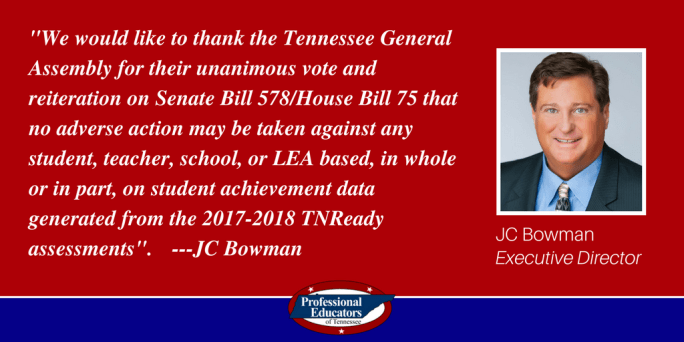
Last night I watched legislators—on both sides of the political aisle, whether you agree with them or not, bust their butts; I witnessed Educators: teachers, administrators and Superintendents—across the state, individually and completely on their own initiative work for a common goal; I saw parents using all means at their disposal to work for the same objective; and, I observed a beleaguered Department of Education also work to get this done with all of us. It was beautiful. No adverse action may be taken against any student, teacher, school, or LEA based, in whole or in part, on student achievement data generated from the 2017-2018 TNReady assessments. Perfect? No. But we will take it. So when the union comes along and claims credit for this work. Remind them: The effort belongs to all of us. We simply serve to protect our kids, educators and schools. We are public education. And together we all accomplish more. —– JC Bowman.

Unanimous Vote Senate Bill 578/House Bill 75

We are pleased that legislators unanimously provided that students, educators or schools will not be held responsible for unreliable results from the failures of the TNReady online assessment platform this year.

JC's Blurb 10

We Can’t Hide from the Tough Issues

Heftiger Disput

Problems are seemingly growing more and more complex, or are they?  In yesterday’s commentary,  Legislators – One Last Thing Before You Go!, we wanted to make sure our teachers are not going to be penalized by flawed test results and scores from this year on a teacher’s 3-year average.  It seems like it should be a simple fix, but actually is a little more complex.  That is what legislators must regularly balance in decision-making in the Tennessee General Assembly.  In public policy it isn’t always a struggle between right and wrong.  There is rarely a perfect solution.

We are very pleased that the Tennessee General Assembly wanted to hold students, educators and school districts harmless.  It really is a hold harmless, provided school districts in fact do not use test data into employment decisions like promotion, retention, termination, compensation—or even an improvement plan. It seems clear that the intent of the legislature was to ensure that the scores couldn’t harm teachers or students in any way, so we think this is an important part emphasized in SB 1623/HB1981.  However, we argued that they just missed a critical component, which is true.  Test results from this year still affect their scores and 3-year averages.

Here is the dilemma:  if we do not use this year’s TVAAS for teachers it would also likely hurt some teachers from gaining tenure.   And that too, is unacceptable and unfair.   So accordingly, this year’s data only counts as 10%, last year at 10% and the previous year at 15% to make up the 35% of the evaluation.   Teachers can use last year or this year as the full 35% if it helps the teacher.   They must have that data as part of their evaluation or the results can’t be used.  So, to be clear, a school district cannot use that flawed data, but a teacher can.  School districts cannot base employment termination and compensation decisions for teachers on data generated by these statewide assessments.  So, do legislators change the law they just passed, try to modify, or leave it be for now?  That is the discussion that they must have this week.

Legislators would be negligent if they do not further discuss the issue. They may choose to just take the fleas with the dog.  They have done excellent work on this issue to protect teachers, and they deserve the credit.  In the end the lesser of disappointing options is to leave in place what was passed.  We understand that choice.  In a perfect world we would have had perfect execution of the TNReady Test by our vendor Questar.  Then we would not be talking about flawed data, impact on 3-year averages or tenure. However, three things are almost certain on the campaign trail in 2018, especially in state races:

  • The continued feasibility of using a complicated statistical method as an evaluation tool for teachers will certainly be further debated by stakeholders and policymakers in the foreseeable future. Do we continue using The Tennessee Value-Added Assessment System (TVAAS)? Move to another more reliable statistical method?  Or do we abandon these complicated formulas altogether?
  • States are allowed to use federal funds, but no longer required, to continue teacher evaluations linked to test scores. Only a handful of states took advantage of the testing flexibility Every Student Succeeds Act (ESSA) allows.  In fact, the US Secretary of Education is explicitly prohibited from mandating any aspect of a teacher evaluation system.  So, will our state continue linkage of test scores to evaluation moving forward? Or will we end the practice?
  • Do we continue moving toward an online test, or do we yet again revert strictly to paper and pencil or some combination of the two?

Sometimes issues are complex, and the simple solution is not possible.  Simon Sinek, wrote: “There is no decision that we can make that doesn’t come with some sort of balance or sacrifice.”  This may be a case where the right solution is based on flawed data may be a right solution.  Then again, we may be all be wrong.  Let the debate continue.

##

Audrey Shores is the Chief Operating Officer of Professional Educators of Tennessee.   JC Bowman is the Executive Director of Professional Educators of Tennessee, a non-partisan teacher association headquartered in Nashville, Tennessee. Permission to reprint in whole or in part is hereby granted, provided that the author and the association are properly cited. For more information on this subject or any education issue please contact Professional Educators of Tennessee.


Legislators: One Last Thing Before You Go!

Capitol

The 110th Tennessee General Assembly is nearing the end, and for many, the end cannot come soon enough.  There are political races waiting and they are ready to hit the campaign trail as election season is about to launch in earnest. But before they exit Nashville, there is one last thing left for them to do: finish protecting our educators.  Unfortunately, these flawed test scores can, and will, impact teacher evaluations.

The Tennessee General prudently and quickly stepped in after the latest testing failure.  Let’s make clear, this was the result of concerned stakeholders to make sure students, educators and districts are held harmless for this year’s TNReady invalid results.  Our legislators deserve the recognition and the acclaim for their effort.  Senate Bill 1623 was sponsored by Senator Dolores Gresham, along with Senators Bowling, Massey, and Pody.  House Bill 1981 was sponsored by Representative Eddie Smith, along with Representatives Hardaway, Daniel, and Parkinson.

Educators wanted to ensure that school districts could not base employment termination and compensation decisions for teachers on data generated by these statewide assessments.  This was accentuated in SB 1623/HB1981.  It must be noted that local districts have always had complete discretion in how they choose to factor test data into employment decisions like promotion, retention, termination, and compensation.  Local school districts have considerable flexibility to pause any policies or programs that emphasize the use of TNReady results in these types of personnel decisions.

Previous legislation, now law:  The Tennessee Teaching Evaluation Enhancement Act (T.C.A. § 49-1-302) adjusted the weighting of student growth data in an educator’s evaluation to lessen impact of TNReady on evaluation scores. TNReady factored into evaluation scores at 10 percent for the 2016-17 school year and will factor into evaluation scores at 20 percent for the 2017-18 school year and 35 percent for the 2018-19 school year and thereafter. Additionally, growth data from year one of TNReady will only be used if it benefits the educator. If it does not, the qualitative component of the evaluation composite will increase.

So, despite the incredible work of Tennessee Legislators, they needed to make sure the excluded test scores from this year does not impact teacher evaluations.  It seems clear that the intent of the legislature was to ensure that the scores couldn’t harm teachers or students in any way, so we think this is an important part. However, they just missed a critical component.  Even if employment decisions shouldn’t be based on them, the test results from this year still affect their scores and 3-year averages.

We first raised these concerns on passage of the SB 1623/HB1981 Conference Committee report with a few policymakers.  One teacher who contacted us really does want to be able to use her scores – her students are taking the paper and pencil science test next week, so they haven’t been affected by any of the issues this week. And they have worked really hard to be ready for the test. Others who may be affected negatively certainly would not want the test scores to be used.

To solve the issue, it would be beneficial to teachers to replicate what was done in 2016 with the Evaluation Flexibility Act – SB2508/HB1419 (PC No. 172) – which stated that student growth composites would be excluded unless they resulted in higher evaluation scores, with the qualitative portion of the evaluation score increased in its place. Section 3 describes a similar provision for teachers without access to individual growth data.

“For the 2015-2016 through 2017-2018 school years, student growth evaluation composites generated by assessments administered in the 2015-2016 school year shall be excluded from the student growth measure as specified in subdivision (d)(2)(B)(ii) if such exclusion results in a higher evaluation score for the teacher or principal. The qualitative portion of the evaluation shall be increased to account for any necessary reduction to the student growth measure.”

All the legislature would have to do is take the previous language from Sections 1 & 3 and change 2015-2016 to 2017-2018, and 2017-2018 to 2019-2020. Section 2 doesn’t need to be changed unless the phased in percentage schedule of (d)(2)(E)(i) – (d)(2)(E)(iii) is being updated.  We don’t think that 49-1-302(d)(2)(E)(ii) needs to be adjusted or referenced, since it’s essentially just a circular reference to (d)(2)(B)(ii). Although we think this would make (d)(2)(E)(ii) obsolete, since if the test results would help they would probably just want to go ahead and use it for the full 35% as provided in (d)(2)(E)(iv).

The continued feasibility of using a complicated statistical method as an evaluation tool for teachers will certainly be further debated by stakeholders and policymakers in the foreseeable future.  However, the issue that members of the 110th Tennessee General Assembly must address before leaving for home is making sure our teachers are not penalized by flawed test results and scores from this year on a teacher’s 3-year average.   We know legislators can take action when they focus.  The goal of the legislature is to ensure these flawed scores don’t harm our educators.  We need legislators to finish the job and end what they started.

##

Audrey Shores is the Chief Operating Officer of Professional Educators of Tennessee.   JC Bowman is the Executive Director of Professional Educators of Tennessee, a non-partisan teacher association headquartered in Nashville, Tennessee. Permission to reprint in whole or in part is hereby granted, provided that the author and the association are properly cited. For more information on this subject or any education issue please contact Professional Educators of Tennessee.

The Changing Face of Advocacy

hellios

According to the Greek Mythology, the god, Helios, would put the Sun in a chariot and drive it through the sky each day.  That is how the Sun would rise and set.  Today, we would scoff at such a notion and understand that such a feat would be impossible.  We would think that people who would believe such a notion probably were not very intelligent and extremely gullible.  Such is the story of modern day lobbyists and advocates.

Frank R. Baumgartner, a Professor of Political Science at the University of North Carolina at Chapel Hill says there is no consistent correlation between money spent on lobbying and outcomes.  In his book, Lobbying and Policy Change: Who Wins, Who Loses, and Why, Baumgartner effectively proves that lobbyists are far less influential than political rhetoric suggests and that they fail to change policy despite millions of dollars spent trying. As to the why?  He points to an “entrenched system” with an enormous “bias in favor of the status quo.”

I have been on the forefront of policy change for over a quarter of a century, advocating for education.  It means that I have witnessed much the last three decades in Tennessee. I have seen policymakers come and go.  I have seen lobbyists come and go.  Next year, in 2019, we will see a new US Senator, a new Governor and perhaps as many as 35 new state legislators.  Campaign contributions, as important as those may be to the candidate, mean very little in the current system.  Money no longer “buys” votes, and it should never have done so in the first place.  Politicians now often receive contributions from interests on both sides of any issue.

It is amazing with the vast array of people lobbying on an issue that anyone or any group should take credit for the passage of any legislation.  The truth is that it is always a coalition of stakeholders building a compelling case on a political issue.  In the end, only the legislator votes.  So, any person or group who claims credit for a passage of legislation needs to be reminded of that truth.

In the end, we build coalitions work together, educate legislators on issues and count votes.  The legislator is the decisionmaker.  Advocates have three numbers you have to reach – 50, 17 and one:  50 votes in the House of Representatives, 17 in the Senate, and one from the Governor.  Only the Tennessee General Assembly deserves credit or blame for the passage of legislation.  In all the years that I have worked with legislators, I truthfully have found most to be honest, hard working people who want to do the right thing for their constituents.  I have also seen some who really do not listen, and these usually do not last long in the political arena.

The key to effective advocacy is relationships, which must be developed and also sustained.  Building relationships with lawmakers and other stakeholders means getting to know them, their personal interests and histories, and even their families. Having a relationship never guarantees support, but it does help to ensure that others will listen to you.  We must build networks and coalitions, around the objective of helping those you serve.  Stakeholders know what is likely to be taken serious by policymakers, sometimes just by whom introduces it, or who carries the legislation for the lobbyists.  We must also know how to correctly draft legislation to assist lawmakers who are overwhelmed during session.  We frequently see people try to put things in the wrong part of the code or use the wrong terminology. Advocates must identify people who support changing a policy and are willing to testify.  Those who advocate or lobby have to be taken seriously at the Capitol.  Then there is media coverage, which is a whole separate issue.  The media will cover an issue if they think voters or their audience are interested in the subject.

In advocacy, we have to be honest and transparent.  We have to tell the truth.  People can spot a snake-oil salesman a mile away.  A Cheshire cat grin and a fake tan will only take you so far.  Legislators do not like being lectured to when you testify.  The biggest mistake I see is when a know-it-all goes before a committee arrogantly and moralizes and lectures legislators.  People talk.  Just answer the question when asked, and don’t pontificate to hear your own voice by expounding on unrelated issues.  Conceit, excessive pride, combined with arrogance is called hubris.

When we engage in grassroots and direct advocacy with policymakers and key influencers around the state on behalf of public education policies, it reminds us that we live for a far greater purpose than just ourselves. Our impact is immeasurable and transforming.  It not only matters to the profession and our educators, it also matters to children and families across Tennessee.

Our experience here in Tennessee ensures our members’ concerns are heard at the Tennessee General Assembly and by other stakeholder groups. It also means we work with other groups on goals we want to achieve: some long-term, some short-term.  By doing this, we witness and help facilitate minor and major shifts in education policies and observe and work with changing political leaders.  And we must remember, these new education policies can have a positive or negative impact on educators or children.  We work the entire year focused on the priorities of our organization and our members.  However, we do not do it alone.  We accomplish our goals by working with others and through elected officials.

Leaders also need mountains to climb.  We and they also realize that they cannot solve every problem on our own. Leadership is about giving.  Great leaders understand that leading others means serving others.  The one question leaders must ask themselves: are you interested in finding solutions for today’s challenges? Then learn to work with others to benefit those you serve, without worrying about who gets credit.  It is a hard lesson to learn for some.  The sun will still come up, even if you don’t get the recognition.

##

JC Bowman is the Executive Director of Professional Educators of Tennessee, a non-partisan teacher association headquartered in Nashville, Tennessee. Permission to reprint in whole or in part is hereby granted, provided that the author and the association are properly cited. For more information on this subject or any education issue please contact Professional Educators of Tennessee.
Building an Organization with Trust

conference.jpg

Organizations continue to transform and change.  Part of the reason for the decline of unions has been their reluctance to change and willingness to cling to an outdated system built on an industrial model.  Creating and sustaining a culture of high performance while leading organizational effectiveness is one of most complex challenges facing non-profit and organizational leaders.  An imperative question that any organization should ask is: Do your members trust you?

Organizational leaders must understand the processes necessary to incorporate performance improvement, membership focus, professional learning, and necessary change to achieve a highly effective organization. Organizational members have a world of data at their disposal, but what they truly desire is to be a member of an organization that knows their needs and gives them maximum value for their investment.  For example, our organization is able to keep our dues  under $200 dollars ($189 to be exact), while unions are priced in the $600 dollars plus range.   And many teacher union membership forms now authorize them to charge an unspecified amount of dues in perpetuity.

Organizations that are recognized as exceptional providers of customer service are the ones that have incorporated member-focused behaviors into their daily operations. A vibrant, energized organization is one that interacts with its members across every potential outlet of communication. Members want to know what you can do for them and they will engage your organization in ways you might not have imagined even six-months ago.  You have to work to keep ahead of your membership.

Even with a dynamic plan and an unambiguous vision for implementing high-performance and effective systems, the foremost question members and prospective members may ask is, “Why should we look to you instead of your competitor?”  It’s simple.  As a professional educators need to remain informed as to what is happening in their chosen field.  Educationally, they need to keep current with all developments in the scope of their work.  Learning new models and methods does not stop in college or graduate school. Educators often need benefits that school districts are not providing.  And as we have known for years, educators may need legal assistance—which we provide by our staff attorney who understands education law.  Educators need to know what laws affect them and their profession.   They need to know what legislative initiatives are being considered that have an impact on their field, and what they can do to effectively influence legislation to promote the profession— without the partisanship.

We have discovered that our most devoted members want to have a relationship with us. Just like we want to know who they are, they want us to know who they are as well. They want to identify how our organization can help them. And once they comprehend that your organization understands and has viable solutions to their particular set of problems, as well as a vision for making them successful in their chosen field.  That is how you gain loyalty.

But how do you build that loyalty? By building a relationship with your members based on openness, effective communication, value and trust.

We strive try to engage our members constantly.  Nearly half of our members now utilize our website (www.proedtn.org) on a regular basis.  We believe in being interconnected and actively engaged by keeping membership simple and uncomplicated, focused on an approach that is “bottom up,” not “top down,” and on our core business mission of education.  If you want to be recognized as an outstanding provider of member service, you have to consistently exceed the expectations of your members.  Once you adopt this approach, you will find a growing commitment by members.  But once you connect, how do you build loyalty?  You build this loyalty by building trust.

Organizations must strive to embrace openness and transparency in how they interact with their members.  For us, this includes how we build our legal services and member services and benefits.  It also includes vibrant professional learning and development for our members, based upon needs identified by educators, state and local district.

Consider this simple formula for creating a loyal membership base: Openness drives accountability. Accountability builds trust. Trust is the foundation of a relationship. Every organization must have a relationship with its members if it wants to be sustainable.

####

JC Bowman is the Executive Director of Professional Educators of Tennessee, a non-partisan teacher association headquartered in Nashville, Tennessee (www.proedtn.org). 

Permission to reprint in whole or in part is hereby granted, provided that the author and the association are properly cited.  Check out his Blog at http://www.jcbowman.com.  Follow him on Twitter @jcbowman